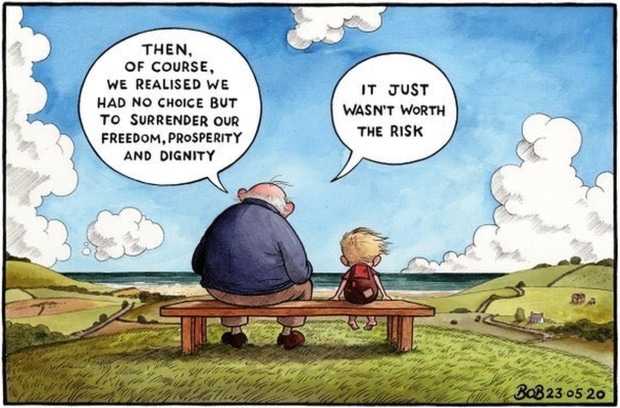

Carlson: The Anglo-sphere Is Committing Suicide Collectively — Australia, New Zealand, Canada, U.S., U.K. ‘Are Allowing COVID to Defeat Them’

Monday on FNC’s “Tucker Carlson Tonight,” host Tucker Carlson opened his program from Budapest with a dire warning about the direction the response to the pandemic was taking the United States and several of its key allies around the globe.

Share

The ‘Fourth Turning Crisis’ Has Arrived

Sweeping social transformations occur during times of crisis. We are in such a predicament now, and transformative change may be coming to America whether we want it or not. It could define who we are as a nation for the remainder of the 21st Century. Whether America reaffirms itself as a beacon for freedom for the world or whether we become just another plot of ground in the new world order remains to be seen. The consequences for all Americans could be enormous, and especially so for Millennials.

Share

How Totalitarianism Rhymes Throughout History: Czechoslovakia, China, & Venezuela

“It can’t happen here” is a political cliche in the United States. Regardless of your personal viewpoint, there is a vast swath of the American population who simply do not believe in the possibility of any totalitarianism in the United States.

It’s worth noting that throughout history, in virtually every place that totalitarian regimes have arisen, the residents of these countries felt the same way. Russia was seen as too traditional and backward, the power of the Czar too entrenched to be defeated. Throughout most of the modern period, Germany had been viewed as the home of Goethe, Schiller, and Mozart, a place where the local Jewish population had largely assimilated.

Because totalitarianism emerges differently throughout history in different countries, it’s crucial to take a broader view of how totalitarian regimes arise. For example, when discussing the rise of communism or the rise of fascism, we see different trends in Russia than we do in China, different trends in Italy than we do in Germany. When we examine multiple, somewhat lesser-known examples of the rise of socialism throughout the world, we paint a picture of the different ways in which socialism originated and its possible resurgence.

Share

Will the West Be Lost?

No one could have imagined that we would so quickly squander the West’s mighty strategic victory in the Cold War.

In an apparently predestined and inevitable manner, as occurs when there is weak international leadership, the United States and China are drifting into a state of prickly antagonism.

During the election, Joe Biden said the Chinese were not a threat to the United States and he has still only half-heartedly acknowledged a serious rivalry between the two countries. There is plenty of evidence that the new administration has made such a poor impression in Beijing that President Xi Jinping has concluded now is the time for China to humiliate and displace the United States—a conclusion he was certainly deterred from adopting during the Trump years.

Share

Anarchy is coming – The liberal world order has failed to usher in global peace

When the Biden administration undertook its first known act of war a few weeks ago, it provided an illuminating snapshot of conflict in the 21st century. The aerial strike on Iranian-backed Iraqi Shia militias in eastern Syria, facing territory held by American-backed Syrian proxy forces, in response to the shelling of American positions in Iraq by Iranian-backed Iraqi militias which led to the death of an American private contractor, encapsulates the central role of surrogate warfare in modern conflict.

Share

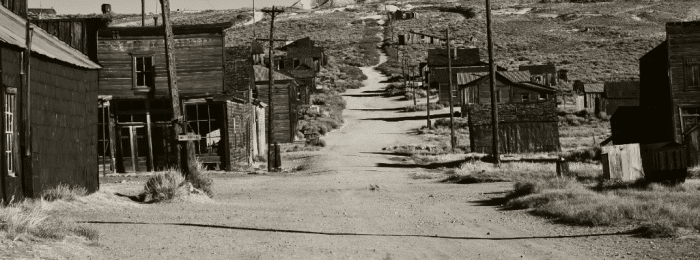
As birth rates fall, animals prowl in our abandoned ‘ghost villages’

Human populations are set to decline in countries from Asia to Europe – and an unusual form of rewilding is taking place

For many years it seemed that overpopulation was the looming crisis of our age. Back in 1968, the Stanford biologists Paul and Anne Ehrlich infamously predicted that millions would soon starve to death in their bestselling, doom-saying book The Population Bomb; since then, neo-Malthusian rumblings of imminent disaster have been a continual refrain in certain sections of the environmental movement – fears that were recently given voice on David Attenborough’s documentary Life on our Planet.

At the time the Ehrlichs were publishing their dark prophecies, the world was at its peak of population growth, which at that point was increasing at a rate of 2.1% a year. Since then, the global population has ballooned from 3.5 billion to 7.67 billion.


In Spain, Entire Villages Are Up For SaleAnd They’re Going Cheap

Italy’s abandoned villages plan to save themselves from ruin by selling homes for $1 or less

Share

The L.A. Times Is Thrilled for Biden to Usher in the Californication of America

Could we be seeing buyers’ remorse? A USA Today/Suffolk University poll released Sunday shows a double-digit increase in the percentage of Americans who think the country is on the wrong track. In December it was 49%, and it has jumped to 65%. While the pollster theorizes this has to do with the Capitol riot and second impeachment, it could just as easily be the insight we have gotten from the fictitious “Office of the President-Elect” and Joe Biden.

Share

The Silent Crisis: The Threat of Mass Illiteracy

Despite enormous efforts, despite a battery of programs and remedial regimes and the emergence of an entire sub-industry of school consultants and marketeers, the capacity to read and write across the English-speaking world shows evidence of steep decline. This should be a cause for community concern. Poor literacy is strongly associated with anti-social behaviour. Very literate people seldom enter the prison system, which suggests that widespread literacy is part of a good inoculation against criminality.

In most Western societies, the prison population has the highest concentration of illiteracy.

Share

Charting the decline of the American Republic

One conservative historian sees in the 1960s the beginning of the country’s divisions

“Look, Jez, what I’m trying to say is, so, for better or for worse the ’60s happened and now sex is fine. But can’t we take the best of that, the nice music, the colours, the ‘I have a dream’, etcetera, but not have to face the… squalor?”

Mark from Peep Show’s take on the 1960s is one I have some sympathy for. That most controversial of decades saw revolutionary cultural change and, depending on your worldview, it was either a period of liberation or the start of a free-for-all that undid the social fabric. It was the decade that created now, and how much you like the modern world will shape your view of it, of the civil rights marches, San Francisco hippies, love-ins and various other groovy happenings.

Multiculturalism destroys nations.

Share

Welcome to the new Middle Ages

Rising inequality, lower mobility, contempt for the poor and widespread celibacy — we’re returning to the past

Today the richest 40 Americans have more wealth than the poorest 185 million Americans. The leading 100 landowners now own 40 million acres of American land, an area the size of New England. There has been a vast increase in American inequality since the mid-20th century, and Europe — though some way behind — is on a similar course.

These are among the alarming stats cited by Joel Kotkin’s The Coming of Neo-Feudalism, published earlier this year just as lockdown sped up some of the trends he chronicled: increased tech dominance, rising inequality between rich and poor, not just in wealth but in health, and record levels of loneliness (4,000 Japanese people die alone each week, he cheerfully informs us).

Kotkin is among a handful of thinkers warning about a cluster of related trends, including not just inequality but declining social mobility, rising levels of celibacy and a shrinking arena of political debate controlled by a small number of like-minded people.

Share