The Usefulness of Haunting

Halloween may be a bulwark of tradition in the fight for Europe’s future.

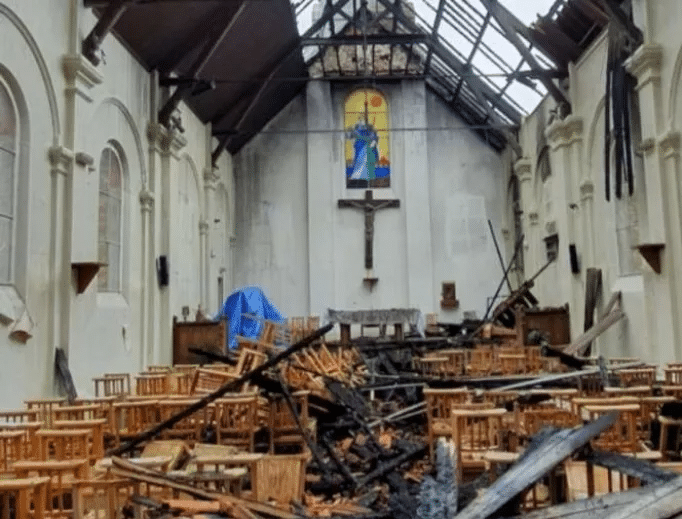
Although the end of October is a long way away, the first Halloween items have crept into retail stores here in Southern California. Of course, what most Europeans see in Halloween is yet another American importation—and one of ghoulish or even Satanic orientation at that. One could hardly blame such a reaction, especially as this observance is preceded by a long list of other such, including (but not confined to) Black Friday, Santa Claus, KFC, McDonald’s, and on and on. Not being aware of either the slightly-terror-tinged-but-wholesome thing that Halloween was in my childhood, or of its Christian and Celtic roots, one can easily forgive the devout European for this conclusion. But the whole thing is rather more complex. It is not merely a question of Halloween, but of the whole body of weird lore that underlies Europe’s cultures—and in a sense may be a bulwark of tradition in the fight for her future. There is also the question of whether that lore is strictly fictional, or if it contains some unpleasant realities that are ignored only at one’s peril—even if one wields political power.

Share

Alarmist Headlines About Europe’s ‘Far Right’ Ignore Failures of the Continent’s Liberal Elite To Heed Voter Concerns

“The far right made big gains in European elections,” reads the Associated Press headline on last week’s European Parliament elections. Lest you wonder why you should dread gains by the “far right,” the lead sentence of the article notes that the European Union has “roots in the defeat of Nazi Germany and fascist Italy.”

For many readers, that juxtaposition is a reminder of the sharp rise in Nazi party percentages in Weimar Republic elections to 43 percent in 1933, 33 and 37 percent in 1932, and 18 percent in 1930, from 3 percent in 1928.

Share

Time to retire the ‘far right’ slur

Millions of Europeans have not suddenly turned into fascists. We need a new political language.

As the EU establishment struggles to make sense of last week’s revolt in the European elections, one thing is clear: our outdated vocabulary is not up to the task of describing today’s political landscape.

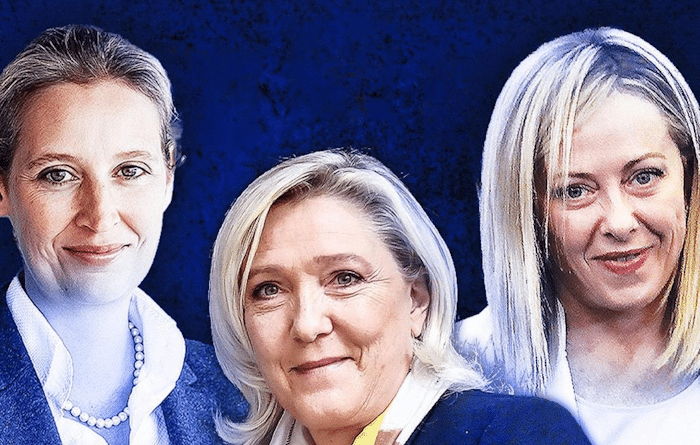
Gains for France’s National Rally, Giorgia Meloni’s Brothers of Italy and the Alternative for Germany (AfD) have been described as a ‘far-right surge’ in newspapers and TV reports, not just across Europe but around the world. Even before the election results came in, labels like far right and extreme right were bouncing off commentators’ keyboards. All agree that the far right is on the rise and ordinary people need to worry. This is Europe’s ‘Trump moment’, explained Politico. Some go further. Marine Le Pen’s National Rally is described as ‘neo-fascist’, while academics calmly ask if the AfD is the new Nazi Party. ‘Fascism has arrived’, declared French author Emilia Roig when the election results became clear. Yet with almost a quarter of Europe’s voters having backed a party branded ‘far right’, it is worth asking how accurate this label is and what purpose it now serves.

Share

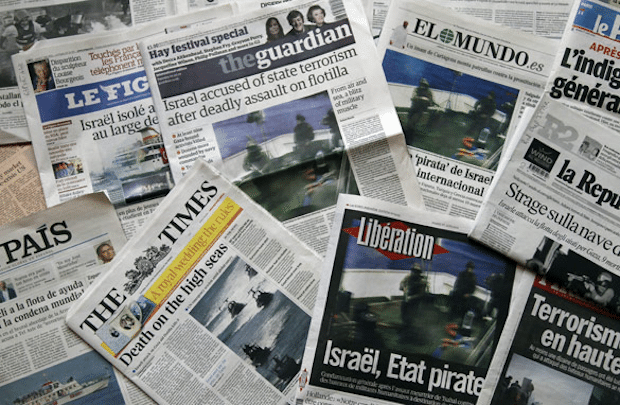
Europe’s Establishment Press Rattled by Successes of the Right

Mainstream newspapers are doing all they can today, on June 10th, to echo Ursula von der Leyen’s triumphant message that “the centre is holding.” But reporters and pundits are unable to hide their concerns surrounding the shift to the Right which, however much they try to downplay it, they accept will raise serious difficulties for the establishment parties.

Coverage of Viktor Orbán’s performance in the European Parliament (EP) elections is indicative of this, with his 44% share of the Hungarian vote—a proportion that most other European political leaders can only dream of—dismissed as a “stumble” or a loss because it is lower than that achieved in previous polls. Reuters in particular framed Orbán’s smaller-than-expected lead as an example of “strong performances by centrist parties” in eastern Europe.

Share

French far right obliterates Macron’s party in EU election

PARIS — The far-right National Rally is projected to win the European election in France with 31.5 percent of the vote — more than twice that of President Emmanuel Macron’s party.

The shock result pushed Macron to call a snap election Sunday evening.

The National Rally, headed by Jordan Bardella, is set to achieve its highest-ever finish in a nationwide election.


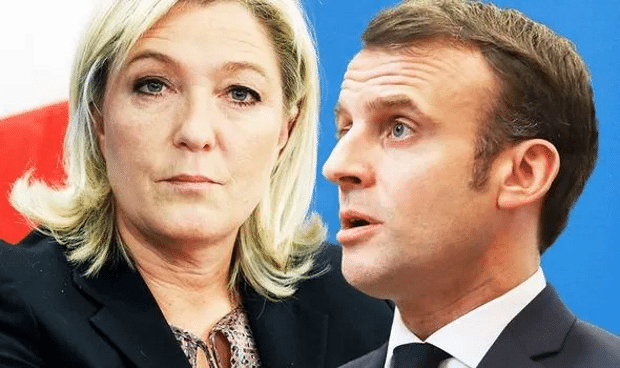
Macron Dissolves French Parliament After Getting THRASHED by Le Pen’s National Rally at European Elections.

French President Emmanuel Macron has dissolved the national parliament following his party’s thrashing by Marine Le Pen’s National Rally in the European Elections on Sunday. The nation will now face domestic elections, with opinion polling showing the right-wing party in the lead. The next presidential elections are scheduled for 2027.


Europe swings to the right — led by France

Europe’s center of political gravity is veering to the right.

Center-right and far-right parties are set to take the largest number of seats in Sunday’s European Union election in the most populous nations: Germany, France, Italy, Spain and Poland.

France led the rightward lurch with such a crushing victory for the far-right National Rally that liberal President Emmanuel Macron dissolved France’s parliament and called an early election. Early results suggested the National Rally would win some 32 percent of the vote, more than twice that of the president’s party.

h/t DS and Mauser

Share

Don’t Blame the Russians When Europe Votes Right

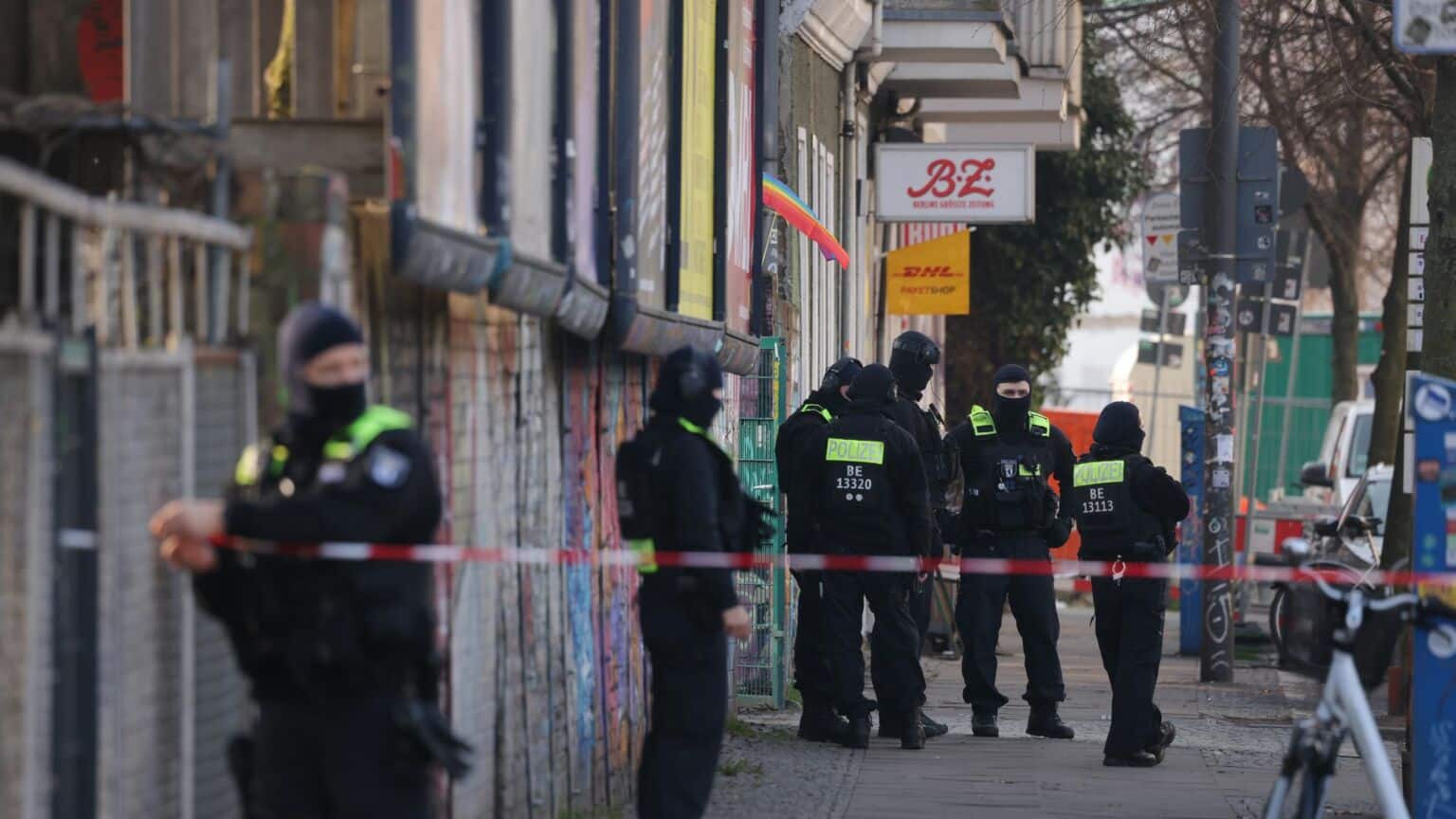
An Afghan knifeman tried to assassinate a leading anti-Islamist campaigner at a rally in the German city of Mannheim on Friday, and murdered a young policeman in the attack. The stabbing, carried out by a failed asylum-seeker who had been living in Germany illegally for years, was a searing indictment of successive German governments’ mass migration policies.

A week before the elections to the European Parliament, this attempted assassination of a critic of political Islam provided a graphic illustration of why support for the right-wing, anti-migration Alternative fur Deutschland (AfD) has soared in recent times.

Share

Should the U.S. and Europe go their separate ways?

Since at least as far back as 1917, when the U.S. unwisely intervened in World War I to rescue the Western Allies, the major European nations have grown accustomed to American largesse. Americans have played the role of overindulgent parents, and the Europeans have responded as would entitled children who both demand handouts and then resent the parents who supply them.

A large proportion of Europeans have negative opinions of the U.S. They consider us arrogant and selfish. As a result, we have been labeled as “the Ugly Americans” for decades.

Share

Europe: Fear of the Elephant and Its Mahout

In the recent summit in Paris of European Union leaders on Ukraine, there was an elephant in the room: The US Republican Party and its current mahout, former President Donald J. Trump.

According to those who were able to peep into the session, much of the discussion was about what the US will or won’t do in case the volatile mahout rides his elephant into the White House in November.

Trump’s musings about ending the war in Ukraine and taming Vladimir Putin without war and his quip about refusing to support a NATO member not paying its share, if attacked by Russia, took up a disproportionate part of the discussions. Then came the French President Emmanuel Macron’s bombshell about boots on the ground in Ukraine.

Share

Revealed: how Putin plans to flood West with migrants

Russia using militias in Africa to ‘weaponise’ flows of people in attempts to influence elections

Russia is using private militias to control and “weaponise” immigration into Europe, The Telegraph can reveal.

The Kremlin has influence over a number of the main routes into the continent and border police are warning that, with the arrival of spring, Russia is likely to “intensify” its efforts to move migrants.

It has been widely feared that Vladimir Putin is using the tactic to destabilise Europe.

Share

We are Europe

Europe is the 3,000 years of history behind us, not a handful of officials and unelected functionaries of the European Commission telling nations how to behave.

It’s now been more than a year since the spectacular victory of Giorgia Meloni and our friends from Fratelli d’Italia. Those elections showed us, once again, that we, conservatives and reformists, the patriotic forces of Europe, can win elections. And we can do so without having to renounce our principles or disguise our ideas, as it has always been mistakenly believed by other forces that proclaim themselves conservatives in front of their voters, but, when election day arrives, are only concerned with not making any noise and keeping a low profile.

The principles and values that we represent are defended openly and without fear. These values are capable of connecting the majority of society, as long as we know how to live, feel, and fight for the demands of our people at all times.

Share

Europe’s new soundtrack: Takbir!

Birmingham England

The US dismissed warnings of an Islamist attack before 9/11, Israel dismissed warnings of a Hamas attack before 10/7, and Europe is making the same mistake.

The video comes from Birmingham, 1 and a half million inhabitants, the second largest city in England, 30 percent Islamic. An entire stadium shouting the Islamic takbir, the submission cry of the “infidels”.

Wikipedia: Takbir is a call to glorify Allah. Takbir is the Arabic term for the phrase Allahu Akbar, meaning “Allah is the greatest.”

Already in 2015 Reuters defined Birmingham as the “English Mecca”. And two years later the New York Times wondered why many English jihadists come from Birmingham. Yes, who knows why.

Share

Europe’s muddled armed forces ‘could be washed away by Russia’

Europe is not prepared for a war with Russia and is in danger of being “washed away” in a conflict, much as the Holy Roman Empire was broken up by Napoleon, Germany’s pre-eminent military historian has warned.

At a high-level defence conference in Berlin, several German generals also suggested that Nato might be unable to win the “first battle” in a defensive war on its eastern flank, because it would struggle to ship sufficient numbers of troops and equipment to the front line quickly enough.

Share