
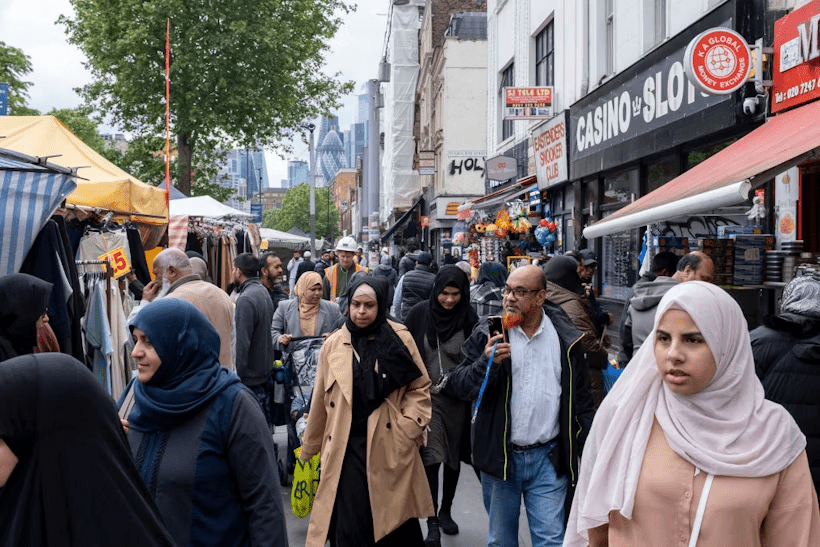
The best argument against multiculturalism is staring you in the face

Whitechapel Market London

Nobody likes the yookay aesthetic

When it emerged as the guiding organisational principle of the British state, multiculturalism was sold, in the words of the hugely influential Parekh Report, as “perhaps the country’s biggest single national advantage”. The arrival of peoples from all over the world, bringing with them their unique perspectives, cuisines, religions, dresses, and cultures, would allow Britain to move on from “a narrow, English-dominated backward-looking definition of the nation” into something altogether more vibrant and exciting. Multiculturalism was to “widen a society’s range of options and increase its freedom of choice, for it brings different cultural traditions into a mutually beneficial dialogue and stimulates new ideas and experiences”. All those within society would thereby gain the opportunity to escape the narrow constraints of the culture they happened to be born into, instead becoming free to choose from the plethora of practices they would encounter every day, in doing so creating all sorts of dynamic new cultural mixes.

h/t Patti Jo

Share

UK: Mass immigration means the water will run out and we are not prepared

The boss of Southern Water has told households that they need to ration their water use because the region is “drier than Sydney, Dallas, Marrakesh and Istanbul”. Needless to say, given the appalling way most of these privatised companies have been run, Tim Mcmahon was denounced for blaming the consumer for the failings of his business. Why don’t you repair the leaks properly and invest more in infrastructure before passing the buck, was a characteristic response.

Share

‘Staggering growth’ makes Toronto the fastest-growing metro area in Canada and the U.S. for second straight year

In New York, Frank Sinatra says, they want to be a part of it. Chicago, he claims, has all that jazz. But it turns out Toronto is where people are going.

Toronto was the fastest-growing metropolitan area in Canada and the U.S. for the second consecutive year and saw an estimated population increase of nearly 269,000 people from July 2023 to July 2024, according to data from Statistics Canada and the U.S. Census Bureau.

… In 2021, 47 per cent of Toronto residents were born in Canada. According to the Census, there were 1,286,140 immigrants in Toronto, or 46.6 percent of the population. In Canada overall, immigrants made up 23.0 per cent of the population.

Share

How about sending them home?

These immigrants say Canada failed to plan for a population explosion. Now it’s their top election issue

Joana Valamootoo felt Canada was a welcoming place when she immigrated here from Mauritius in 2012, but that sense has faded in recent years as immigration numbers have gone up and up.

“I came here in 2012 on a francophone initiative program, an immigration program, and I was welcome, but I was also provided what I needed to succeed here,” she said.

She believes that’s no longer the case for newcomers to the country.


Bad news immigrants, there has been no intake slowdown. 

Carney and his predator pal Wiseman plan on swamping Canada with even more incompatible cultures.

But we know most of you will vote Liberal anyway, you wouldn’t be here otherwise.

Share

Canada’s ‘Pause’ on Immigration-Driven Population Growth May Be a Statistical Illusion

Last fall, Ottawa responded to a surge in public support for immigration restriction with a cut to immigration levels that it promised would “pause population growth in the short term” to ease “pressures on housing, infrastructure and social services.” But a curious question about this policy U-turn is beginning to emerge: Is Canada’s population growth really on pause?

A new report by Benjamin Tal, CIBC’s deputy chief economist, argues that the federal government is significantly overstating the effect its immigration cut will have on population growth—a statistical undercounting that could hamper Canada’s ability to plan for our social services, infrastructure, and housing needs.

Share

Liberal government’s high immigration policy created housing crisis: report

The federal Liberal government is belatedly trying to fix a housing affordability crisis it created though immigration policies which caused population growth to far exceed Canada’s capacity to build new homes to accommodate it, according to a new Fraser Institute study.

“Despite unprecedented levels of immigration-driven population growth following the COVID-19 pandemic, Canada has failed to ramp up homebuilding sufficiently to meet housing demand,” said Steven Globerman, co-author of the study, “The Crisis in Housing Affordability: Population Growth and Housing Starts 1972-2024.”

Share

The missing debate on immigration

Fear of Donald Trump and loathing of his tariffs have obscured other vital issues in this federal election campaign. And none is more vital than restoring confidence in Canada’s broken immigration system.

“Broken” is the right – if politically loaded – word. Even the Liberals agree that their open-door policies toward temporary workers and foreign students badly damaged the immigration system.

The issue is whether the Liberals have correctly diagnosed what went wrong and can be trusted to fix it, or whether the Conservatives could better do the job.


Immigration, all 3 mainstream parties pander. All 3 are scared to death to do what’s right.

Carney even hired “100 Million 3rd World Migrants Mark Wiseman” to destroy Canada and Poilievre didn’t have much at all to say about it.

Corporate Canada and our political class are evil.

This is not how to unify a nation.

Share

How immigration is concealing Canada’s economic crisis

As Canadians flex their patriotic muscles and hold “elbows up” in response to punishing U.S. tariffs, many might be surprised that another economic crisis has been percolating here for years — from inside the country.

It effectively dropped Canada into recession months ago, has left us as poor as the residents of Alabama and is so dire, the usually circumspect Bank of Canada warned it’s time to “break the glass” and sound the emergency.

For this at least, U.S President Donald Trump can’t be blamed.

Share

What election promises on housing would mean for Toronto and the GTA

The soaring cost of home ownership is a challenge facing people across Canada, arguably nowhere more so than in big cities like Toronto.


From the 1980s through the late 2000s, the price of the average home in Toronto and the surrounding Greater Toronto Area stayed within three to five times the average annual household income.

But since 2010, that ratio has shifted dramatically. The average home now costs nearly 10 times the yearly income of the average household, based on data from the Toronto Region Real Estate Board (TRREB) and Statistics Canada.

Combine that with the fact that Toronto and the GTA account for one in six seats up for grabs nationally in the federal election and it’s little wonder the main parties are trying to woo voters with promises to make housing more affordable.


Only the CBC could produce propaganda like this.

At no point is the Liberal Party’s scandalous mass-immigration policy mentioned as a cause of Canada’s horrific housing shortage.

Share

Immigration is overshadowed in election by Trump and tariffs

For more than a year, immigration has been at the forefront of the political agenda, and the subject of heated exchanges in the Commons. Polls have shown that Canadians’ long-standing support for increasing the number of new arrivals has dropped in the past two years, amid fears about the cost of housing and strains on health care.

But during the election campaign so far, immigration has been relegated to a second-tier concern. The threat to the economy and job security posed by U.S. President Donald Trump’s tariffs and other “pocketbook issues” has eclipsed it as an issue, even though border security – fuelled by Mr. Trump’s barbs about illegal migration from Canada – has been in the spotlight for months.

Share

OLDCORN: Put Canadian students first, stop importing Third World countries’ problems onto school campuses

Canada’s universities and colleges risk losing their way as schools increasingly prioritize international recruitment over their core duty to educate Canadian students.

What began as a push for cultural exchange has morphed into a system described as a “visa-for-cash” model, sidelining domestic learners and straining school communities as third-world students try to impose their backward values.

Share

‘We’re being taken for fools’: How soaring migration came back to bite Ireland’s political elite

With finite housing and overstretched public services, the government’s ‘cack-handed’ border policies have triggered a wave of public anger

Driving through Dublin in his taxi, Gavin Pepper gestures down a stretch of pavement. “You wouldn’t go there at night,” he says. “There’s gangs of foreign men hanging around all over the city. You don’t see many Irish people walking there any more.”

It’s the sort of forthright remark that tends to stay in a cabbie’s front seat. But Pepper no longer speaks only as a taxi driver. He’s now a councillor for Finglas, a working-class district of north Dublin, elected on a wave of public anger over migration.

He says his election was driven by a migration policy handed down from on high – imposed, as he puts it, by Ireland’s political elite on poorer communities with no say in the matter. “You’re punching a wall that won’t break,” he says. “They have all the money, all the power, all the NGOs.”

We have the same evil pricks in Canada.

Share

Geoff Russ: Mark Carney can’t be trusted to get immigration under control

Donald Trump and his tariffs will not be the only key issue that determines who will be prime minister after April, 28. Canada has been plagued by a diverse set of problems for years, all of which will be remembered by voters on election day, including immigration.

Prior to Trump’s election and his decision to threaten Canada, one of the biggest controversies in Canada was the abrupt end of an uncontested pillar in Canadian political culture — immigration. It crumbled as if struck by a sledgehammer after just a few years of the Trudeau government’s careless mass-immigration policies.


The Star whitewashes the Century Initiative of course.

Pierre Poilievre has the ‘Century Initiative’ and its links to Mark Carney in his crosshairs. So what is it?

When Conservative Leader Pierre Poilievre mentioned the “Century Initiative” at a campaign rally in Hamilton, Ont., the crowd booed loudly.

Poilievre has made an attack on the immigration-focused group a part of his stump speech in the first week of the campaign, and has criticized Liberal Leader Mark Carney for appointing one of the group’s co-founders to a key advisory council.

Share

This should be the first Canadian election that focuses on migration

Mark Wiseman – Evil Bastard

A controversial appointment put migration in the headlines on the same weekend that Prime Minister Mark Carney announced a snap election.

The investment fund manager and former head of the Bank of Canada, who won the Liberal leadership contest two weeks ago, became the subject of news stories focusing on how he has chosen Mark Wiseman, an advocate for open borders, as a key adviser.

Share