Slavery in Canada: The facts rarely told

Executive summary

This study summarizes the key facts on slavery in Canada, from the colonial period to slavery’s eradication in British Columbia over four centuries later.

In early Canada, indigenous slave-trading networks were robust:

Before the transatlantic slave trade, in pre-Columbian North America alone there were at least 39 distinct slave societies.
By the late 17th century, up to two-thirds of the population of some Iroquois communities consisted of “adoptees”—that is, captives.
A system of native alliances traded slaves to the colonists of New France from as far away as the Missouri River basin, Upper Mississippi, the Great Lakes, and Chesapeake Bay.
Well into the 19th century, indigenous networks traded slaves along the Pacific Coast and Columbia River, with only minimal involvement of Europeans.
Thus, it makes sense that about 64 percent of all the slaves held by Europeans in New France from the mid-17th century to 1834 (when slavery was fully abolished in the British Empire) were indigenous; 34.5 percent were African. Using the upper estimates of historians, the grand total of all slaves held in Canada across that period numbered 7,000 to 7,500. For comparison, more than thirteen hundred times that many souls—nearly 10,000,000—were enslaved from 1619-1865 in the United States.

Despite opposition from slave-owning legislators, Upper Canada passed the first legislation in the British Empire to end slavery—15 years before Britain outlawed the slave trade, 41 years before Britain abolished slavery in the West Indies, and 72 years before the States settled the issue on the battlefield. Thus, if by “Canada” we mean the country confederated in 1867, the fact is that slavery has never been legal here; all legal Canadian slavery was pre-Confederation.

Moreover, Canada welcomed over 30,000 African-Americans who escaped slavery and found freedom at the northern terminus of the Underground Railroad.

Yet, indigenous slavery was not fully stamped out in British Columbia until near the turn of the 20th century. And human trafficking remains a grave evil facing Canadian society today.

On balance, Canada’s history and record on slavery deserve to be cherished and celebrated.

Slavery in Canada

Share

Lloyd Axworthy accuses Carney of taking ‘bootlicking’ approach to Trump

OTTAWA – Former Liberal foreign affairs minister Lloyd Axworthy is accusing Prime Minister Mark Carney of taking a “bootlicking” approach to U.S. President Donald Trump at the expense of Canadian values.

“You have to be principled, you have to be tactical, you have to be pragmatic. But you also have to be tough and know what you stand for,” Axworthy said in an interview with The Canadian Press.

“Flattery is always part of the game, but you can take it to the point where you actually become unctuous.”

Share

Christian artist reported to police over gender-critical views

A Christian artist was reported to the police and banned from her own exhibition because of her gender-critical beliefs.

Victoria Culf also claims a council worker wrongly accused her of being under police investigation when she was not.

Mrs Culf launched legal action against Watford borough council last year on nine grounds, including breach of contract, discrimination and harassment.

Share

The Sheer Bad Craziness of UK Immigration Law

Here’s a little experiment that you can run in your own free time with a willing research subject. Take a fairly mild-mannered, middle-class, reasonable adult-in-the-room voter. Then give him five judgments to read from the Upper Tribunal’s Immigration and Asylum Chamber, taken at random. And then watch your Centrist Dad transform into Attila the Hun.

Share

JK Rowling vs the pronoun police

Ah, pronouns – those once-innocent little words have become the Molotov cocktails of the 21st century. We used to learn them in primary school, blissfully unaware that ‘he’ and ‘she’ would one day destroy friendships, careers and dinner parties. Once just humble substitutes for names, they’re now a litmus test for moral worth, a gateway to Twitter pile-ons and a fast track to declaring your side in a culture war. Say the wrong one and you’re a bigot. Say the right one, wrongly, and you sound like a hostage reading a script with a gun to your head.

Share

The state of Canada’s economy halfway through 2025

That was an intense six months for Canadian businesses, consumers, and policymakers alike.

Not quite the shock and urgency of the pandemic, or the existential peril of the Global Financial Crisis. But it was right up there.

The first half of the year exposed Canada’s economic vulnerabilities. It gave Prime Minister Mark Carney not only an election victory but a wide berth to pursue his promised economic transformation. And we may have even seen the Canada-U.S. relationship fundamentally altered.

Share

The statistics of systemic racism

Educators, media personalities, students, and others frequently claim that blacks are subject to “systemic racism.” It’s a broad claim and sounds scary, but what does it actually mean? One might infer from the term “systemic” that it refers to racism within organizations, whether in government agencies, private industry, or society in general. “Racism,” in this context, refers to obstacles to education, employment, and career advancement. I asked X’s AI (Grok) to dig into some employment data to test this broad claim. In this research, Grok cited a number of public sources including the Office of Personnel Management (OPM) data, the Center for American Progress, the Bureau of Labor Statistics (BLS), Housing and Urban Development (HUD), private companies’ diversity reports, Equal Employment Opportunity Commission (EEOC) filings, and data aggregated by third parties such as DiversIQ, Statista, and McKinsey. The employment data is presented below along with a brief discussion on the impact of education.

Share

Scrapping the Royal Train is a symbol of the monarchy’s demise

Until quite recently I was very confident that the monarchy would survive for the foreseeable future. Polling suggested that support for a republic was becalmed at around 20%, although always higher among younger age groups, and that this figure had barely shifted in decades. Big occasions like royal weddings and the old Queen’s Jubilees brought forth an enormous groundswell of goodwill. Protests by anti-monarchists felt mean-spirited and joyless.

Share

With his immigration bill, Canada’s prime minister is bowing to Trump

There are many stereotypes about Canada – that we are a nation of extremely polite people, a welcoming melting pot, and that we’re the US’s laid-back cousin who lives next door.

But right now, Canadian prime minister, Mark Carney, is bucking all of that lore after pressure from the US in the form of Donald Trump’s “concerns” about undocumented migrants and fentanyl moving across the US-Canada border. In response, the recently elected Liberal PM put forward a 127-page bill that includes, among other worrying provisions, sweeping changes to immigration policy that would make the process much more precarious for refugees and could pave the way for mass deportations.

Oh please. Just another Guardianista lamenting Trump’s success.

Share

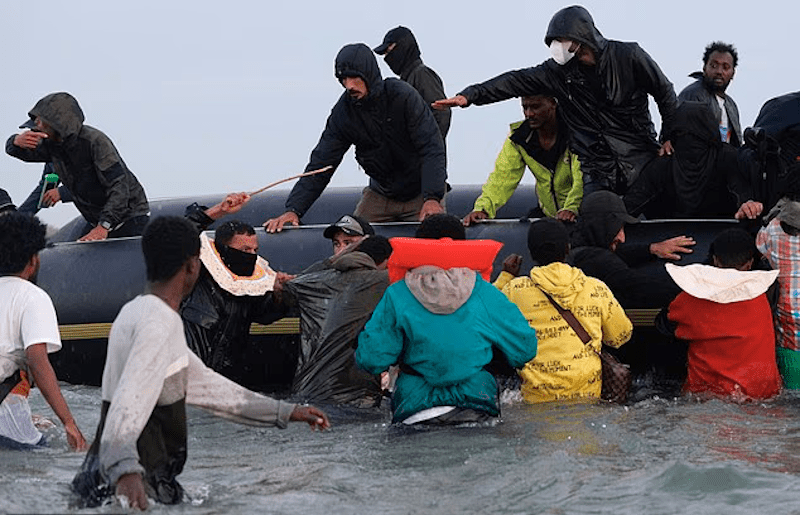
Chaos on French shores as ‘people trafficker’ is seen WHIPPING terrified migrants as they scramble to board boat bound for the UK

Migrants were whipped by apparent people smugglers and a desperate mother with a baby hauled onto a dinghy amid extraordinary out-of-control scenes in France this morning.

The Mail beat French police to the shore at small-boat hotspot Gravelines beach at 5.30am, where large groups of migrants were running the mile down to the beach to reach the waves.

The group, all young men, were up to their knees in the water as a dinghy emerged from a canal into the sea, and turned back to the shoreline towards them.

Share

Those Anti-Gun Tech CEOs? They’re Allegedly Stockpiling Guns

Throughout the tech industry, there’s a certain amount of anti-gun bias just about everywhere. Facebook used to be pretty good about the buying and selling of firearms, but now even gun stores run into advertising problems. YouTube used to be a great place to learn about firearms, and now they’re making it more and more difficult for anyone to learn anything.

And that’s just the social media companies.

Share