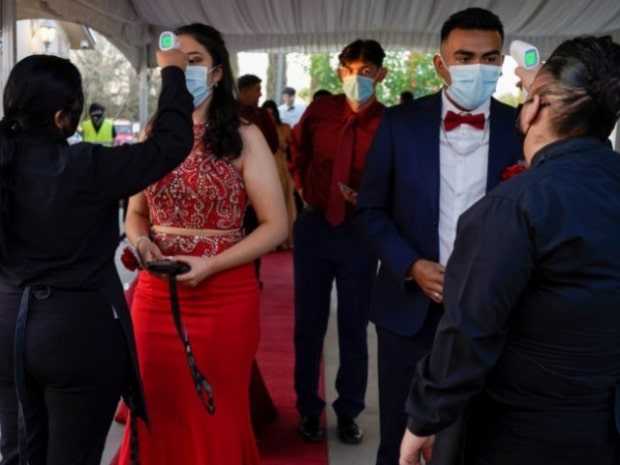
“It’s not a violation of the law as we are not requiring individuals to receive the vaccine nor are we prohibiting those without a vaccine from attending,” Superintendent Jennifer Martin-Green said in an email to a resident.

“It’s not a violation of the law as we are not requiring individuals to receive the vaccine nor are we prohibiting those without a vaccine from attending,” Superintendent Jennifer Martin-Green said in an email to a resident.

As several provinces suspend the first dose of AstraZeneca, and questions remain about whether a second shot will be green-lighted, the researcher who oversaw the development of the vaccine says the move is not only flawed but may lead to serious consequences.

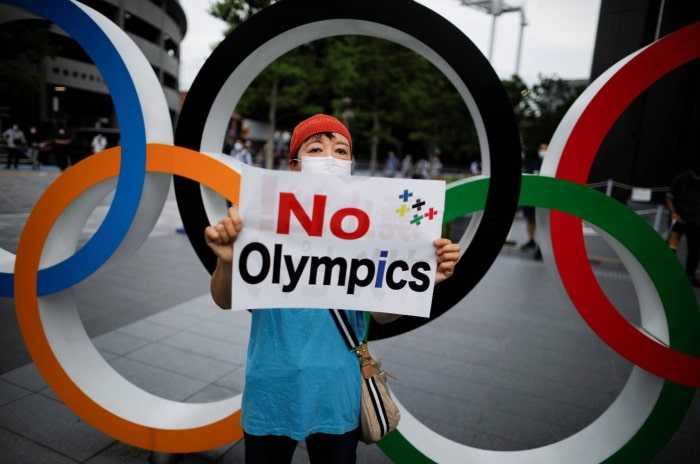
The Tokyo Olympics are now just over two months away and calls to ditch the Games in the face of the pandemic are getting louder by the day. So why isn’t Japan talking about cancelling the Games? The answer as it turns out, is not that simple.
The situation is not looking great in Japan.
A coronavirus state of emergency has been extended in the capital Tokyo and three other major prefectures as cases continue to rise.
Yet there’s been no word about cancelling the Games, despite both health experts and public opinion being stacked against them.
Boris Johnson will send the Army into Britain’s worst hotspots of the Indian coronavirus variant to assist with surge testing as he presses ahead with reopening – despite dire warnings from SAGE that the strain is more infectious and risks a serious third wave.
The PM announced last night that Britain will press ahead with plans for indoor drinking and dining from next week, even while warning that there was ‘a real risk’ that the Indian variant could curtail further reopening in June.
Government scientists revealed in minutes released on Friday night that the variant could ‘realistically’ be 50% more infectious than the Kent strain, which models project could lead to 1,000 deaths a day, as well as 10,000 daily hospitalisations, by the summer.
Ontario reports 2,584 new COVID-19 cases and 24 deaths; ICU occupancy remains elevated
Ontario reported more than 2,500 new COVID-19 cases and 24 additional deaths on Saturday, as intensive care capacity continues to remain elevated.
Provincial health officials logged 2,584 new coronavirus infections today, marking the sixth straight day where cases are below 3,000.
Most Canadians say they are unlikely to travel outside of their community this summer: Nanos survey
OTTAWA — New polling by Nanos Research has found that a strong majority of Canadians won’t be travelling outside of their communities this summer, despite the expected easing of public health restrictions and the acceleration of vaccinations.
According to the survey, commissioned by CTV News, nearly 70 per cent of respondents said they were either “unlikely” or “somewhat unlikely” to travel, while 28 per cent said they were “likely” or “somewhat likely.” Three per cent were “unsure,” even if their community is under a stay-at-home order.
U.K. officials race to test, vaccinate as COVID-19 variant threatens reopening plans
Britain deployed public health officials, supported by the army, to distribute COVID-19 tests door-to-door in two northern England towns on Saturday in an effort to contain a fast-spreading variant that threatens plans to lift all lockdown restrictions next month.
Cases of a strain first identified in India have more than doubled in a week, defying a sharp nationwide downward trend in infections won by months of restrictions and a rapid vaccination campaign. Government scientific advisers say the variant is likely more transmissible than the U.K.’s dominant strain, though it’s unclear by how much.
We know the Indian variant has been found in Ontario but so far there is no data on what if any impact it may be having.
Larry Caulfield loved Premier Doug Ford.
He loved Ontario, Canada, his three kids and six grandkids — all of whom urged him to get the coronavirus vaccine.

If three million people died from an industrial accident, what do you think the popular and press reactions would be?
I ask the question that way because it’s entirely possible that this is what happened with COVID-19 — indeed, it might be the most-likely explanation of the origin of the pandemic. That’s the conclusion that acclaimed science journalist Nicholas Wade came to recently in a detailed post on Medium, where he meticulously examines the Wuhan lab-leak hypothesis, and finds the case for it plausible but unproven, while the case against it, and for a natural origin, is shockingly thin.

The provincial government has been granted an injunction that will put a stop to all anti-vaccine and anti-public health order protests, including an anti-mask rally that was planned for Saturday in Halifax.

A lot of government pressure — and some rumors of actual legal coercion — to get you to take the vaccine, while government employees, who could be ordered to get vaccinated as a condition of their employment, refuse and are permitted to refuse.

It is embarrassing at this point that Canada’s government persists with the charade that its hotel quarantine program for international travellers is in any way mandatory, serious or science-based.
It is not, and has never been, compulsory or universal. International travellers can fly into border cities in the U.S. and enter Canada by land, rendering them exempt from the hotel requirement – a loophole the government hasn’t remedied in the more than three months since it first announced the program.

The May 2017 event was “co-organized by U.S. National Academy of Sciences, Chinese Academy of Sciences (CAS), Wuhan Institute of Virology (WIV), CAS and Hubei Society for Microbiology.”
According to the Wuhan lab, the event had five academic sessions, the first of which was “gain of function research, gene editing, targeting and delivery and other novel biotechnology.”
Among the Americans in attendance as special guests were Professors Linda Saif, James LeDuc, and David Relman. Together, the three professors have received nearly 200 grants from the National Institutes of Health (NIH), with 75 coming from Fauci’s National Institute of Allergy and Infectious Diseases (NIAID).
h/t Marvin
The Ontario government and its medical advisors remain committed to the idea that blunt and broad lockdowns not only work but are the reason why the situation is improving throughout the province.
But some infectious diseases experts in the province say evidence out of Michigan — which borders Ontario — calls that argument into question.

A group of prominent scientists have agreed not to rule out the possibility that the coronavirus was man-made in a laboratory, pending additional information needed.
Until there is proof that signals otherwise, the theory that COVID-19 got created in a Chinese laboratory and it somehow leaked onto the rest of the world is something to take into serious consideration, the scientists say, Reuters reported.
In its earliest development, the virus was first reported to be in China in 2019, however, like Ravindra Gupta, a clinical microbiologist at the Cambridge Institute of Therapeutic Immunology and Infectious Disease at the University of Cambridge, said: “More investigation is still needed to determine the origin of the pandemic.”

The UK has one of the fastest vaccine rollouts in the world. But the emergence of a highly infectious variant first discovered in India has caused concern.
UK – Indian variant: Second jabs could be brought forward to tackle rise
Second vaccine doses could be brought forward and local restrictions introduced to help tackle the Indian variant in the worst-affected areas, the UK government has said.
Minister Nadhim Zahawi said steps could also include vaccinating younger people in multi-generational households.
Meanwhile, a top scientist has warned lifting restrictions on 21 June is in doubt because of the Indian variant.
Cases in the UK have more than doubled to 1,313, Public Health England said.
A global study involving more than 540,000 people shows that vaccine hesitancy and concerns about safety have declined steadily over the past year, but people in many countries, including Canada, have become more unhappy with how their governments have handled the COVID-19 pandemic.
Researchers at Imperial College London have been tracking people in 29 countries since April, 2020, to gauge how the public has responded to the virus. The latest findings, released Friday, showed polling results from 14 countries, including Canada, that have been surveyed most regularly.