Joel Kotkin: Why the Fourth of July is relevant to Canada, too

Joel Kotkin: Why the Fourth of July is relevant to Canada, too

The United States approaches its 250th anniversary deeply divided. Pride in the country, at roughly 40 per cent, has dropped to a historic low, notes Gallup, a trend most evident among younger, educated people.

To be sure it depends where in the U.S. you go. There used to be little difference between the parties, as was evidenced in the 1976 centennial. But, again predating Donald Trump, the gap between Republicans and Democrats has widened, with the latter generally not proud of their country. In deep blue areas like California and New York, celebrations are muted; even the traditional Fourth of July fireworks show in Long Beach, Calif., has been cancelled. Don’t expect much celebratory treatment in left-dominated Hollywood either.

Share

TAYLOR: How Canada became a country that wastes your time

TAYLOR: How Canada became a country that wastes your time

For years, Canadians have been warned about their country’s declining labour productivity. According to the Bank of Canada, it’s a “break the glass emergency” that requires immediate attention. But what about our other productivity crisis — the one of personal, rather than national, proportions?

Modern life has become full of tiny frustrations and complications that steal our attention and creativity a few minutes at a time, leaving us all less productive. 

Share

Canadians hate being called the 51st state. But they don’t mind moving south of the border, study says

Canadians hate being called the 51st state. But they don’t mind moving south of the border, study says

WASHINGTON, D.C. — Canadians may hate the idea of U.S. statehood, but some still see the grass as greener across the border. The question is why, and a new study says the answer is more complicated than tax envy or better jobs.

The data tell a mixed story: More Canadians seem to be heading to the U.S. in recent years, even as long-term permanent migration has declined. Nearly 20,000 Canadians emigrated to the U.S. permanently in 2022, a 65 per cent increase from the year before, according to Statistics Canada. But the average number of native-born Canadian-born people granted permanent U.S. residence fell from 15,600 in the late 2000s to nearly 11,000 in the late 2010s.


We can be such smug hypocrites when it comes to the USA.

Share

Personal Wealth: The US $696,277 per adult. Canada $399,886 per adult. Thanks Liberal Party!

Personal Wealth: The US $696,277 per adult. Canada $399,886 per adult.  Thanks Liberal Party!

North America is the richest region of the world when it comes to personal wealth, according to a new report from Swiss bank UBS, but in terms of countries Canada ranks 13th.

With an average personal wealth of US$660,000 per adult in 2025, North America is followed by Australia and New Zealand, which together had an average wealth of US$590,000. Western Europe was ranked third, with an average wealth of US$330,000 per person.

… Canada came in 13th place in the country rankings with an average wealth of US$399,886 per adult.


The US $696,277 per adult. Canada $399,886 per adult.

Thanks Liberal Party!

Share

GOLDSTEIN: Carney’s pivot on climate change the right move, but is it real?

GOLDSTEIN: Carney’s pivot on climate change the right move, but is it real?

Prime Minister Mark Carney’s pre-Canada Day pivot away from Justin Trudeau’s failed $200-billion-plus climate strategy, after supporting it up to late last year, is a classic example of what makes the public cynical about politics.

The timing was strategic, after Parliament had adjourned for the summer and the day before Canada Day, when Canadians were thinking about barbecues and fireworks, not industrial greenhouse gas emission targets.


“The Great Negotiator Carney” having zero success beyond Eurovision and accelerating ChiCom infiltration needed some good PR knowing CUSMA was not going to be renewed.

So he tossed some crumbs to the peasants by “renouncing” Trudeau’s nation killing green-scam.

Don’t believe it, Carney wants Canada destroyed as much as Junior did.

Next he’ll have CBC telling us that it was Poilievre’s idea to bail out his Developer bagmen.

Share

Canada to compete in Eurovision for first time in 2027

Canada to compete in Eurovision for first time in 2027

CALGARY — Canada will officially join the world’s biggest televised music competition in 2027, marking the country’s first appearance in the Eurovision Song Contest and making it the first new participant since Australia joined more than a decade ago.

The announcement was made Tuesday by CBC/Radio-Canada and the European Broadcasting Union (EBU), just days after CBC secured full membership in the organization that oversees the annual event.

Ugh.

Share

Canada: Regina, Saskatchewan’s Call to Islamic Prayer on Loudspeakers on Hold After Backlash

Canada: Regina, Saskatchewan’s Call to Islamic Prayer on Loudspeakers on Hold After Backlash

Some good news (for now) as people begin to slowly wake up in the West. Jihad Watch reported the original story HERE about the Muslim call to prayer in Regina, Saskatchewan blaring over loudspeakers in the wee hours of the morning. Now, the plan is on hold after a backlash. “Regina mosque’s weekly call to prayer on hold after backlash,” by Randi LaRocque, CBC, June 26, 2026 …

Share

A Steep Exit Tax Won’t Solve Canada’s Brain Drain

A Steep Exit Tax Won’t Solve Canada’s Brain Drain

For some critics of American immigration policies, Canada’s system, which focuses on admitting educated, experienced workers who can support themselves and bolster the national economy, should be a model for U.S. reforms. About six in ten new residents whom Canada admits are classified as members of the “economic class” of immigrants, granted entry based on their education, work experience, and ability to speak one of the country’s official languages. While America’s legal immigration regime is heavily weighted toward family unification, those admitted to Canada based on familial ties make up less than one-quarter of migrants.

h/t patthedog

Share

LYTLE: This Canada Day, ask yourself — who’s really betraying Canada?

LYTLE: This Canada Day, ask yourself — who’s really betraying Canada?

Canada Day is upon us, and I just walked around a very pretty, older middle-class neighbourhood distributing a flier giving reasons for why Albertans should leave the nation that once nurtured us. Am I a “separatist traitor” as more than one person has alleged to my face? It is a question worthy of serious consideration.

A traitor is defined as one who violates his allegiance and, in a breach of trust, betrays his country. The question is, “Who or what is my country?”

Share

Who does Mark Carney think we are, anyway?

Who does Mark Carney think we are, anyway?

What is the story Mark Carney is telling us about Canada? And why is he doing it?

These seem like ridiculous questions on the surface, because the Prime Minister’s entire political career has unfolded in a maple-soaked tourism commercial, thanks to the ferocious nationalism unleashed by Donald Trump’s unhinged threats. It’s like asking what ice has to do with hockey: The question seems to miss the point.

Share

Conrad Black: Canada Needs to End Its Self-Flagellation and Focus on Building a Prosperous Future

Conrad Black: Canada Needs to End Its Self-Flagellation and Focus on Building a Prosperous Future

The anniversary of Canadian Confederation is traditionally a time to wallow in orotund platitudes about our good fortune to have this country, and the admirable qualities of all those who discovered it, settled it, and built it. This custom has perhaps been tempered slightly by the heckling of dissenters and particularly lamentations, some of them sincere and justified and some false and defamatory, over the historic treatment of indigenous peoples. My intuition is that the Canadian tendency to emulate popular cultural trends in the United States is part of the source of the current widespread national self-criticism over treatment of the indigenous.

Share

U.S. Republicans are casting the Canadian border as a rising security threat

U.S. Republicans are casting the Canadian border as a rising security threat

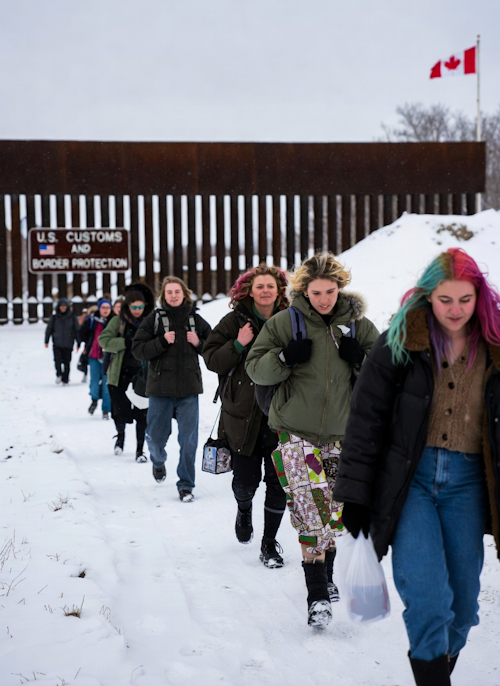
WASHINGTON, D.C. — The U.S. administration and its congressional allies are continuing to make the case that America’s northern border is facing a rising national security threat.

Two weeks ago, Homeland Security Secretary Markwayne Mullin said during a CSIS panel discussion in Washington that pressure on Mexican cartels at the southern border was pushing criminal operations and fentanyl trafficking northward toward the Canadian border. Drug researchers notably questioned the claim.


I don’t believe anything our politicians say on border security, transnational drug crime etc.

Frankly I suspect our institutions have been compromised by the CCP and the cartels.

Share