The most significant news from the Middle East since the Hamas terrorist raid on Israel last year is happening in real time and for whatever reason legacy media is giving it the minimum required coverage as if it’s just another skirmish in the war-torn region. It’s not.
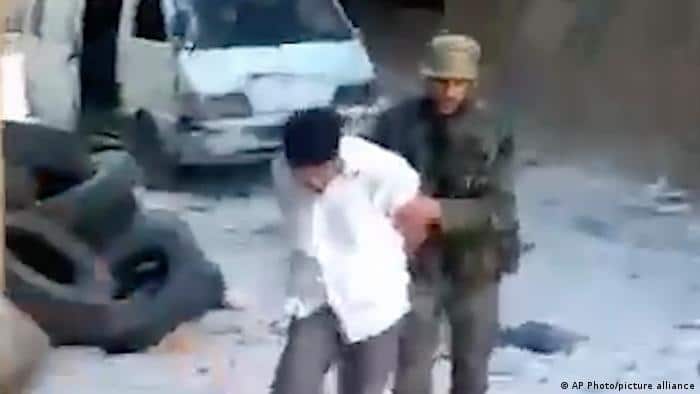
#Syria: the first groups of prisoners is leaving the cells of the Sednaya prison following the collapse of the #Assad regime. pic.twitter.com/JCW2kEksVa
There is no incentive for factions to tread gently
The Syrian jihadist group Hayat Tahrir al-Sham (HTS) surprised the world and probably itself with its almost unimpeded conquest of Aleppo at the weekend, conquering in hours territory that had been bloodily fought over for many years. And like an ancient bacterium released from melting permafrost, the sudden unfreezing of Syria’s assumed frozen conflict has released noxious old strains of geopolitical discourse into a very different world. One of the things that made the Syrian war, at its height, so hard for casual observers to understand was that it was a series of rapidly-shifting, amoral and pragmatic alliances and betrayals. Yet these convoluted dynamics were filtered for external observers through a moralising internet war, aimed at mobilising foreign intervention: the results were disastrous for Syria’s people, on all sides.
This time around, we may still hope that things turn out differently. Rather than a reversion to the great crisis of a decade ago, the dramatic events of the weekend, and the international reactions, highlight how far the region, and the wider world, have changed since the war’s bloody height.
Turkey is unleashing another gruesome jihad in Syria.
On November 27, jihadist terror groups — led by the Islamist group Hayat Tahrir al-Sham (Organization for the Liberation of the Levant; HTS) — launched a coordinated attack on Aleppo Governorate in northwestern Syria, cut off the main highway from Damascus to Aleppo, captured and killed dozens of Syrian Army soldiers, promised mass executions and beheadings “in front of TV cameras,” and seized control of a military base and several villages.
Iran may not be finished paying for its massive miscalculation against Israel. Of the two proxy armies that have been decimated if not destroyed in the war launched by Hamas and Hezbollah in October 2023, the latter is by far the most significant to Iran’s geopolitical ambitions. Hezbollah didn’t just turn Lebanon into a puppet state for Tehran, but it also propped up Bashar al-Assad against Sunni Islamist rebels over the last thirteen years.
A lot of Assad supporters in the GTA – from the BCF wayback machine 13 years ago …
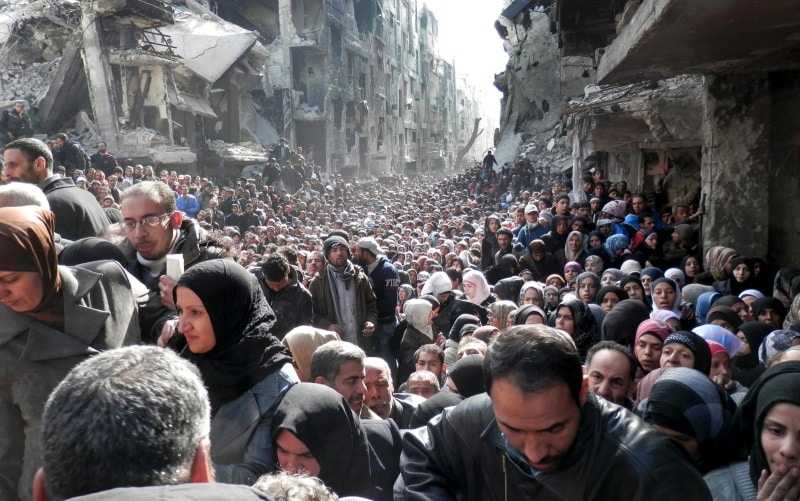
Syria is clearly on the verge of collapse in terms of the economy and humanitarian situation.
The country’s southern province of al-Suwayda’, whose population primarily comes from the Druze minority, is currently witnessing protests on an unprecedented scale. While the province has previously seen protests motivated primarily by the country’s deteriorating economic and livelihood situation, these protests are now far more widespread in the province and larger in scale.
A Syrian website run by opponents of the Assad regime recently reported that in early June that Russian military officials in Syria’s Deir ez-Zor Province met with Iranian operatives. The primary agenda of the Russian-Iranian meeting was reportedly “to discuss expelling the United States from Syria, which may indicate Russia’s intent to facilitate Iranian-backed attacks on US forces.”
After a series of Iran-directed attacks on U.S. military outposts in Syria and the kinetic responses from American forces, leaked documents indicate that Iran is planning to target US armored vehicles in Syria by with remotely-detonated roadside bombs.
The Christians of Iraq and Syria have for decades suffered from persecution and instability caused by oppression by the Ba’ath regimes, the 2003 US-led invasion of Iraq, the outbreak of Sunni-Shiite fighting in 2006, al-Qaeda terrorism, the 2014 genocide by ISIS, ongoing Turkish airstrikes on Iraq and Syria, and in many cases, pressures and harassment at the hands of their Muslim neighbors. All this persecution has forced many of them to leave their home countries and seek asylum elsewhere.
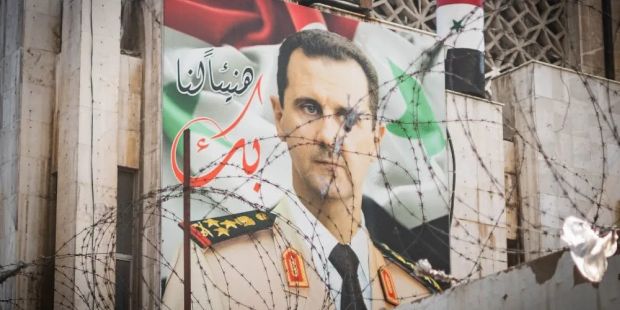
Syrian dictator Bashar al-Assad’s offer to ease border restrictions to allow aid agencies better access to areas of northern Syria that were devastated by the recent earthquake is nothing more than a calculated ploy to have the punitive sanctions regime against Damascus eased.
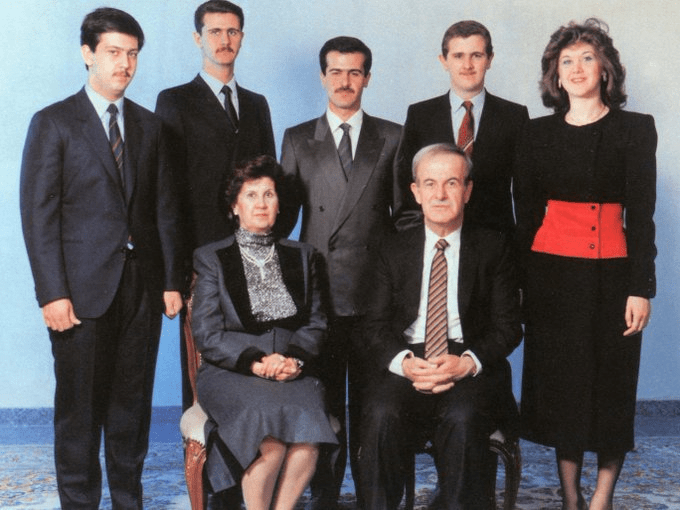
During the five decades or so the Assad regime has been in power, one of its less appealing characteristics has been its willingness to exploit any global crisis for its own benefit.
In late April 2022, a Syrian defector leaked a video of the Tadamon massacre. Hundreds of Syrian families watched the clip, hoping to learn what had happened to their missing sons.
The Siyam family watched it, too. Their son, Waseem Siyam, left his home in Damascus in the early morning of April 14, 2013. He had been ordered by the government to deliver flour to a state-run bakery in the city’s southern Tadamon neighborhood. The 34-year-old never returned from what should have been a routine task.
Recently I was in the city of Hassakeh, Syria, sitting and making small talk with two Syrians, one Kurdish and the other Syriac Christian. The Christian said he would like to invite me to his house but, because he lives in the government-controlled area of the city, he couldn’t. He’d previously had a guest from another Arab country, and the government’s security service immediately knocked on his door, asking who the guest was. As an American journalist without a Syrian visa, I would not be welcome in the government-held part of the city. (Hassakeh is currently divided between the majority of the city that falls under the control of the Kurdish-led Syrian Democratic Forces and a small section that falls under the control of the Syrian government.) The Kurd sitting with us immediately piped in, saying that it was for the people’s benefit that the government kept such a close watch on the security situation. That was why Syria was so safe before the war. The Christian enthusiastically agreed.
A French-Syrian man has been detained by French police on suspicion of supplying components for the manufacture of chemical weapons in Syria through his shipping company, sources briefed on the case told AFP Sunday.
The man, who was born in 1962 and lives abroad, was arrested Saturday in the south of France according to one of the sources.
“He returned to France with his family for the holidays,” a source close to the case told AFP.
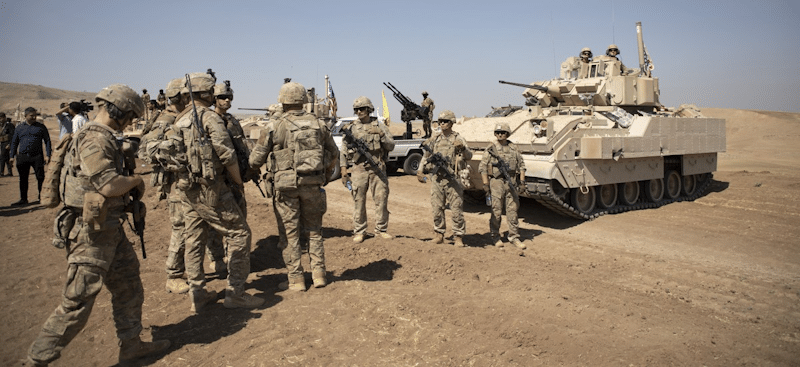
A week ago, US troops camped out in the small, dusty Syrian outpost of al-Tanf suddenly found themselves under a “deliberate and coordinated attack“, as multiple explosive-laden drones barreled toward their positions. According to US officials who spoke to the AP on background, Iran “resourced and encouraged” the latest drone attack targeting US forces. The five drones were also reportedly Iranian-manufactured, leading to speculation that Tehran is testing the Biden administration at a time when nuclear negotiations between the US and Iran remain in limbo.
Fortunately, US troops managed to defuse the drone attack without suffering any casualties. But the near-miss was still deeply troubling, for it again illustrated the extremely dangerous environment in which nearly 1,000 US forces in Syria are operating.