The AfD aren’t ‘far-Right’, and they aren’t going away

A downcast mood hung over Germany ahead of the snap elections. The week before 83 per cent of voters admitted in a survey to having a pessimistic outlook on the situation the country is in. But turnouts were remarkably high: 84 per cent of voters went out to cast their vote, up from 36.5 per cent in 2021. One thing all voters can agree on is the desperate need for change.

The CDU, the centre-Right party of Germany, has been given another chance at power. At 28.5 per cent, the party has won back some voters, compared to the 24.1 per cent they got in 2021 after 16 years under Chancellor Merkel. However, that is still underperforming when you consider how hated the prior left-wing coalition government was.


Related … Germany’s next chancellor warns Nato could soon be dead

Friedrich Merz, who is poised to become Germany’s next chancellor, has warned Nato could be finished and Europe must prepare to build an alliance “independent” from the US.

In stark comments, Mr Merz, 69, leader of the centre-Right Christian Democratic Union (CDU), suggested the continent may have to “quickly” establish an “independent European defence capability”.

After exit-polls predicted Mr Merz would win the election, Donald Trump hailed the result as a “great day for Germany and for the United States of America”.

Share

Conservatives projected to win German election – as AfD surge into second

The centre-Right Christian Democrat Union party has won the German election according to an exit poll released on Sunday evening.

Friedrich Merz, the CDU leader, is projected to win 29 per cent of the vote, after a campaign dominated by economic stagnation, migration pressures and growing uncertainty over how best to secure the future of Ukraine.

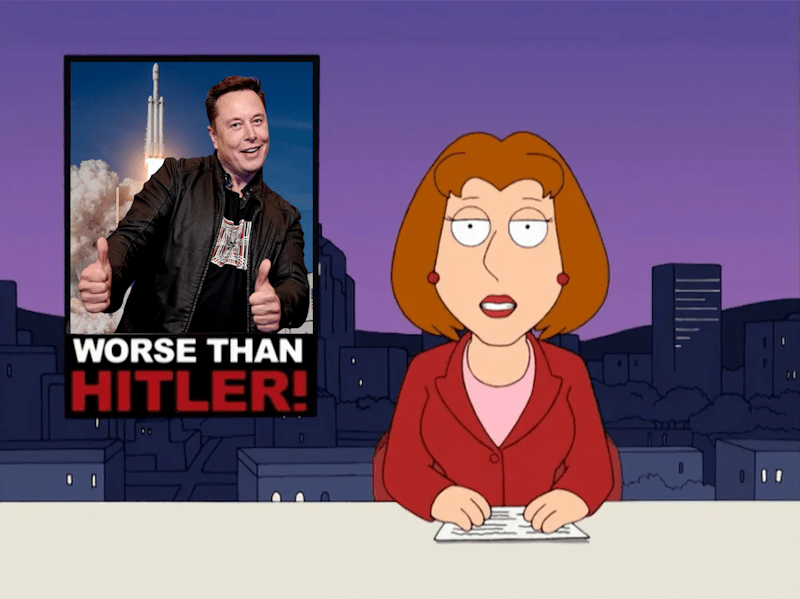
The far-Right Alternative for Germany party, which had high-profile backers including Elon Musk, has come second place with 19.5 per cent. It marks the strongest result for a far-Right party since the Second World War.

Share

Germany at a Crossroads: Why Voters Are Looking for an Alternative

Germany is preparing for the general elections this Sunday, February 23, with the possible consolidation of Alternative for Germany (AfD) as the country’s second-largest force in a surge that challenges the traditional political balance. It deeply worries the socialist-conservative establishment within Germany—and at the European level.

Share

Why Germany is ripe for revolt – The German elites were wrong about everything.

As Germany’s federal elections approach this weekend, chancellor Olaf Scholz and his Social Democrats (SPD) are bracing for their worst results since 1887. The SPD is battling with its equally unpopular coalition partner, the Green Party, for a humiliating third place, behind the conservative Christian Democrats (CDU) and the right-populist Alternative for Germany (AfD).

Share

A train through Germany: is Europe’s powerhouse going off the rails?

In the run-up to Sunday’s crucial election, the Guardian took a long journey through Europe’s heartland to talk to voters

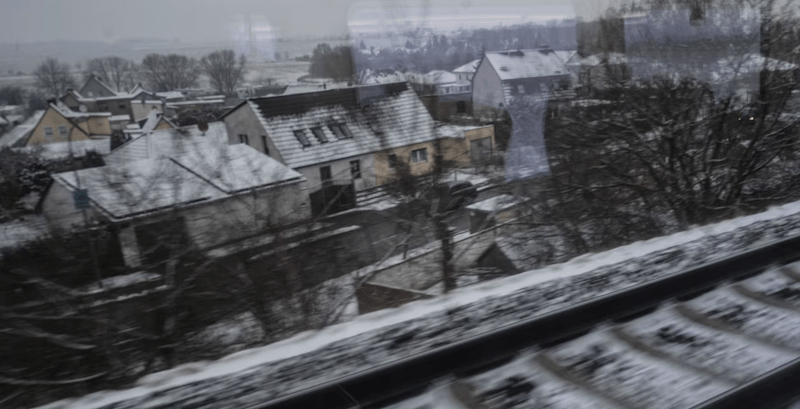
Creaking, overcrowded, neglected, Germany’s railways, once a source of national pride, have taken a battering to their image in recent years. Amid wider concerns about the health of Europe’s stagnating largest economy, the state of its trains has become something of a metaphor for a more general sense of malaise.

On Sunday Germans will go to the polls in one of the most important elections in recent times, with an emboldened far right hoping to more than double its share of votes. In the run-up, the Guardian travelled more than 850 miles on trains across Germany to hear what its citizens have to say about the state of their nation.

The Guardian is beside itself with anxiety over the Afd.

Share

Is Germany heading for a second Weimar?

In the Thuringian city of Weimar, opposite the theatre where the National Assembly hashed out Germany’s constitution in 1918, stands the museum of the history of the Weimar Republic. ‘A spectre is rising in Europe – the spectre of populism,’ a plaque reads. ‘Forces long thought overcome seem to be returning to threaten the basis of democracy. The Weimar Republic and its neighbours knew the phenomenon only too well.’

Share

JD Vance meets AfD leader after attacking Germany for excluding party

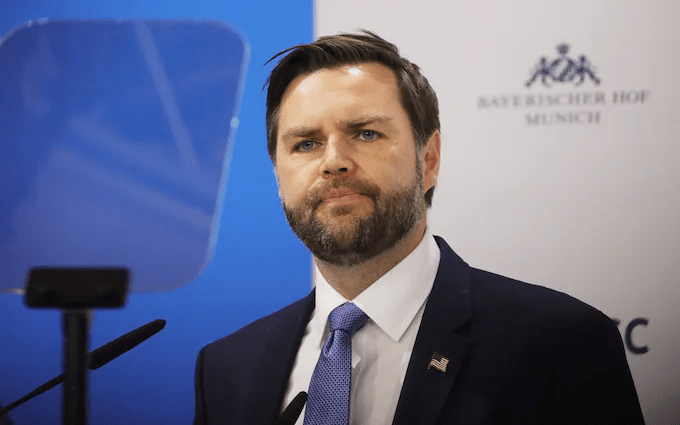
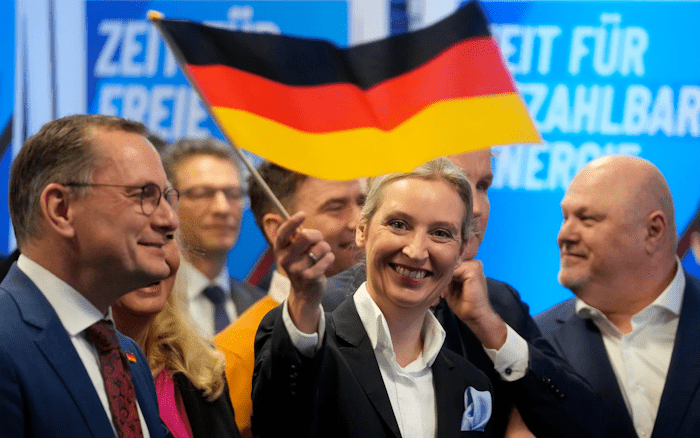
JD Vance has met Alice Weidel, the co-leader of Alternative for Germany (AfD), outside the Munich Security Conference (MSC) after criticising the organisers for excluding the party.

In a landmark address to the conference, the US vice president denounced the pariah status placed upon the AfD.

“Democracy rests on the sacred principle that the voice of the people matters. There’s no room for firewalls,” he said, referencing a pledge by mainstream German parties not to work with or form governments with the party.

Share

Germany has lost count of migrant terror attacks – the AfD hasn’t

First Mannheim, then Solingen, then Magdeburg, and Aschaffenburg and now Munich.

Germany has seen so many terror attacks committed by foreign citizens over the past 10 months that it is difficult to keep track of them.

And inevitably, this latest attack will ensure that mass migration and border security remains at the very top of the campaign agenda, ahead of elections on Feb 23.

Share

Why do so many gay men support the AfD?

‘There are many neighbourhoods we can no longer go to because we are in danger of being injured, attacked or murdered,’ Ali Utlu tells me. As a gay German man of Turkish extraction and an ex-Muslim, he’ll be voting for the hard-right Alternative for Deutschland (AfD) party in the German elections later this month. And he’s not alone.

A survey of more than 60,000 gay German men by Europe’s largest gay dating platform Romeo found that almost 28 per cent of its users intend to vote for the AfD, making it the most popular party in Germany for gay men. The poll showed that the AfD did best among 18 to 24-year-olds: 34.7 per cent said they’d vote for the party. Among those aged 25 to 39, it was 32.3 per cent.

Alice Weidel the AfD leader is gay. This must scare the left to death.

Share

Why more young men in Germany are turning to the ̷f̷a̷r̷ right … mass immigration from incompatible cultures

“What my parents taught me is that they used to live in peace and calm, without having to have any fear in their own country,” says 19-year-old Nick. “I would like to live in a country where I don’t have to be afraid.”

I meet him in a small bar on a street corner in the ex-mining town of Freiberg, Saxony – where he is playing darts.

It’s a cold, foggy night in February with just over two weeks to go until Germany’s national election.

Nick and his friend Dominic, who is 30, are backers or sympathetic to Alternative für Deutschland – a party that has been consistently polling second in Germany for more than a year and a half, as the far right here and elsewhere in Europe attracts an increasing number of young people, particularly men, into its orbit.

It’s not far right when it’s near majority status Mr. BBC commie.

Share

Germany’s Right Surges as Voters Back Tough Migration Stance

Talking tough on migration has reaped its reward in Germany: both the centre-right CDU/CSU alliance and the right-wing Alternative für Deutschland (AfD) party have risen in the polls following their support for a non-binding motion that aims to turn back migrants at the border.

According to a survey commissioned by public broadcaster ARD, both parties gained one percentage point compared to a previous poll. The CDU/CSU alliance now stands at 31%, making it the frontrunner for the elections on February 23rd. The AfD is on 21% in second place.

Share

‘Firewall’ Crumbles: Bundestag Passes Migration Motion With AfD’s Support

The German parliament (Bundestag) on Wednesday, January 29th backed a non-binding motion aimed at turning back illegal and undocumented migrants at the nation’s borders.

The vote marked a significant shift in German politics, as it is the first time mainstream parties have cooperated with the right-wing Alternative für Deutschland (AfD) in accepting a proposal in the federal parliament.

Share

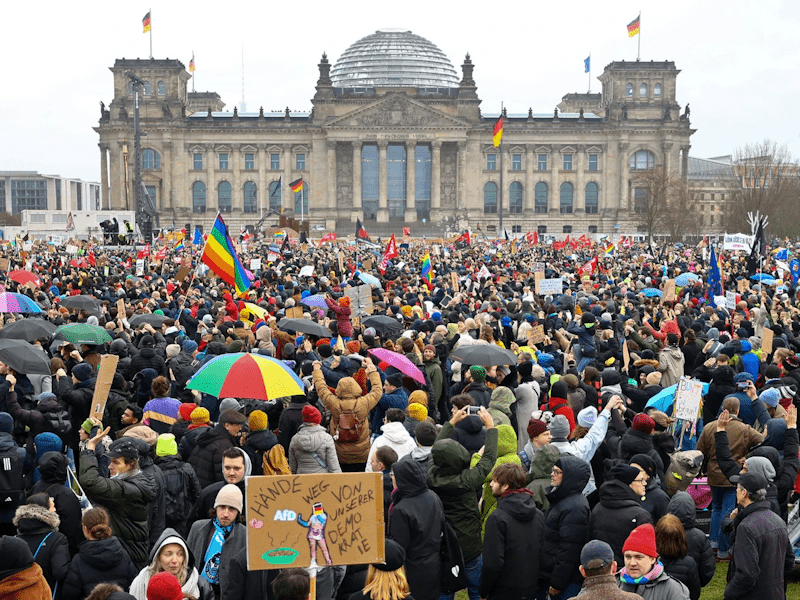
Thousands march in Germany as AfD launches election campaign

Thousands of Germans took to the streets in several cities to protest the rise of far-right extremism and the growing popularity of the anti-immigrant Alternative for Germany (AfD) party.

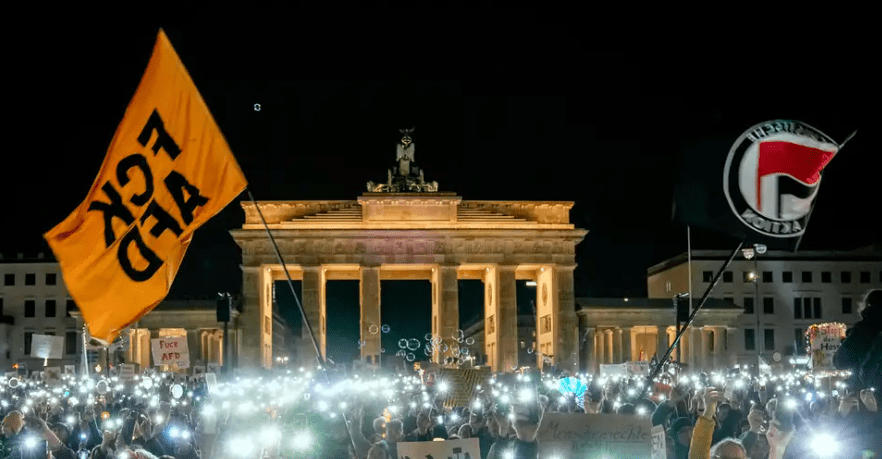
At Berlin’s Brandenburg Gate, people blew whistles and sang anti-fascist songs, and in the western city of Cologne, protesters carried banners denouncing the AfD.

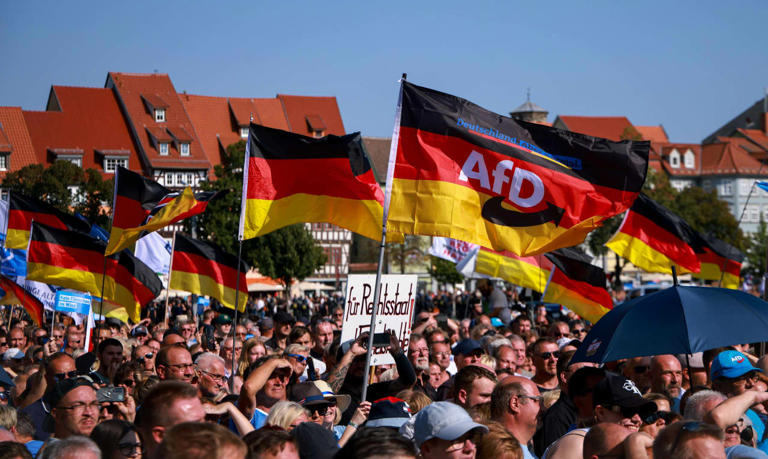
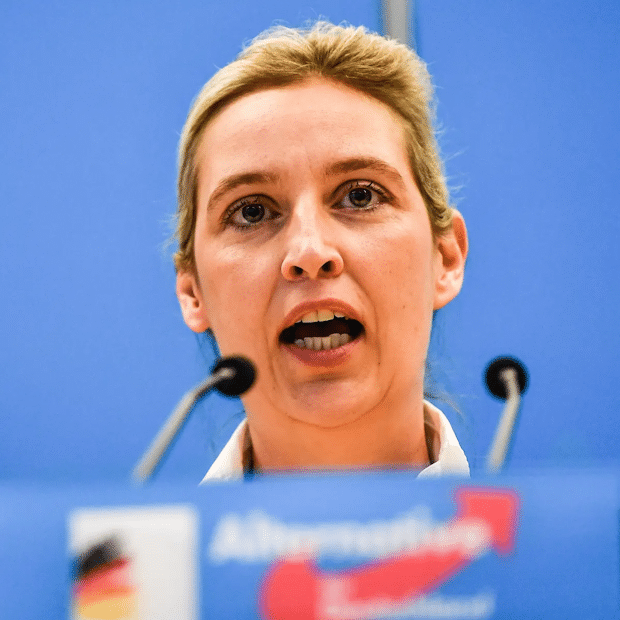
The protests also came as the AfD opened its election campaign in the central city of Halle. Around 4,500 AfD supporters gathered at a venue where the party’s leader and chancellor candidate Alice Weidel addressed the crowd.


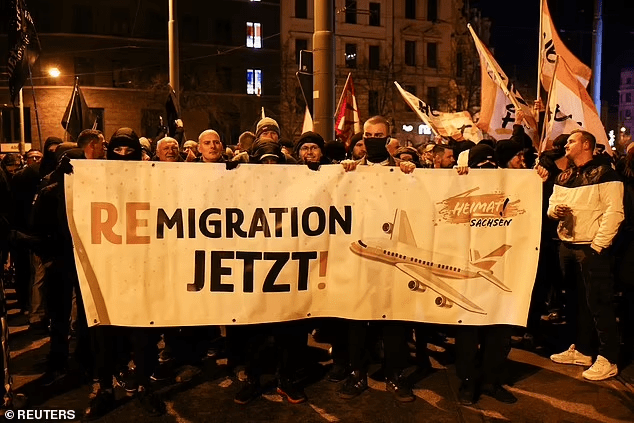
Note the pic above that accompanied this article at media outlet DW, a CBC gov’t type propaganda outfit.

See the flag belonging to the violent extremist left Antifa movement?

How many times is Antifa mentioned in the article?

Zero mentions, Antifa and it’s violence are given a pass, normalized in fact, while the dissent of the common man is smeared as “far right extremist”.

Share

The Horror! Elon Musk told an AfD meeting “It’s good to be proud of German culture, German values, and not to lose that in some sort of multiculturalism that dilutes everything,”

Elon Musk made a surprise ap   pearance during Germany’s AfD (Alternative fuer Deutschland) election campaign event in Halle in eastern Germany on Saturday, speaking publicly in support of the far-right party for the second time in as many weeks.

Addressing a hall of 4,500 people alongside party leader Alice Weidel, Musk spoke live via video link about preserving German culture and protecting the German people.

“It’s good to be proud of German culture, German values, and not to lose that in some sort of multiculturalism that dilutes everything,” Musk said.

Share