Even auto giants know it: the electric car boom is out of charge

“I think the customer has spoken. That’s the punchline,” said Jim Farley, the chief executive of Ford.

The American boss was speaking last week as his company unveiled a $5bn (£3.7bn) annual loss, barely two months after it had booked a shock $19.5bn write-down.

The cause? An aggressive bet on electric vehicles (EVs) that backfired spectacularly.

In 2025, sales of the Mustang Mach-E crossover and the F-150 Lightning pickup truck – once hailed by Farley as the “truck of the future” – went into reverse.

Share

Carney practises the illusion of EV mandate repeal

Replacing a ban on gas cars with strict new emissions standards sounds more sensible but will kill the auto industry just as effectively

Prime Minister Mark Carney, recognizing the need to act decisively to support our auto sector, has scrapped Canada’s electric vehicle (EV) mandate. Or has he? Unfortunately, close inspection shows that he merely rephrased the policy but the effect remains the same. Following the pattern of indecision and obfuscation set by his “Memorandum of Understanding” with Alberta, in which Carney sounded like he was greenlighting a new pipeline without actually doing so, the new auto policy repeals the mandate in name only.


I am really hoping that Trump does a Maduro on our WEF snake.

Meanwhile down south … The New York Times is sad!

With Latest Rollback, the U.S. Essentially Has No Clean-Car Rules

The E.P.A.’s killing of the “endangerment finding” caps a year of deregulation that is likely to make cars thirstier for gas and less competitive globally, experts say.


Share

Randall Denley: Carney’s EV plan benefits Carney, not Canadian carmakers

At first glance, Prime Minister Mark Carney’s new auto industry strategy looks like billions of dollars in support for Ontario’s beleaguered vehicle manufacturers. Unfortunately, Carney’s EV-focused approach will do little or nothing to solve the industry’s problems.

It’s difficult to imagine a plan more untethered from the economic realities of the real-world auto industry. To summarize, the Carney plan relies on electric vehicles (EVs) that Ontario plants don’t produce, a sudden and dramatic new appetite for buying EVs and an imagined export market that doesn’t exist. To top it off, the federal government will provide $2.3 billion in EV rebates that will encourage Canadians to buy cars made elsewhere, although the new Chinese imports are excluded.

Share

Matthew Lau: Carney government should scrap all damaging EV policies

As the iron door of reality slams onto the toe of even the most fervent advocates of climate change action, the Carney government has walked back its electric vehicle (EV) mandate, which would have banned the sale of new conventionally powered vehicles in Canada by 2035.

However, the government will not abandon its push to switch Canadians to EVs. It’s bringing back rebates of $5,000 for EVs under $50,000 (for vehicles made in Canada or in countries where we have free-trade agreements) and plans to offer billions in subsidies to automakers. The continued push for EVs highlights the significant discrepancy between how individual Canadians want to spend their money and how the federal government thinks they ought to spend it.

Share

EVs Are a Failed Experiment

General Motors admits it has lost — so far — about $3.3 billion on EVs. It is apparently not enough to persuade GM that EVs are losers.

“We continue to believe in EVs,” GM’s CEO Mary Barra said the other day. Adding that “our portfolio brought almost 100,000 new customers to GM in 2025.” That these customers didn’t add a cent to GM’s bottom line doesn’t seem to matter to Barra. “We know these drivers do not often go back to gas, so we will continue executing our plan to reduce EV-related costs and we remain confident in our path to EV profitability.”

Share

Think tank says federal EV quota changes unrealistic and costly

The federal government’s plan to replace electric vehicle sales quotas with a reduced emissions standard is unrealistic and could saddle Canadians with massive costs, according to the Montreal Economic Institute (MEI).

Prime Minister Mark Carney announced that instead of gradually banning conventional vehicles by 2035, 75% of new vehicles sold in that year would need to meet an electric-equivalent emissions standard.

(Incognito)

Share

GOLDSTEIN: Just admit it, Canada, the EV market has crashed

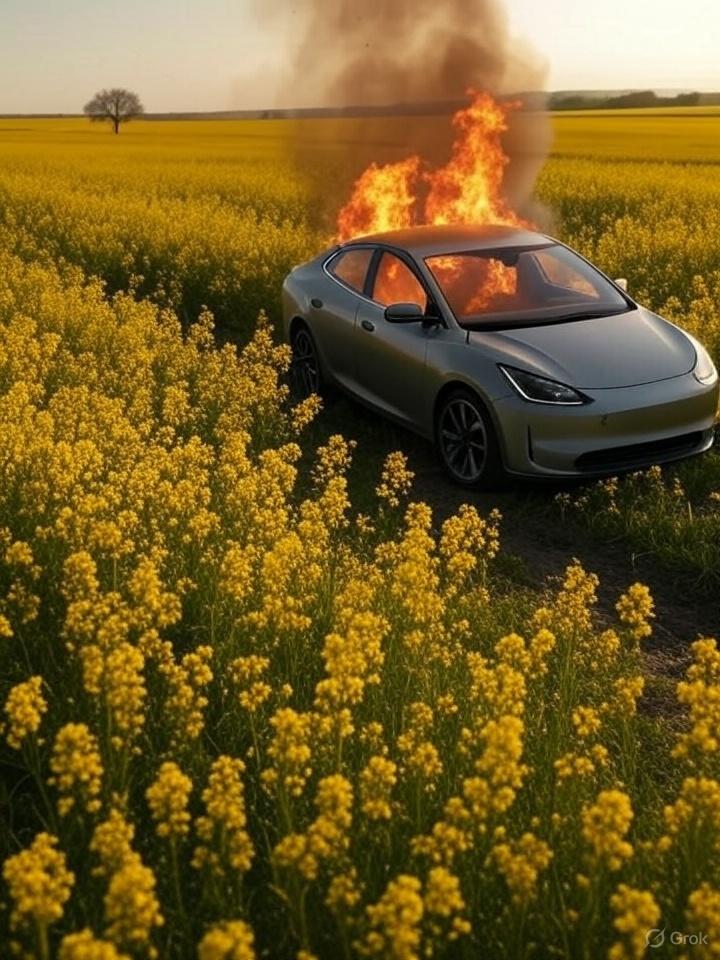
EV’s repurposed as canola field burners

For heaven’s sake, can we just admit the painfully obvious point that Canada’s federal and provincial governments committed a massive strategic blunder when they went whole hog into subsidizing the production and sale of EV vehicles and batteries?

Share

Will Canada’s new auto strategy put as many EVs on the road as Carney says?

Despite widespread approval from provinces and auto manufacturers, Prime Minister Mark Carney’s auto plan might not accelerate the transition to electric vehicles as fast as he says.

On Thursday, Carney ended Canada’s electric vehicle mandate, resumed purchase incentives and said higher standards for fuel efficiency were coming. Ontario and Alberta’s premiers said they were both “pleased” and car manufacturers said the move provided “welcome policy stability.”

Share

The EV Car Crash

With the ban on the sale of new petrol and diesel cars less than four years away now, there remains one seemingly insurmountable obstacle: nobody wants to buy electric cars.

Last year, sales of EVs achieved a market share of just 23.43%. Newly released figures for last month show this fell to 20.6%. The Government has set a target this year of 33%, rising to 66% in 2029.

Once petrol and diesel cars (known as ICE vehicles, short for Internal Combustion Engine) are banned in 2030, zero emission cars must make up at least 80% of the market, with the rest filled with hybrids. However, the latter will also be gradually phased out by 2035. Zero emission essentially means battery-electric, although hydrogen fuel-cell vehicles would also qualify.

Share

LG Energy Solution to buy Stellantis’s stake in Ontario EV battery joint venture for just $100

South Korea’s LG Energy Solution on Friday said it plans to buy the 49-per-cent stake held by Stellantis in their battery joint venture in Ontario for the nominal amount of US$100.

Stellantis also said on Friday it would book charges of around €22.2-billion ($35.81-billion) in the second half of last year as the Franco-Italian automaker scales down electric-vehicle development plans and launches a “strategic shift.”


But wait there’s more!

Stellantis shares plunge as carmaker takes $22.2-billion writedown on EVs

Chevy Ends Building Tremec Corvette Transmissions in Canada, Production Shifts Back to America

Poor Joly! h/t Mauser

Share

U.S. Dealers In Full Panic Mode After Canada Green-Lights Chinese Cars

If you feel like Chinese cars are suddenly right around the corner, you’re not alone. The notion has received a groundswell of both direct and indirect support lately, and as affordable new cars drop like flies from U.S. lineups, American consumers are becoming more open-minded about the prospect of allowing Chinese OEMs to enter the market.

Given the political climate, it’s no wonder that dealers feel caught a bit off-guard by this development. And now they’re getting vocal about it.

Share

Ottawa Scraps EV Mandate, Aims to Reach 90 Percent EV Adoption Through Emissions Regulations

Prime Minister Mark Carney says he will abolish the electric vehicle mandate while replacing it with emissions regulations that he says will achieve a similar objective of reaching widespread EV adoption by consumers.

Carney announced on Feb. 5 that Ottawa will repeal the electric vehicle mandate that would have required automakers to produce and sell only electric vehicles by 2035. Instead, Carney said the government will put in place tougher greenhouse gas (GHG) emissions standards for model years 2027 to 2032. The revised aim is to reach an EV adoption rate of 75 percent by 2035 and 90 percent by 2040.

Share

Carson Jerema: The EV mandate isn’t being scrapped, it’s being renamed

The electric vehicle mandate that would have forced 100 per cent of all new cars sold in Canada to be zero-emission vehicles by 2035 was a typical Trudeau-era policy. It had more to do with preening self-righteousness than anything else. It sacrificed economic growth for green fantasies and was extremely paternalistic. As with most climate-change policies, the objective seemed to be more about control than actually accomplishing anything.

Share