
 The astronomical cost of rentals in Canada these days has forced Canadians to resort to desperate measures amid the rising cost of living.
Prime Minister Justin Trudeau took to social media to preview what lies ahead for the nation’s renters.
The astronomical cost of rentals in Canada these days has forced Canadians to resort to desperate measures amid the rising cost of living.
Prime Minister Justin Trudeau took to social media to preview what lies ahead for the nation’s renters.

The federal government is clearly worried about the onslaught of criticism of its newly introduced Bill C-63, the Online Harms Act. That criticism has come from all corners, including civil society groups like the Canadian Civil Liberties Association and the Canadian Constitution Foundation¸which I work for.
Academics have warned about amendments to the Criminal Code and Canadian Human Rights Act chilling speech, and about the expansive search powers for the proposed “Digital Safety Commission.” Thousands of regular citizens have written to their Members of Parliament asking them to stop and fix the bill.
It speaks to the seriousness of the situation that the Bank of Canada is not so much taking the gloves off as slipping lead into them.
Senior deputy governor, Carolyn Rogers, came as close to wading into the political arena as any senior deputy governor of the central bank probably should in her speech in Halifax this week .
But she was right to sound the alarm about a subject — Canada’s waning productivity — on which the federal government’s performance has been lacklustre at best.

As a classical liberal who believes in individual liberty, the pursuit of happiness, secular democracy, rule of law, social equality, free trade, fiscal responsibility, and a strong national defence, I was politically homeless in Canada long before cancelling my Laurier Club membership and leaving the Liberal Party in October 2023.

I have to say that watching the recent fiasco in the House of Commons with respect to the subtle (maybe not too subtle) shift in Mideast policy makes it embarrassing enough to be a Canadian, but the government’s mishandling of the economy and fiscal policy is beyond the pale — declining real per-capita incomes in Canada year in and year out.
If not for the tight trading ties with the United States and the good fortune of a rich endowment of resources, the Canadian economy would be in perennial recession.

The federal government is calling on banks, credit bureaus, landlords and financial technology firms to include rent payments in credit scores in a bid to help Canadians secure better mortgage rates. But officials say they won’t yet enforce the practice, and one critic expects the move will have little impact on affordability.
… It’s a move that David Hulchanski, a housing expert at the University of Toronto, sees as relatively toothless. Along with the voluntary nature of implementation, he noted that credit scores were less pervasive of a barrier to homeownership than the sheer cost of homes today compared with income levels.
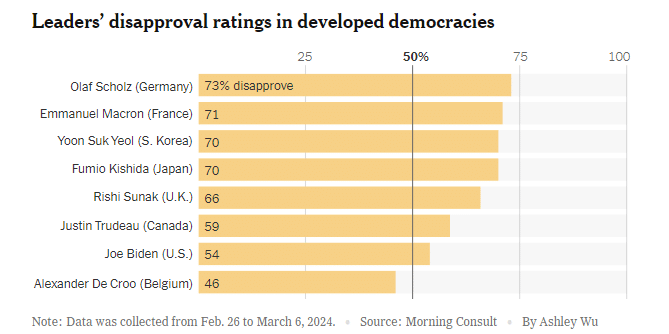
… Many world leaders are also up for re-election. More than 60 countries — half of the world’s population — will vote or have voted this year. Most of the countries in the chart above will vote in national or European Union elections in the coming months.
Why are people so upset with their leaders? Some explanations are local, but four global issues have driven much of the public’s anger. Call them the four I’s: inflation, immigration, inequality and incumbency.
The vast majority of residents of France (82%), Hungary (79%), Great Britain (79%), Japan (73%), the Netherlands (73%), Germany (72%), Sweden (71%), Canada (70%) , Belgium (69%) and Italy (68%) believe their countries are on the wrong course. Data – Ipsos Global Advisor.
And the… pic.twitter.com/uLzMfMJX4P
— S p r i n t e r F a c t o r y (@Sprinterfactory) March 28, 2024

Canadians want the government to cut immigration to ease the housing crisis across the country, according to new focus group data.
“Asked whether they thought Canada was currently experiencing a housing crisis, all believed this to be the case,” said a Privy Council report, called Continuous Qualitative Data Collection of Canadians’ Views. The report was released on March 26, with data collected in October 2023, as first reported by Blacklock’s Reporter.

OTTAWA – The Trudeau government began a series of pre-budget announcements Wednesday targeting Millennials and Gen Z voters in a bid to attract two generations that have largely abandoned the Liberal party.
Trudeau made an announcement in Vancouver, while other ministers made similar announcements in Toronto and Montreal about new programs that will be included in next month’s budget. Wednesday’s announcement included $15 million to go to Legal Aid organizations across the country to help those organizations provide more services to renters dealing with “renovictions” or other issues with their landlord.

When Sarah Morin hears the phrase “axe the tax,” what enters her mind is “freedom.”
The 41-year-old is a stay-at-home mother of two who has been using a food bank amid cost-of-living pressures.
She was among those who packed into a crammed room at a convention centre near Ottawa’s airport on Sunday to listen to Conservative Leader Pierre Poilievre speak.

OTTAWA — The federal Conservatives say they won’t be taking advice from “so-called experts” when it comes to carbon pricing, after more than 200 economists signed an open letter challenging Pierre Poilievre’s stance.
Instead, the party is pledging to listen to the “common sense of the common people.”
The comments come after economists associated with universities across Canada took aim at common claims in the heated debate over the policy.
Economists are pushing back on assertions the carbon price has driven up the cost of living, and calling out opponents for failing to pitch a less costly alternative to reduce emissions.

Interference inquiry must walk very fine line on secrecy, transparency: commissioner
OTTAWA – The head of an inquiry into foreign interference emphasized Wednesday that the need for secrecy about the sensitive subject has not hindered her work to date.
Commissioner Marie-Josée Hogue cautioned, however, that the inquiry must walk a very fine line in balancing confidentiality and the desire for transparency.
Hogue’s remarks came as the commission began two weeks of hearings into foreign meddling allegations and how the federal government responded to them.

Canadian businesses say housing crisis is forcing them to boost pay: survey
Business leaders see the housing crisis as the biggest risk to the economy, a new survey from KPMG Canada shows.
It found 94 per cent of respondents agreed that high housing costs and a lack of supply are the top risk, and that housing should be a main focus in the upcoming federal budget. The survey questioned 534 businesses.
Housing issues are forcing businesses to boost pay to better attract talent and budget for higher labour costs, agreed 87 per cent of respondents.
Feck em
Canada’s population hits 41M months after breaking 40M threshold
Nine months after reaching a population of 40 million, Canada has cracked a new threshold.
As of Wednesday morning, it’s estimated 41 million people now call the country home, according to Statistics Canada’s live population tracker.
The speed at which Canada’s population is growing was also reflected in new data released Wednesday by the federal agency: between Jan. 1 2023 and Jan. 1 2024, Canada added 1,271,872 inhabitants, a 3.2 per cent growth rate — the highest since 1957.


Newly released figures from Immigration, Refugees and Citizenship Canada show the federal government spent more than $100 million housing asylum seekers at hotels in Niagara Falls over the last year.
Nearly 5,000 asylum seekers were sent to hotels in the tourist city between Feb. 1, 2023, and Feb. 1, 2024, according to the immigration department. Most were from Nigeria, Venezuela, Kenya, Turkey, and Colombia.
