While the West ponders whether Vladimir Putin will invade eastern Ukraine, Xi Jinping watches. For China, Ukraine is a convenient proxy for Taiwan. How NATO responds to Russian aggression will serve as a barometer for the Chinese Communist Party (CCP) to calculate how the United States and its network of Asia-Pacific allies might react to unprovoked Chinese aggression against Taiwan. At the operational and tactical levels, the People’s Liberation Army (PLA) could gain invaluable insight from how the Russian Armed Forces move against Ukrainian territory. As the Biden administration and NATO engage in security talks over Ukraine with their Russian counterparts, the West should consider the message it intends to send to the Kremlin and Zhongnanhai.
Apparently Canada has a solution to the Ukraine crisis after all. Unfortunately it involves being somewhere else when the trigger, to torture a phrase from Orwell, isn’t pulled. Which won’t save our ally or our credibility.
Back in 1994, as it fled the squalid wreckage of the Soviet Union, various nations promised that if Ukraine gave up the nuclear weapons it inherited, they would ensure that it was never devoured by Russian revanchists. With Russia looking mostly harmless, it seemed like resolve on the cheap. But then along came Vladimir Putin with his characteristically parochial belief that the collapse of the USSR was “the greatest geopolitical disaster in history.” So now what?
Wendy Sherman, one of the world’s most powerful diplomats, is known as the Silver Fox because of her snowy white mane and her canny deal-making style. On Wednesday, she is helping to lead the US-Russia talks in Europe.
Ms Sherman – the US Deputy Secretary of State, one of the department’s top positions – has been meeting Russian officials this week to discuss Ukraine. The stakes are high.
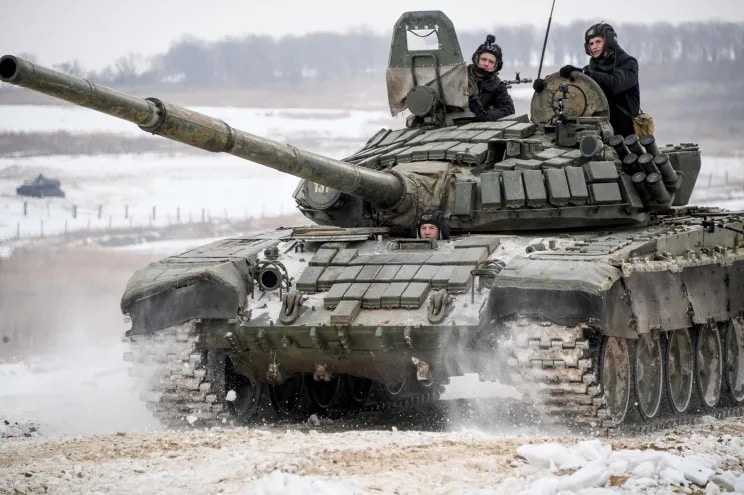
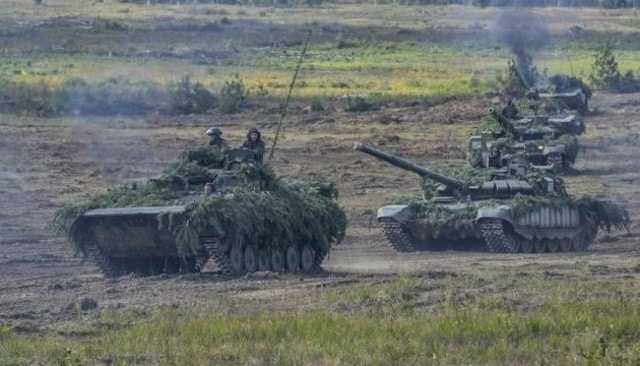
President Vladimir Putin has deployed around 100,000 Russian troops close to the border with Ukraine, prompting fears of an incursion and warnings from the West.
US officials are hoping to defuse the tense situation through negotiations with the Russians – and Ms Sherman is in her element.
If I were Ukraine I’d get a headstart on designing the new national letterhead etc.
No one is going to war over this “quarrel in a far away country, between people of whom we know nothing”
Canada has told the U.S. that it’s willing to help with possible deterrence measures against Russia — which could include sanctions — to de-escalate the crisis in Ukraine, CBC News has learned.
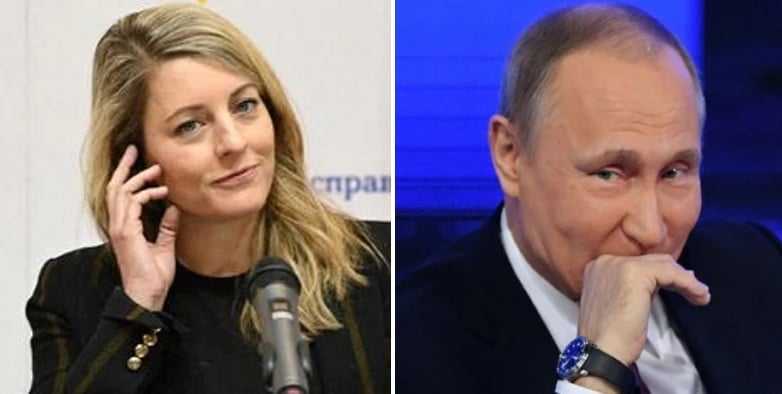
Canada made the offer during a meeting between Foreign Affairs Minister Mélanie Joly and U.S. Secretary of State Antony Blinken on Dec. 31, according to a source with knowledge of the matter.
The source said the message was received well by Blinken.
Russia has threatened war if the United States and its NATO allies fail to comply — unconditionally — with sweeping demands for a new security arrangement in Europe.
The demands, issued by the Russian Foreign Ministry, require the United States to remove its nuclear umbrella from Europe and allow Russia to reestablish its Soviet-era sphere of influence over Eastern Europe.
The Russian demands, which effectively require NATO to commit suicide, are so obviously outrageous and unmeetable that Western analysts are split over interpreting Russian President Vladimir Putin’s motives. Some say he is using the impossible list of demands as a pretext to invade Ukraine. Others think he is playing a weak hand to try to divide the West and reorder Europe’s security architecture in Russia’s favor.
The White House is writing off an ally to appease an enemy.
The situation in Ukraine has become very grave.
On December 17, Russian dictator Vladimir Putin sent U.S. president Joe Biden an ultimatum, effectively demanding that NATO abandon Eastern Europe or face military action. Biden agreed to a phone conversation with Putin to talk it over, giving the Kremlin what it sought: The affected countries were now on the table instead of at the table. When the two then talked on December 30, according to the White House, Biden rejected the ultimatum and informed Putin that if he proceeded to invade Ukraine, he would face strong economic sanctions from the U.S. and its European partners. Putin then countered by saying that such sanctions would result in a “complete rupture in relations” between Russia and the U.S.
This is not a surprise. Ukraine or Taiwan, who will be first?
(Bloomberg) — In the days before Christmas, U.S. officials in Boston unveiled insider trading charges against a Russian tech tycoon they had been pursuing for months. They accused Vladislav Klyushin, who’d been extradited from Switzerland on Dec. 18, of illegally making tens of millions of dollars trading on hacked corporate-earnings information.
Yet as authorities laid out their securities fraud case, a striking portrait of the detainee emerged: Klyushin was not only an accused insider trader, but a Kremlin insider. He ran an information technology company that works with the Russian government’s top echelons. Just 18 months earlier, Klyushin received a medal of honor from Russian President Vladimir Putin. The U.S. had, in its custody, the highest-level Kremlin insider handed to U.S. law enforcement in recent memory.
Secretary of State Antony Blinken on Friday debriefed Canadian Foreign Minister Melanie Joly on a tough talk between Presidents Joe Biden and Vladimir Putin over the Russian troop buildup on the Ukraine border.
Blinken’s office said in a statement that he and Joly discussed “shared priorities, including a strong, united response to further Russian aggression against Ukraine.”
As was reported yesterday, President Joe Biden took a call from Russian President Vladimir Putin where the two leaders discussed the situation on Russia’s border with Ukraine, among other matters. Despite the best efforts of the State Department to put some positive spin on the discussion, it doesn’t sound as if things went very well. Both sides wound up sticking to their previous positions and Putin sounded increasingly frustrated and belligerent over what he perceives as NATO’s stubborn refusal to comply with his demands.
The Ukraine crisis should be a wake-up call for European nations to boost defense spending and finally take seriously France’s calls for European strategic autonomy. And yes, Americans should cheer them on.
Presently, Europe is heavily dependent on decisions made in Washington regarding whether or how to counter the Russian threat, largely because they lack the collective military heft to deal with Russia on their own. Washington, however, has good reason to dither; few have any appetite for a war with Russia, or for “dying for Kyiv.”
Russia’s Supreme Court has ordered the closure of International Memorial, Russia’s oldest human rights group.
Memorial worked to recover the memory of the millions of innocent people executed, imprisoned or persecuted in the Soviet era.
Formally it has been “liquidated” for failing to mark a number of social media posts with its official status as a “foreign agent”.
That designation was given in 2016 for receiving funding from abroad.
But in court, the prosecutor labelled Memorial a “public threat”, accusing the group of being in the pay of the West to focus attention on Soviet crimes instead of highlighting a “glorious past”.
He’s prepared to make war at a time of his choosing.
Russian President Vladimir Putin scored major propaganda points in his over four-hour annual press conference this week. He turned attention away from Russia’s invasion of Crimea, support of Russian separatists in the Donbas region (Donbas), and troop buildup on Ukraine’s borders. Instead, Putin guides the untrained eye through the conflict in terms of Russian grievances. In Putin-speak, the Ukrainian conflict is a product of Ukrainian persecution of Russians and separatists, and NATO’s expansion eastward. Putin also used the news conference to showcase the growing Russia-China strategic partnership.
Dec 24 (Reuters) – New satellite images captured by a private U.S. company show that Russia has continued to build up its forces in annexed Crimea and near Ukraine in recent weeks while pressing the United States for talks over security guarantees it is seeking.
Reuters could not independently verify the latest images from U.S.-based Maxar Technologies. The Kremlin reiterated on Friday that it reserves the right to move its own forces on Russian territory as it sees fit and that Western countries were carrying out provocative military manoeuvres near its borders.
Canada’s long-standing, stalwart support of Ukraine will be under new and intense pressure early in the new year, say experts and a former top military commander, as the West braces for possible military action by Russia, perhaps as soon as late January.
There could be as many as five possible scenarios on how the current crisis in Eastern Europe might play out, and they’re almost all bad.
The assembly of over 100,000 Russian troops on Ukraine’s eastern border and the possibility of a full-blown invasion has riveted the attention of western leaders and policy-makers.
Will Russia invade? That’s doubtful, in fact I suspect they’ll get what they want through threats alone.
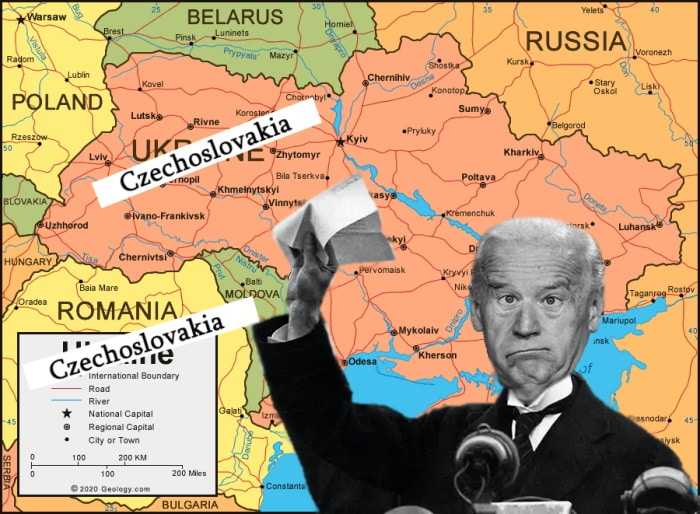
Whether they do or don’t remember Czechoslovakia.
NATO will do nothing except hasten its own end as it is exposed as a sham alliance.
Canada will do nothing beyond sanctions, if that.
Biden will get his 10% so America will do nothing. The American, Ukrainian, Russian and Euro Oligarchs recognize war is sometimes bad for business.
Chrystia Freeland will be sad so she’ll dream up some horrid domestic policy to punish Canadians.
Meanwhile Canada’s armed forces will be tasked with developing a Quick Deployment Pride Parade Brigade.
This is likely a more realistic take on things by a Polish MEP, and few know Western and Russian treachery better than Poland.
‘The current situation reeks of a new Yalta’ – Polish MEP warns over potential deal between US and Russia
… “Poland is in a difficult geopolitical situation. The U.S. wants to draw Russia to its side against China. If this works out, Russia will demand some kind of payment. What will it be? We need to remind ourselves of history. Poland must arm up and build a coalition of states which will not accept another Yalta,” he said.
The Yalta conference saw much of Europe carved up between the great powers in preparation for the end of the Second World War. The allies recognized that the USSR had a sphere of influence over much of Eastern Europe, and essentially green lit the Soviets taking control of Poland.
Washington is pretending that Russian president Vladimir Putin is bluffing about invading Ukraine. He isn’t, and he may strike before the new year.
There are at least four reasons why. Putin, as I wrote in November for Foreign Affairs, is thinking about his legacy. Great Russian leaders grab land. Second, he doesn’t see anyone stopping him. Third, he’s convinced that Ukraine isn’t a real country. Fourth, Putin hasn’t been able to get a deal out of Ukrainian President Volodymyr Zelenskyy, and Putin sees approval for NATO membership in Ukraine only growing.
Team Biden has tried to cool down the situation, but it hasn’t worked. The number of Russian forces on the border continues to increase.