Trump ratchets up attacks on NATO, says U.S. no longer needs alliance

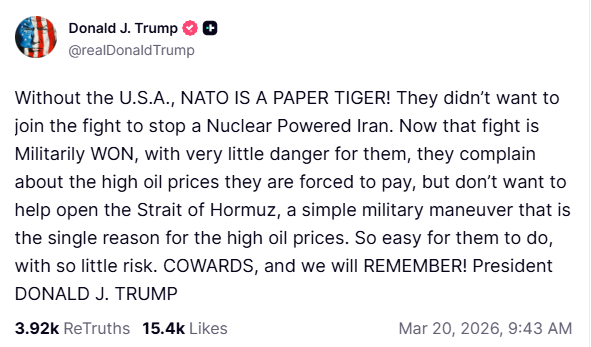
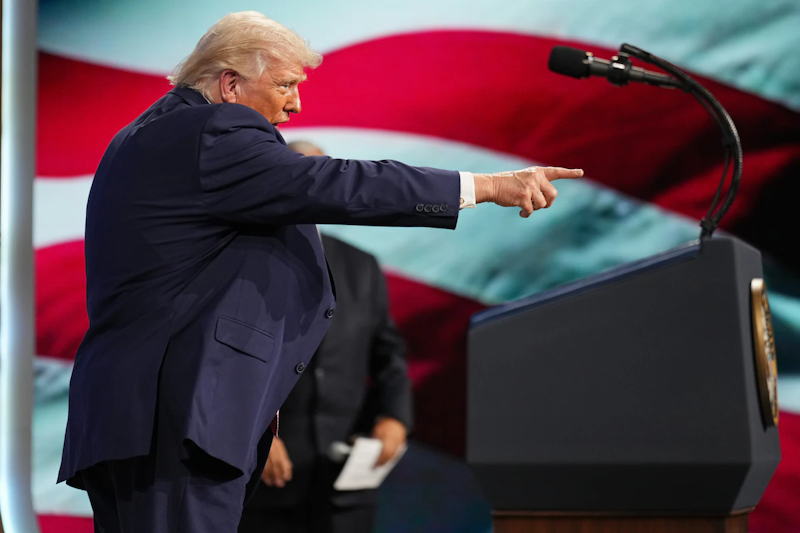
MIAMI BEACH — The United States may stop promising to defend its NATO allies should they come under attack, President Donald Trump said Friday, escalating his verbal barrage against the alliance as his frustration grows that European leaders have not significantly contributed to his war against Iran.

“NATO just wasn’t there” when he asked for help with the Iran war, Trump told a Miami Beach investment conference sponsored by the Saudi sovereign wealth fund. That, he said, was “a tremendous mistake” by the Europeans.

“We spend hundreds of billions of dollars a year on NATO, hundreds, protecting them, and we would have always been there for them, but now, based on their actions, I guess we don’t have to be,” he continued.

Share

Trump scorches NATO for failing Iran loyalty test, debates bailing on alliance

President Trump blasted NATO on Thursday for its unwillingness to help with the Iran war and implied the US may no longer “be there” for its allies.

Before the Feb. 28 US-Israeli military attacks, Trump said, “we’re always gonna be there” for NATO allies.

“At least we were. I don’t know anymore, to be honest with you,” Trump said Thursday at a cabinet meeting.

Share

Perennial laggard Canada now the equal of Albania after clearing NATO’s 2% bar

Canada crossed the politically significant threshold of meeting NATO’s defence spending benchmark of two per cent of gross domestic product, according to the Western alliance’s annual secretary general’s report and compilation of statistics released on Thursday.

It is the first time since the late 1980s — toward the end of the Cold War — that the country has met the target, which has in recent years taken on enormous political and symbolic significance.

Share

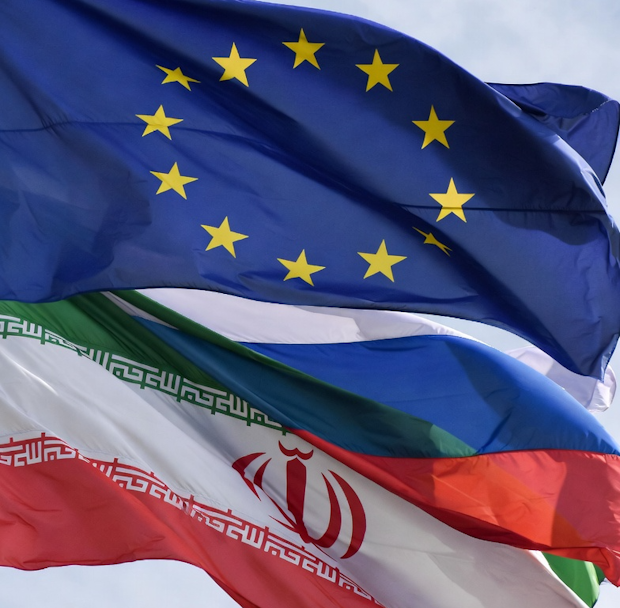
Special Report Putin, Iran, and Europe in a Post-NATO World

Russia and the Globalist left are working to diminish Trump’s hand in his latest high-stakes gamble with Iran. Moscow is helping Iran conduct surgical strikes in the Middle East while leftist governments in Europe slow-walk support for the U.S. and try to block American access to NATO bases.

Since launching Operation Epic Fury 10 days ago, the U.S. and Israel have destroyed Iran’s navy and air force, much of its missile capacity, layers of its genocidal leadership, and blown up Islamic Revolutionary Guard Corps facilities across the country. Trump is now threatening to target their energy infrastructure. But Vladimir Putin is enabling savage Iranian retaliatory strikes on the vulnerable Gulf Arab states hosting U.S. bases in hopes of leveraging them to support a Moscow-brokered peace deal that would frustrate U.S. objectives.

Share

Rubio’s charm conceals a brutal truth – Europe is on its own

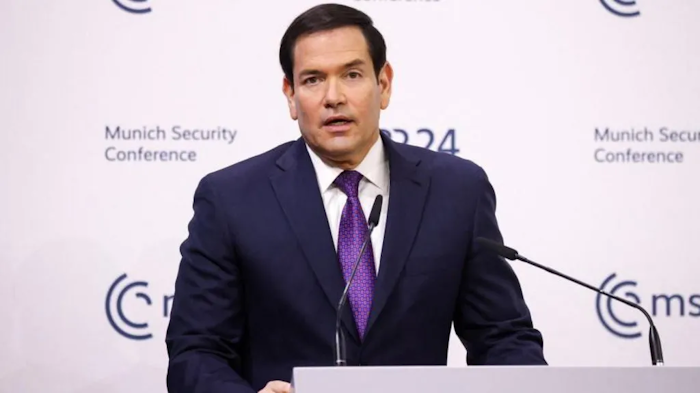
What a difference a year makes. At this weekend’s Munich Security Conference, Secretary of State Marco Rubio was given a standing ovation for a speech that echoed what Vice President JD Vance had said so scandalously 12 months earlier. Rubio accused Europeans of trying “to appease a climate cult” that has impoverished the continent by forcing it to adopt catastrophic energy policies. Like Vance, he also criticised Europe’s immigration policies and its dogmatic commitment to global free trade, which he said has fuelled deindustrialisation and hollowed out supply chains. He even lamented the transfer of sovereignty to international organisations — a swipe not just at the UN and international legal bodies, but at the EU itself.

Europeans hated Vance’s speech. Yet they loved Rubio’s. The difference was tone. Unlike Vance, Rubio sugar-coated the message. “For us Americans,” he said, “home may be in the Western Hemisphere, but we will always be a child of Europe.” Europeans just love it when Americans show respect for their cultural heritage. It flatters their sense of pride — and superiority.

Share

Just how bad are Nato’s armies?

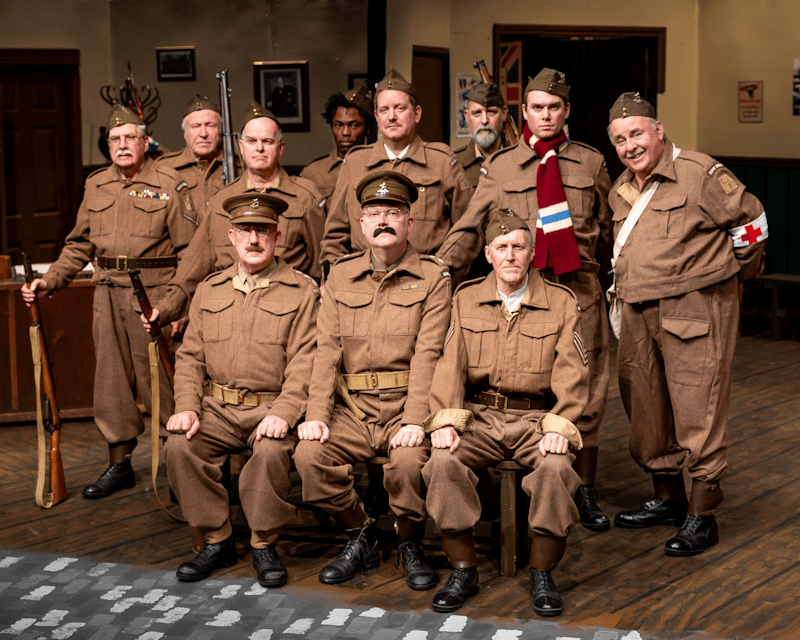
Dad’s Army – and Canada’s

Given the relative sizes of their economies, one might conclude that Russia would quake before the military might of Europe’s Nato members. Russia, the ninth-largest economy in the world, is up against the third, sixth, seventh and eighth in the shape of Germany, Britain, France and Italy.

Yet the reality is that, militarily, it is the other way around. Russia has the world’s second-strongest military, while France comes sixth, UK eighth, Italy tenth and Germany 12th. To put a few figures on it, Russia has 1.32 million active service personnel, 560 fighter aircraft and 3,941 tanks ready for deployment. For Britain, the corresponding figures are 141,000, 67 and 187; for France 264,000, 178 and 342; and Italy 165,000, 62 and 142.

As for Canada, it ranks a lowly 28th, despite being a G7 nation with the world’s tenth-largest economy. It has 63,000 troops, 50 fighter aircraft and 56 tanks – all to defend a landmass that is larger than that of the US. Looked at from a military perspective, it is not hard to see why Donald Trump is considering incorporating Canada into the US. After all, Canada’s vast Arctic frontier is virtually a demilitarised zone.

Share

Can the U.S. finally just shut up about Canada’s defence spending?

Our trailblazing Prime Minister was at the podium in Montreal. “Over the last few decades,” Mark Carney said, “Canada has neither spent enough on our defence nor invested enough in our defence industries.”

That has to change, he added, setting out plans for far more domestic spending on military hardware because “the assumptions that defined decades of Canadian defence and foreign policy have been turned upside-down.”

Share

Munich and the Fate of the West

Marco Rubio’s warning against civilizational suicide.

If you live long enough, you can trace the river of history apart from the smaller tributaries and streams. You’ve watched it rise or fall according to the acts of men. You’ve seen great leaders bend it where it wasn’t going, and bad leaders redirect it into the shoals. And you can tell what will lead to greatness and what will end in disaster. Which is how I know Secretary of State Marco Rubio’s speech last Saturday at the Munich Security Conference was not only the finest of this century, but the most potentially consequential.

Share

Rubio to Munich: Mass Migration Threatens Survival of European People

The “delusion” of globalism and the decision to allow mass migration into the West threaten the future of Europe and its peoples, U.S. Secretary of State Marco Rubio told attendees at the Munich Security Conference in Germany on Saturday.

Share

America warned Europe it needed to defend itself. Only half of the Continent listened

Donald Trump had only just regained the White House when his acolytes dealt Europe two verbal sucker punches in the solar plexus.

Pete Hegseth, the US defence secretary, declared that “stark strategic realities” meant that America would no longer be “primarily focused on the security of Europe”. Then JD Vance, the vice-president, marked St Valentine’s Day 2025 by telling the Munich Security Conference that Europe’s greatest peril came not from Russia, but “from within”, and that there was “nothing more urgent” than curbing mass immigration.

In the 12 months since those speeches, European governments have been forced to confront the stark reality that they must shoulder prime responsibility for defending the Continent, with all the extra costs and risks that implies, because America can no longer be relied upon to give reflexive support to Nato.

Share

Rubio warns Europe of new era in geopolitics before big Munich speech

US Secretary of State Marco Rubio has spoken of a defining moment and a “new era” as he travels to Europe for a major speech to the Munich Security Conference.

Rubio will lead the US delegation at the first major global event since President Donald Trump threatened Danish sovereignty with a pledge to annex Greenland.

French President Emmanuel Macron has insisted Europe must prepare for independence from the US, while Nato Secretary General Mark Rutte has stressed that transatlantic bonds are as close and important as ever.


Related…

Share

Pentagon hawk calls on Nato to push for ‘partnership, not dependency’

President Trump’s main military strategist has called for a Nato “based on partnership rather than dependency”, in which European countries, Britain and Canada will be expected to accelerate their commitments to increase defence budgets.

Before a meeting of alliance defence ministers in Brussels on Thursday, Elbridge Colby, 46, argued for a reformed “Nato 3.0” that was closer to its original Cold-War era iteration, rather than a group mainly underwritten by US military power.

“In 2025, we saw a genuine commitment to have Europe lead the conventional defence of Nato,” he said. “Now it’s time to march out together, to be pragmatic, we have a really strong basis for working together in partnership, for a Nato based on partnership rather than dependency. Really, a return to what Nato originally was intended for.”

Share

The rules-based international order is officially dead. Has NATO suffered the same fate?

Much of the world is still trying to figure out what the consequences will be from Mark Carney’s speech in Davos, Switzerland. The prime minister won plaudits for daring to call out the behaviour of the world’s superpowers, particularly, President Donald Trump and the United States, although in neither case, by name. Janice Stein, the founding director of the Munk School of Global Affairs and Public Policy, looked back at several previous speeches by Canadian prime ministers on an international stage and concludes that Carney’s was the most impactful ever.


The Poohbahs of the EU are pressing for their own “armed forces” so it may be NATO has run it’s course. 

Share

NATO sets Arctic mission plans in motion

NATO on Tuesday said “planning is underway” for an Arctic mission, coming weeks after US President Donald Trump frayed the strategic alliance by claiming the US needs to control Greenland to avert unverified security concerns from Russia and China.

Martin O’Donnell, a spokesman for NATO’s Supreme Headquarters Allied Powers Europe, told reporters that a “NATO enhanced vigilance activity” will “further strengthen NATO’s posture in the Arctic and High North.” He did not provide further details as planning has just begun.

Share