One person reportedly killed, 30 injured as “German Armenian” drives car into crowd in Berlin … motive unknown

Moment German-Armenian man, 29, is arrested by police after repeatedly mounting pavement and ploughing his car into shoppers in Berlin

This is the moment Berlin police arrested a 29-year-old German-Armenian man after he ploughed his car into crowds of shoppers early today, leaving at least one dead and 30 injured.

Footage shows police leading the handcuffed man – dressed in a yellow hoodie, dark tracksuit trousers and red trainers – to a black BMW and shutting him inside. Just a short distance away, the man’s own car sits buried in the front window of a perfume shop, as badly wounded people he just ran over lie on the pavement.

The suspect, who lives in Berlin, is known to police for ‘property crime’, Bild reported.

Fire service spokesperson says about 30 people have been injured in incident near scene of 2016 Muslim terror attack

A car has been driven into a crowd of people in western Berlin, killing one person, the newspaper Das Bild has reported.

A spokesperson for the German capital’s fire service told Reuters about 30 people had been injured.


Germany: Car drives into crowd in Berlin, 1 dead

He said the suspected driver of the vehicle was detained. It was unclear whether the incident was the result of an accident or whether the driver had intentionally driven into the crowd, Dams said.

The incident took place close to the scene of a fatal attack on December 19, 2016, when Islamist extremist Anis Amri, hijacked a truck, killed the driver and then plowed it into a crowded Christmas market in Breitscheidplatz. The attack killed 11 other people and injured dozens of others.

Share

‘We were all wrong’: how Germany got hooked on Russian energy

Germany has been forced to admit it was a terrible mistake to become so dependent on Russian oil and gas. So why did it happen?

On Sunday 1 February 1970, senior politicians and gas executives from Russia and Germany gathered at the upmarket Hotel Kaiserhof in Essen. They were there to celebrate the signing of a contract for the first major Russia-Germany gas pipeline, which was to run from Siberia to the West German border at Marktredwitz in Bavaria. The contract was the result of nine months of intense bargaining over the price of the gas, the cost of 1.2m tonnes of German pipes to be sold to Russia, and the credit terms offered to Moscow by a consortium of 17 German banks. Aware of the risk of Russia defaulting, the German banks’ chief financial negotiator, Friedrich Wilhelm Christians, took the precaution of asking for a loan from the federal government, explaining: “I don’t do any somersaults without a net, especially not on a trapeze.”

Share

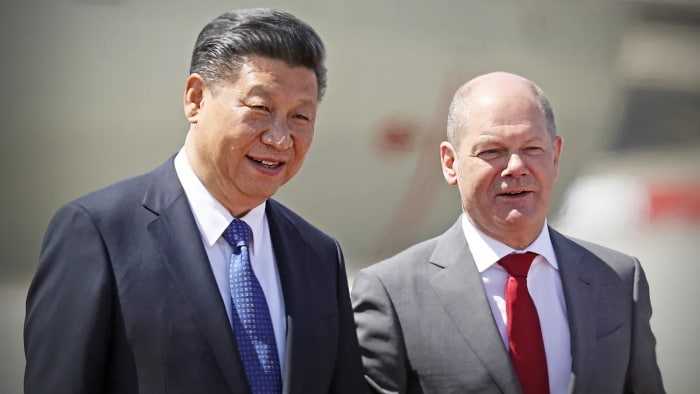
Germany’s dangerous dependency on China

It is now extremely difficult for Olaf Scholz to pursue an independent foreign policy

The war in Ukraine has asked a fundamental question of Germany: how far does an aggressor need to go before Berlin rethinks its economic ties to the regime? The answer may be uncomfortable in relation to Russia. But Germany’s reliance on China is even more worrying.

Amidst inflation, war and domestic politics, the Xinjiang Police Files are only the latest cache of evidence about human rights violations in China. Yet, according to one recent survey, 94% of German companies want to maintain their presence in China; 71% want to even increase investment. Volkswagen Group China alone employs 90,000 people including in a factory in Ürümqi, the capital of Xinjiang province.

Our “Elites” are moral monsters. 

Share

Criticize multiculturalism and become a pariah

Famous author Uwe Telkamp is cancelled for saying that most Muslim migrants are not fleeing persecution but looking for social welfare.

“I have to justify even being German, to dare to refer to Goethe. Suddenly, you are like a pariah.” This is how Uwe Tellkamp speaks at the Süddeutsche Zeitung. His is the cultural case of recent years.

Not only because in 2008 Tellkamp published the great novel “The Tower”, which sold over a million copies and describes the last years of the German Democratic Republic through the educated middle class of Dresden. It has won numerous literary awards and has been celebrated by all feuilletons and literary critics.

Share

Germany has not sent promised large arms to Ukraine, leaked documents show

German broadsheet Welt says it has seen official papers that show Germany has not supplied any significant weapons to Ukraine for weeks

Germany has failed to provide any heavy weapons to Ukrainian forces in recent weeks and appears to be scaling back its military support in a break from Western policy, leaked documents have revealed.

German broadsheet Welt said it had seen official papers that showed Germany had not supplied any significant weapons to Ukraine since the end of March, despite vowing to grant its forces the weapons they need to repulse the Russian army.

In the nine weeks since the end of March Germany has made just two deliveries to Ukraine consisting of small arms.

In contrast with Western allies who are sending huge quantities of anti-tank and air defence weaponry such as NLAW launchers, as well as artillery, Germany has provided around 4,600 anti-tank mines.

Share

Afghan Accused of Sexually Abusing Two Ukrainian Refugee Children

An Afghan migrant who worked as security at German asylum accommodation has been accused of sexually abusing two Ukrainian refugee children aged six and seven.

The alleged abuse is said to have taken place at asylum accommodation in the town of Meßstetten in Baden-Württemberg, where the 24-year-old Afghan was contracted to work security.

Share

Germany: Knife attack on train leaves 5 wounded – Muslim suspect a known wolf prone to ‘religious radicalization’

Several people are being treated in hospital after being injured during an attack on a train in the western German state of North Rhine-Westphalia (NRW), officials said on Friday.

Herbert Reul, the NRW state interior minister, said six people were wounded, including the suspected attacker. Reul said the suspect struck passengers “indiscriminately and arbitrarily.”

Reul also said that “based on everything that we know so far,” investigators believed the perpetrator’s intent was to harm as many people as possible.

Share

Jeremy Warner: Thatcher’s prophetic view of German reunification

Rewind 32 years to one of those moments of great euphoria in European affairs — the reunification of West and East Germany. The celebrations were by no means confined to Germany. There was rejoicing too in the United States and much of the rest of the West, for Germany’s rebirth as a single country seemed powerfully symbolic of the end of the Cold War and the defeat of communism.

Both these two latter outcomes had long been the primary foreign policy goal of Britain’s then prime minister, Margaret Thatcher. But German reunification? This was regarded in No. 10 with great suspicion and foreboding.

Thatcher’s doubts have in many ways proved prophetic, no more so than in Germany’s deeply ambivalent attitude to today’s war in Ukraine, where Berlin seems, Janus-like, to face both ways.

Share

France and Germany evaded arms embargo to sell weapons to Russia

Paris and Berlin sent Moscow £230m of military hardware, including bombs, rockets and missiles, that is likely being used in Ukraine

France and Germany armed Russia with €273 million (£230 million) of military hardware now likely being used in Ukraine, an EU analysis shared with The Telegraph has revealed.

They sent equipment, which included bombs, rockets, missiles and guns, to Moscow despite an EU-wide embargo on arms shipments to Russia, introduced in the wake of its 2014 annexation of Crimea.

The European Commission was this month forced to close a loophole in its blockade after it was found that at least 10 member states exported almost €350 million (£294 million) in hardware to Vladimir Putin’s regime. Some 78 per cent of that total was supplied by German and French firms.

Share

Germany has officially surrendered – to Islam

Germany is no longer a nation, it is a condominium and the rest of Europe is following its lead. We haven’t seen anything yet.

Shortly after playing time for the German football championship match between Augsburg and Mainz, the referee, Matthias Jollenbeck, stopped the match to allow Muslim footballer Moussa Niakhaté to break his fast for Ramadan and quench his thirst at sunset. For the first time, a Bundesliga match was stopped for this reason. But the initiative was welcomed by the German Football Association and will not be the last.

Europe is changing so rapidly that we haven’t even noticed it. From concession to concession, we have capitulated on everything.

Let’s stay with Germany, which for me is no longer even a nation, but a condominium.

Share

Germany is letting Europe down

Berlin is already moving to dilute EU sanctions

It’s beginning to dawn on the mainstream media that Angela Merkel didn’t just leave a “mixed” legacy behind her, but a disastrous one.

There’s an excellent feature in The Times yesterday, in which Oliver Moody provides a blow-by-blow account of how the Germans surrendered Europe’s security to the Kremlin. Moody reports that ‘President Zelensky of Ukraine [has] invited Merkel to visit the scenes of Russian atrocities in Bucha and witness for herself what ‘the policy of concessions to Russia has led to in the past 14 years’.’

Share

Move out of the way, Europe, Islam is taking over

Germany as a prototype:Christian symbols disappear as Europeans discard them, but there is no vacuum. Islam takes their place.

Cologne Cathedral, known as the “German Rome”, is the landmark of the city and has been declared a World Heritage Site since 1996. It is one of the most visited places in Germany and one of the most important in Christianity (it was visited by Popes John Paul II and Benedict XVI). The first stone of the cathedral was laid in 1248. On old black and white photos you can see how the towers of the cathedral protrude from the rubble of the historic center completely destroyed during the Second World War.

Now the city of Cologne is deleting the iconic cathedral from its new logo. “My 92-year-old mother is stunned, my 11-year-old son is crying and my friend in London doesn’t understand it,” writes sculptor and painter Cornel Wachter.

Share

Verboten: In Germany it is increasingly dangerous to criticize Islam

There are no taboos in modern Germany, except for critcizing Islam – which gets you fired, cancelled or worse.

What has emerged in recent days from the Goethe University of Frankfurt shows us that Europe is no longer a real democracy, but an ideological oligarchy. The newspaper Frankfurter Allgemeine Zeitung tells us that Professor Susanne Schröter, director of the Frankfurt Research Center and professor at the Institute of Ethnology, reported that a young researcher’s political stance on Islam now plays an important role in his future career. If he speaks well of Islam, he will make a career, otherwise he will not.

Schröter denounced the “cancel culture” which seeks to ban politically or morally unpleasant positions from universities. She referred to graduate students whose dissertations were not accepted because they dealt with “wrong” topics. For example, “honor killings” in Islam. “If an anthropologist deals with Islam, his career is over,” said Schröter.

Share

German prosecutors: Syrian asylum seeker who knifed 4 on train had Islamic motive

BERLIN (AP) — German prosecutors said Monday they now believe that the suspect in a knife attack on a train in November that left four people wounded had an Islamic extremist motive.

The attack took place on an ICE high-speed train traveling from Passau, on the Austrian border, to Hamburg on Nov. 6. Authorities said that the man attacked his victims apparently at random and showed signs of mental illness, but initially said there was no immediate indication of a terror motive.

Munich prosecutors said a few weeks later that they were no longer ruling out an Islamic extremist motive.

Share