The Great Reset Didn’t Work: The Case of EVs

We are living through one of history’s longest and most excruciating versions of “We told you so.” When in March 2020, the world’s government decided to “shut down” the world’s economies and throttle any and all social activity, and deny kids schooling plus cancel worship services and holidays, there was no end to the warnings of the terrible collateral damage, even if most of them were censored.

Every bit of the warnings proved true. You see it in every story in the news. It’s behind every headline. It’s in countless family tragedies. It’s in the loss of trust. It’s in the upheaval in industry and demographics. The fingerprints of lockdowns are deeply embedded in every aspect of our lives, in ways obvious and not so much.

h/t YH

Share

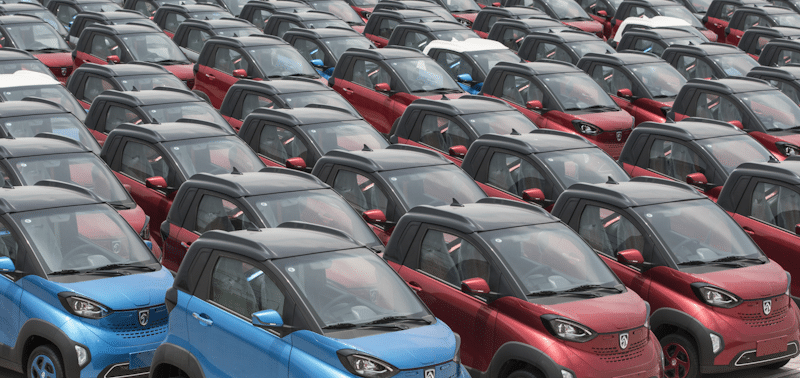
How China plans to invade Europe — with electric vehicles

China crappy electric cars, EV

As it makes its maiden voyage up the English Channel next week, not much will visibly distinguish the BYD Explorer No 1 from any of the other giant cargo ships ploughing through the world’s busiest shipping lane.

In fact, it heralds a revolution. When it deposits its contents in the Dutch port of Vlissingen on Wednesday, the Explorer will start either the next wave of Chinese worldwide manufacturing dominance or a trade war, depending on the tolerance of voters and politicians in Brussels and London.

Share

EV owners likely to pay more for insurance, report says. Here’s why

Electric vehicle (EV) owners in Canada may start to see their insurance rates jolt in the coming years, a new report indicates.

The study by credit rating agency Morningstar DBRS suggests insurers in the U.K., Europe and parts of the U.S., where EV uptake is higher than in Canada, are starting to experience the impacts the EV transition is having on claims costs.

Share

In giving billions to electric car makers, Canada is blinded by economic delusion

Canada’s electric vehicle manufacturing subsidies are not “investment” – they are economic illusions. There has been over $40-billion worth of Canadian federal and provincial handout announcements, including up to $15-billion for Stellantis and LG, up to $16.3-billion for Volkswagen, $7.3-billion for Northvolt, and a continuing race to give billions to Honda and others. As Dutch, South Korean, German, Swedish, and Japanese companies build their value chains using Canadian taxpayers’ dollars, what’s in it for Canada?

Share

How China Built BYD, Its Tesla Killer

China’s BYD was a battery manufacturer trying its hand at building cars when it showed off its newest model in 2007. American executives at the Guangzhou auto show gaped at the car’s uneven purple paint job and the poor fit of its doors.

“They were the laughingstock of the industry,” said Michael Dunne, a China auto industry analyst.

Nobody is laughing at BYD now.

The company passed Tesla in worldwide sales of fully electric cars late last year. BYD is building assembly lines in Brazil, Hungary, Thailand and Uzbekistan and preparing to do so in Indonesia and Mexico. It is rapidly expanding exports to Europe. And the company is on the cusp of passing Volkswagen Group, which includes Audi, as the market leader in China.

Share

Higher price tag, repair costs could drive up insurance premiums for EVs, report says

TORONTO – Drivers may see higher premiums for their electric vehicles as the insurance industry adjusts to the shift from gas-powered cars to electric alternatives, a new report suggests.

The price tag of EVs and higher costs for repairs are likely to be key factors that could drive Canadian auto insurance higher in the coming years, similar to a trend seen in the U.K., the report published by Morningstar DBRS on Monday shows.

Share

Why the e-bike boom is raising fire fears

When Ollie, a delivery rider in York, England, got his first e-bike in 2022, it was a bit of a splurge. He bought it at a discounted rate negotiated by his delivery company.

Even with the discount, it set him back £1,000.

“The biggest issue is that e-bikes are expensive, and ones with safe batteries are extremely expensive, so many people opt for cheaper, less reliable and often dangerous batteries,” Ollie says.

Share

Heritage Foundation economist calls attention to a fresh concern with the left’s EV agenda

Diana Furchtgott-Roth, an economist with the conservative think tank Heritage Foundation who studies climate and energy issues, recently appeared on a Fox News broadcast alongside Stuart Varney to discuss the E.V. market, and its negative impact on car manufacturers; “going green, losing green” was the tagline that flashed across the screen before the segment. (Furchtgott-Roth also served in President Trump’s administration, and is a professor at George Washington University.)

Share

Ottawa’s EV timeline is way too optimistic

The federal government recently finalized regulations for its “zero-emissions vehicle” mandate. The mandate requires sellers of light vehicles (passenger cars and light trucks) to sell a rising minimum of zero-emissions vehicles — basically, electric vehicles or EVs — every year, culminating with 100 per cent EVs in 2035, just 11 years from now. Reasonable forecasts of production and sales make clear that Ottawa’s timeline is unrealistic.

There cannot be optimism for an idea doomed to fail from the start.

Share

ANALYSIS: Charging, Resale Among Added Hurdles Slowing EV Adoption

The near-term challenges of mass electric vehicle (EV) adoption inevitably begin with price, but a recent cold snap has re-emphasized battery and charging snags. In addition, as prices for new EVs trend down, new buyers also have to consider potentially lower resale values.

Tom Narayan, lead equity analyst covering global autos at RBC Capital Markets, told BNN Bloomberg on Jan. 31 that the EV market is going through a bit of a slowdown.

Share

Electric cars are not ‘zero emission’, says advertising watchdog

Electric cars cannot be advertised as completely “zero emission” because of the carbon dioxide that is generated when they are made and charged, the advertising watchdog has declared.

In a ruling that will change how electric vehicles (EVs) are promoted, the Advertising Standards Authority has banned carmakers from referring to them as zero emission unless they make clear this is only while driving.

The decision emerged as the regulator criticised BMW for describing its range of EVs as “zero emission cars” in Google searches.

Share

Biden Admin Classifies Martha’s Vineyard And Other Elite Enclaves ‘Low-Income’ To Push EV Charger Subsidies

Some of the wealthiest liberal enclaves in the country are being classified by the Biden administration as “low-income” in order to qualify for an electric vehicle (EV) charger subsidy program contained within the Inflation Reduction Act (IRA), the Daily Caller reports.

Share

Toyota Refused To Hop On The Electric Vehicle Bandwagon, And It Paid Off Big Time

Toyota said Tuesday the company will see an annual profit of $30 billion at the end of the fiscal year in March, and it’s probably down to one big decision.

The Japanese car giant suggested that its decision to avoid going fully electric within its fleet of vehicles, and instead emphasize hybrid machines, is likely why it’ll end the fiscal year on such a high, according to Axios. Shares in Toyota rose nearly 50% in the last 12 months, while electric vehicle manufacturers struggle to deal with the fact that no one wants their stupid cars.

… Ford was forced to cut the price of the electric version of its iconic F-150 pickup truck by around $10,000 because no one wanted to buy them. Models were piling up at dealerships, despite the lower-cost, because common sense consumers know that electric vehicles (a) don’t really help the planet as they are still fueled by electricity from traditional power plants, and (b) are often junked over the most minor of damages.

Share

Rowan Atkinson blamed for poor electric car sales by House of Lords report

Rowan Atkinson has been blamed for poor sales of electric cars in a report by the House of Lords.
Atkinson, known for Mr Bean and the Blackadder series, found himself the centre of a real-life drama on Tuesday.

The Lords’ environment and climate change committee was told that the star, 69, was partly at fault for “damaging” public perceptions of electric vehicles (EVs).

He spoke honestly that the public was being mislead about electric cars.

Share

The electric vehicles farce has reached a shambolic new low

When the electric vans startup Arrival announced that it was seeking to focus its business on the US market, it seemed like a good move. Biden’s Inflation Reduction Act was offering massive subsidies for the green industries of tomorrow; the market would surely surge, and Arrival’s fortunes with it.

They did not. The “British Tesla” as it was once known, which was valued at over £10 billion on the Nasdaq at one point, has seen its UK arm enter administration. It follows that other darling of green industrial policy, Britishvolt, which collapsed last year (it was later bought by Recharge Industries).

Share