
China unlikely to invest in Canadian auto plants, experts say

If the federal government is expecting Chinese electric vehicle manufacturers will rush to build an assembly plant in Canada, economists, industry analysts and insiders say they’re sorely mistaken.

The biggest reasons, say experts? There’s no guarantee Chinese EV makers would be able to sell anything they produced here in the U.S., it would cost billions to build or buy a plant, and they’ve already got more than enough capacity at home.


The goal is for Carney and pals to personally profit from their ‘relationships” with the ChiComs.

They’ll casually lie to further those interests.

Share

Adam Zivo: Carney doesn’t care how dangerous China really is

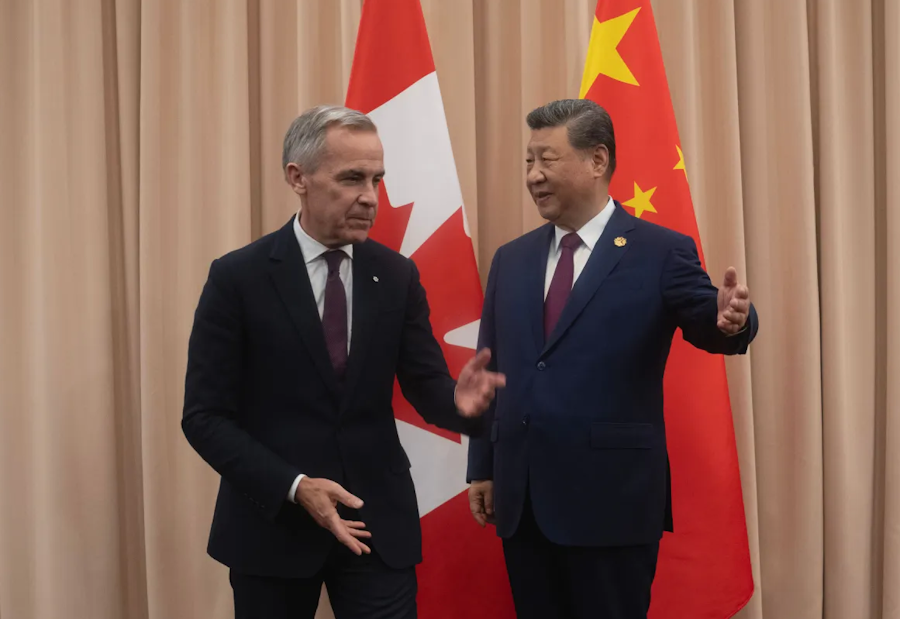
Prime Minister Mark Carney’s new plan to expand Chinese-Canadian ties will jeopardize, not protect, our national sovereignty. However volatile the United States may be these days, pursuing a “comprehensive strategic partnership” with Beijing as a counterbalance is myopic and reckless.

The plan was announced Friday at the end a four-day trip to China — the first prime ministerial visit to the country since 2017 — wherein Carney, joined by a high-ranking delegation, strove to thaw diplomatic relations after a decade of mutual distrust.

Share

Analysis: CSIS Warned Beijing Weaponized Canola and Elections in the 2019 Meng Crisis — Is Carney’s EV Trade-Off a Replay?

OTTAWA — A high-level Canadian Security Intelligence Service assessment in June 2019 concluded that Beijing, jolted by Canada’s detention of Huawei executive Meng Wanzhou, launched a “calibrated and multi-faceted pressure campaign” that blended trade coercion — including curtailing canola imports — with the detention of Canadians and clandestine interference surrounding the 2019 federal election, aiming to exert “personalized political pressure on Canada’s leadership,” with the Ministry of State Security driving the response and CSIS collection further establishing that President Xi Jinping received reports “directly from the MSS.”

Share

Europe is folding in the face of China’s EV dominance

The EU is considering widening its tariffs on Chinese electric vehicles to include hybrid vehicles, in an attempt to finally get an upper hand in the EV market. The move would extend the bloc’s existing anti-subsidy measures beyond battery-only models, broadening the range of cars which receive tariffs. Yet, the underlying truth is that tariffs have not worked so far: Chinese-made cars have even gained ground in Europe, with a record high — 12.8% — of the continent’s EV market share.


All Europe folds but Carney will bend the CCP’s will to his own designs!

Share

Burner phones, security warnings and no ‘megaphones’: How Carney’s trip to Beijing struck a surprising new tone with China

BEIJING — In April 2025, Prime Minister Mark Carney was standing on the stage of the federal election leaders’ debate when he was asked to identify the greatest threat to Canada’s national security.

Without hesitation, Carney declared: “China.”

Share

Doug Ford calls on Carney to ‘step up’ to help Ontario’s auto sector after Chinese EV deal

As Prime Minister Mark Carney moves to allay concerns about lifting tariffs on Chinese EVs, Premier Doug Ford says Ottawa needs to “step up” to protect Ontario’s auto industry.

Speaking to Rural Ontario Municipal Association conference delegates at the Sheraton Centre on Monday, Ford reiterated his alarm at Carney’s new agreement with China.

Share

US Lawmakers Warn Canada Against Allowing ‘Beijing a Foothold in the North American Auto Market’

The U.S. House Select Committee on China is warning Canada that it should reconsider opening its auto industry to Beijing and risking thousands of jobs, ahead of the upcoming renewal negotiations for the United States-Mexico-Canada Agreement (USMCA).

By opening its market to Chinese electric vehicles (EVs), Canada risks distorting its auto industry by giving “Beijing a foothold in the North American auto market, threatening thousands of jobs and undermining a century of integrated automotive leadership,” the committee said in a Jan. 16 post on X.

“China’s state-subsidized overcapacity has already distorted Europe’s auto industry, and North America will be next if this precedent stands,” the committee said.

Share

Michael Taube: Canada shouldn’t increase trade with China until years of confrontation have been resolved

Canada and China have had a difficult relationship for years. Many Canadians have a real lack of faith and trust when it comes to China’s role as an honest broker and reliable trade partner — and understandably so.

Prime Minister Mark Carney clearly felt differently. The still-very-green prime minister somehow believes he’s identified the key to dealing with the Chinese Communists on a level playing field: give them everything they want, and more.

Share

A dramatic B.C. court case reveals how one family moved huge sums of money from China to Metro Vancouver

First of two. Go here for part 2.

The saga of how one extended family transformed their wealth from China into roughly $60 million worth of property in Canada, specifically in Metro Vancouver, has come to light in a lawsuit that has been working its way through B.C. courts.

The case, presided over by B.C. Supreme Court Justice Gordon Funt, tells a remarkable story that blends the trans-national transfer of huge sums out of China with the yearning of migrating families for a more secure lifestyle abroad.

(Incognito)

Share

Lexington Institute Explains the Exact Event Which Caused Trump 45 to Want to Acquire Greenland


In a Fox News interview on Thursday, Denmark’s foreign minister [finally admitted that] Trump has a point on China and Russia’s threat to Greenland. Indeed, none other than the intelligence service of Denmark itself warned last year about Russian and Chinese military goals toward Greenland and Arctic.

Let’s be very clear: There is only one conclusion to be drawn from this: when Danish politicians, leaders, and media outlets mocked (or demonized) Trump administration leaders while pooh-poohing American worries about the threat from China and Russia as being “delusional”, they were lying. They were lying to the Americans, they were lying to the Danes (to their own people), and (perhaps insert “and/or” here) they were quite possibly lying to themselves. 

h/t X — Formerly IB_Joe

Share

Mark Carney brushes off Doug Ford’s anger and Autoworkers fears over China EV tariff cuts

DOHA — Prime Minister Mark Carney’s response to Doug Ford’s criticism of Ottawa’s deal to reduce tariffs on Chinese EVs: he’s out to build the auto industry of the future, not the past.

“Remember, this is a market that is the auto sector, which is evolving very rapidly,” Carney told reporters at a news conference. “We don’t want to be competitive in the market of 2000, 2010. We want to become competitive in the market in the future. That’s what’s going to get great jobs for Ontarians going forward,” said Carney.


The auto industry of the future? Sure Carney.

The only thing this carpetbagger is building is policy to funnel ill-gotten gains to his pals.

Share

‘Looking like a supplicant is undignified’: Michael Kovrig on Carney’s China trip

Former Canadian diplomat Michael Kovrig — who was detained by China for more than 1,000 days between 2018 and 2021 — says Prime Minister Mark Carney’s tone and messaging during his trip to China were “worrisome.”

In a bid to reset relations with China and counter trade threats from the United States, Carney became the first Canadian prime minister to travel to the Asian country in eight years this week.


Thread by @andrewmichta on Thread Reader App

The announcement by Canadian PM @MarkJCarney of a reset in Canada-China ties accompanied by a trade deal of dramatic proportions will likely go down in history as a major political blunder. But don’t listen to me: Premier Doug Ford of Ontario already denounced the deal. 1/9

Anger, however justified, should never be the principal driver of policy. This is true both about our Canadian brethren, and true about our European allies. We are living through a rocky transformation of the international system, but the geopolitical realities remain

Share

From surge in patriotism to fewer US trips – Trump’s impact on Canada

In the year since US President Donald Trump was inaugurated for his second term, he has brought with him significant global shifts.

Like many countries, Canada – America’s closest neighbour to the north – has felt the impact and seen a change in the long-standing relationship with its close security ally and trading partner.

Trump has imposed tariffs on several key Canadian sectors and has warned of more to come. He has also referred to Canada as “the 51st state” — a jab that has been met with a mix of anxiety and an uncharactaristically fierce display of patriotism.

Share