GEIST: Ottawa’s latest bill could force your lawyer to rat you out

The government’s inclusion of warrantless information demand powers in Bill C‑2 has attracted mounting concern, particularly the stunning decision to target everyone who provides services in Canada — which creates near-limitless targets for warrantless disclosure demands.

Department of Justice officials have confirmed that Bill C‑2 extends far beyond just telecom companies to services such as financial institutions, car rental companies, and hotels. The inclusion of professional services that frequently face strict confidentiality obligations deserves greater scrutiny, as the approach virtually guarantees a constitutional challenge — alongside the privacy challenge — in light of Supreme Court of Canada rulings in Spencer and Bykovets.

Share

Ontario privacy commissioner urges guardrails on police gravitating toward ‘unbridled genetic surveillance’

In Burnaby, B.C., police investigating the rape and murder of a 13-year-old girl staged an undercover operation at a Kurdish New Year’s celebration in hopes of capturing the perpetrator whose identity was at that point completely unknown.

After DNA analysis from the crime scene suggested the suspect was likely Kurdish, the RCMP posed as market researchers for a fake beverage company at the ethnic cultural festival. Undercover officers served tea to festivalgoers at random in more than 140 disposable cups, which were then discarded, swabbed and analyzed. The DNA found on the cups included the brother of the suspect – a key step that allowed authorities to later arrest and convict the killer.

Share

Germany’s Social Media Crackdown

At 6:00 local time on Wednesday morning, police in Germany began a massive operation to crack down on people posting hate speech on social media. Remix reported that the Federal Criminal Police Office seized smartphones, computers, and tablets during raids involving over 100 different cases. The raids were conducted under a Criminal Code Paragraph 188 and were designed to take down those engaging in racism or other forms of hate speech. The outlet noted …

Share

Germany’s ‘Speechcrime’ Raids Are a Chilling Sign of Things To Come

At around 6 a.m. this morning, hundreds of people across Germany awoke to police officers at their door. Their only ‘crime’ is to have openly made critical or offensive comments on the internet, many about specific politicians.

This is not a scene from the Third Reich or the German Democratic Republic, but from the Federal Republic in the 21st Century. Officers from the Federal Criminal Police Office (BKA) intend to make approximately 170 house visits today, to investigate ‘hateful’ or insulting comments made online. Suspects have had their tablets, laptops, and phones confiscated, and their homes searched. This operation has been taking place annually for several years now, to enforce paragraph 188 of the German criminal code. This was amended in 2021 to make it a criminal offence to insult a political figure, punishable by a maximum sentence of three years in prison.

Share

Spy agency says it ‘improperly’ shared Canadians’ data with international partners

One of Canada’s intelligence agencies says it “improperly” shared information about Canadians that it had obtained “incidentally” with international partners.

The Communications Security Establishment (CSE) shared some details about the incident after the intelligence commissioner — the quasi-judicial position that reviews the cyber spy agency’s activities — flagged the case in his annual report tabled in Parliament earlier this week.

CSE spokesperson Janny Bender Asselin told CBC News that last year the agency had to notify the defence minister “of an incident where CSE improperly shared information.”

Share

Christine Van Geyn: Do police have the right to peer at you in your car with a drone?

Can police use a drone with a zoom lens to peer into the interior of vehicles stopped at red lights? Can police enter a home’s private driveway and look in the windows of vehicles? Can the government track the cellphone location data of millions of Canadians to track their movements? And can a private foreign company scour the internet collecting photos of Canadians for use in facial recognition technology that is sold to police?

Share

CARPAY: That didn’t take long… Liberal crusade against cash begins

If government were reliably a force for good — always benevolent, never abusive — we would not need constitutional protections for freedoms of speech, movement, religion, assembly, or association. We wouldn’t need to worry about the abuse of state power. We could ignore Lord Acton’s famous warning that “power tends to corrupt, and absolute power corrupts absolutely.”

But, we should learn from history.

Share

Strong Borders Act would give law enforcement access to internet subscriber information without a warrant

Other People’s Carney

A border security bill tabled this week by the federal government would grant CSIS, the police and other law enforcement agencies the right to demand information about internet subscribers – including their locations – without a warrant from a judge.

The proposed changes, part of a sprawling piece of legislation unveiled on Tuesday, were criticized by civil liberties advocates and legal experts, who argued that the measures would run counter to previous court rulings and would almost certainly face new challenges.

Share

Disguised “Agitators”: German Spy Agency Runs Thousands of Fake Social Media Accounts

German intelligence workers have reluctantly admitted they are running fake accounts on social media and are now unwilling to go into detail about their purpose.

287 such accounts are run by the Office for the Protection of the Constitution in Brandenburg alone, according to the response to a parliamentary question from the AfD. Party official Hans-Christoph Berndt said this suggests there could be “10,000 such disguised provocateurs” across the whole of Germany, joking that Erich Mielke—the Stasi boss whose tactics earned him the nickname “The Master of Fear”—“is back.”

Share

Supermarket workers are wearing body cameras. Welcome to the new dystopia

At some Loblaws and Shoppers Drug Mart stores, you may soon see employees strolling about wearing a new accessory: body cameras. Walmart is also piloting this tech in Canada. They’re compact and sometimes colourful devices that hang from a lanyard like a name tag at a conference. Except instead of sweetly introducing you to a clerk, they introduce the tacit threat of being recorded.

This technology is typically associated with law enforcement, not retail clerks. Though the cameras aren’t always storing video or audio, they can be switched on during “escalations.” It’s a surreal update to the kind of “Karen”-esque supermarket-aisle showdowns you sometimes see on social media, but more importantly, it’s a dark sign of what’s being asked of wage workers in today’s surveillance economy.

Share

Police face lawsuit after former officer arrested over ‘thought crime’ tweet

A retired special constable is preparing to sue Kent Police after being arrested over a social media post warning about rising anti-Semitism.

Julian Foulkes, from Gillingham in Kent, was handcuffed at his home by six officers from the force he had served for a decade after replying to a pro-Palestinian activist on X.

The 71-year-old was detained for eight hours, interrogated and ultimately issued with a caution after officers visited his home on November 2 2023.

Share

Retired police officer arrested over ‘thought crime’ tweet

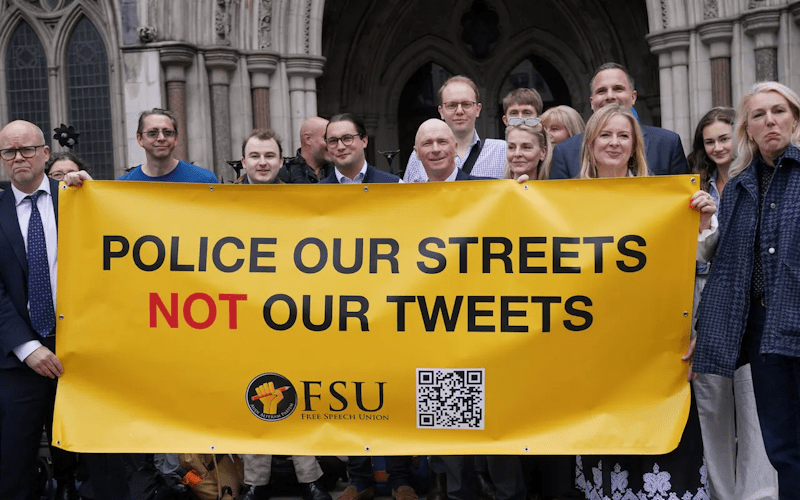
Tweet Police

A retired special constable was arrested and detained over a social media post warning about the threat of anti-Semitism in Britain, The Telegraph can reveal.

Julian Foulkes, from Gillingham in Kent, was handcuffed at his home by six officers from Kent Police – the force he had served for a decade – after challenging a supporter of pro-Palestinian marches on X.

Police body-worn camera footage captured officers scrutinising the 71-year-old’s collection of books by authors such as Douglas Murray, a Telegraph contributor, and issues of The Spectator, pointing to what they described as “very Brexity things”.

Share

Border agents are going to photograph everyone leaving the US by car

Customs and Border Protection (CBP) plans on photographing every single person who leaves the US by car, an agency spokesperson told Wired. The agency says it will start using facial recognition technology at official border crossings to match all outbound travelers’ faces to their passports, visas, or other travel documents, though there’s no public timeline for when this will happen.

Share