
Canada’s food industry has become addicted to the Temporary Foreign Worker Program (TFWP). The numbers tell a sobering story.
In just a few months of enforcement data — from July to late September 2025 — the federal government has listed 26 food-related employers found non-compliant with federal rules governing the program. That’s everything from oyster farms to sushi restaurants, cafes, and food processors. That’s nearly 40% of all companies fined during that period.
The owner of an Etobicoke-based Canadian Tire store has been fined $111,000 by the federal government for violating the guidelines of Canada’s Temporary Foreign Worker (TFW) program.
Employment and Social Development Canada (ESDC), the federal ministry that runs the TFW program, found branch owner Ezhil Natarajan in violation of two guidelines: that wages, work conditions or the job did not match what was listed in offers of employment and that employees were assigned to work different roles than what they were hired for.
Across Canada White people have been raptured leaving behind confused 3rd World masses
‘I’ve applied to more than 50 jobs, didn’t get one interview’: Why job fairs are attracting massive crowds
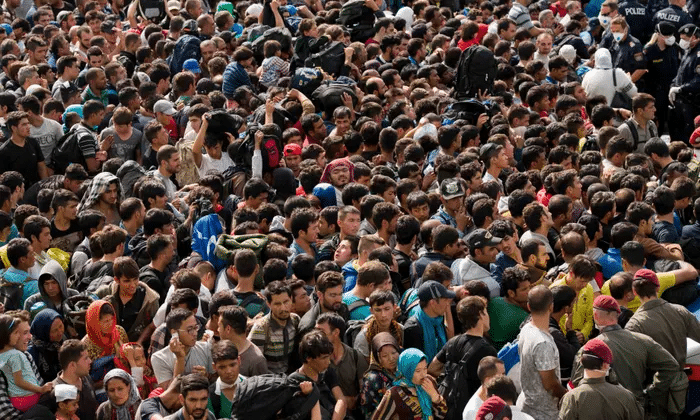
They lineup by the hundreds, shoulder-to-shoulder, roped off around the centre court of Markham’s Markville Mall.
It’s 2:30 p.m. on a weekday afternoon. You might suspect the crowd is queued up for the newest iPhone or perhaps a video game console release, instead they’re looking for a way to put food on the table, a roof over their heads.
This is a job fair, an increasingly popular way for employers to screen large crowds of prospective employees.
With unemployment hitting highs not seen in a decade, the crowds at these recruitment events outnumber openings.
A number of such “employment” articles have run of late, all of them with photos of job fair lines. None feature any white people.
The federal government issued more than $6.8 million in penalties to employers violating the rules of the temporary foreign worker program from January to September 2025, already surpassing the total from 2024’s record-setting year of fines, according to data from Immigration, Refugee and Citizenship Canada.
That is about a 65 per cent increase from the $4.1 million in penalties handed out last year.
From January to the end of September this year, Ottawa levied 214 fines against non-compliant companies, averaging $31,971 per decision, according to the Star’s analysis of the data. That’s up from 155 fines last year, which averaged $26,776 — nearly double the 2023 average of $13,860.
Star propaganda on behalf of the Liberal Party and their corporate cronies.
The fines are small and treated as the cost of doing business. They are not a deterrent.
I am told on good authority that this is a typical day at the Albany Club
Exclusive Tory club hires foreign workers under program Pierre Poilievre vows to kill
OTTAWA — Toronto’s Albany Club bills itself as the “premier private club for leaders in Canada’s business and Conservative political spheres,” and offers luxurious suites, brings in Australian Wagyu beef for the dining room and allows members to buy imported wines not available at the LCBO.
But one thing it couldn’t procure last year was Canadian staff.
A majority of Canadians feel that the country does not need new immigrants and people are divided over whether newcomers should have to give up their customs, according to a new national poll.
The survey, conducted by Leger for the Association for Canadian Studies found that 60 per cent of respondents disagreed that “Canada needs new immigrants,” with the highest levels of opposition found in Alberta (65 per cent), Ontario (63 per cent) and Quebec (61 per cent), followed by Manitoba and Saskatchewan (60 per cent), the Atlantic provinces (56 per cent) and British Columbia (48 per cent).
The ethnic composition of this job lineup indicates Canada desperately needs more unskilled 3rd World labour.
Not long ago, Casey McLaughlin was executive director of the Yukon Transportation Museum in Whitehorse, but earlier this month she found herself lining up with hundreds of others at a job fair in Ottawa, vying for a coveted position at a new Food Basics grocery store.
“I’m willing to go from being a boss to shelving vegetables because you have to pay the bills,” she said. “It’s really hard to find a job in Ottawa right now.”
Nafisa Ijie also attended the job fair at a hotel in Barrhaven, despite having a master’s degree and experience working as a business analyst in Nigeria and England.
(Link fixed)
Canada had a shortage of Nigerian business analysts?
Douglas Todd: Those who pay the highest price for high migration levels, says Denmark’s Social Democratic PM Mette Frederiksen, are the working class. “It’s not the elite people.”
Unlike most social-democratic parties, Denmark’s has been winning elections since 2019.
That’s because the Nordic country’s centre-left party has stayed true to its working-class roots. Rather than allowing itself to be run by what French economist Thomas Piketty calls “the Brahmin left” — by which he means educated city elites — Denmark’s Social Democrats have been taking blue-collar workers seriously.
Alberta MP calls out president of Conestoga College on Parliament Hill
An Alberta Member of Parliament called out Conestoga College president John Tibbits during a committee meeting on Parliament Hill this week.
It happened Tuesday at a Standing Committee on Citizenship and Immigration meeting, where Conservative MP Michelle Rempel Garner serves as vice-chair. The committee examines laws, programs and policies related to citizenship and immigration.
Earlier this month, the committee agreed to study Canada’s immigration system, with a specific focus on the international student program and study permits. The goal is to identify systemic issues and explore long-term solutions.
Two Ontario colleges face deep cuts as foreign student cap shrinks enrolment, reports show
Two Ontario colleges are facing significant financial hardship if they do not slash costs to cope with weaker foreign student enrolment, according to reports prepared for the Ontario government.
Loyalist College in Belleville and Northern College in Timmins could suffer revenue declines of approximately 60 per cent and 35 per cent, respectively, between 2025 and 2030, according to the reports, which were authored by consulting companies KPMG and Deloitte and obtained by The Globe and Mail.
Douglas Todd: How can decision-makers plan for housing, jobs, schools, water supply, physicians, rental units and social services when a significant number of people who were supposed to leave the country aren’t being tracked?
It’s hard to run a city, or country, when you don’t know how many people actually live in them.
How can public officials and businesses plan for housing, workers, schools, water supply, physicians, rental units or social services when they don’t know how many individuals need them?
Yet, according to experts, that is the problem in Canada, especially in the Toronto and Vancouver regions. The federal government isn’t being transparent about how many people in Canada remain in the country after their visas expire.
Data shows that apart from the surge in 2022, 2023 and 2024, this spring saw more immigrants arrive in Canada than any second quarter since 1957
B.C. was the only province in Canada where the population declined between April and June, while the province’s birthrate remains the lowest in the country, according to new Statistics Canada data that shows the impact of changing federal immigration policy on B.C.’s population.
The drop is “the other side” of the surge in the number of temporary residents who came to B.C. over the last three years, said Werner Antweiler, a business professor at the University of B.C. Many of those people are now leaving as their work and study permits expire.
Canada is a high-trust country. Surveys consistently show that Canadians are more likely than most people in the world to say “others can be trusted,” to respect the rules, and to view government and civic institutions as broadly legitimate. In Q4 2024, for instance, 43.5 percent of Canadians reported that “most people can be trusted”, which is significantly higher than global averages and among the highest in the OECD.
New permits for foreign students plunge 97 per cent as Conestoga College braces for impact
Conestoga’s pipeline of fee-paying foreign students has collapsed with a 97 per cent reduction in students from abroad receiving new approvals to attend.
The federal government approved just 540 new international study permits for the Kitchener-based community college between January and June, according to new data released to The Record.
That’s down from 17,600 new study permits approved in the same months in 2023.
Globe Editorial – The necessary pain of ending the TFW dodge
If the postings on the government of Canada’s job bank site are to be believed, hardly anyone in this country wants to work, whatever the wage. Never mind rising unemployment, particularly among young Canadians. Good help, it seems, remains impossible to find.
Companies seeking permission to hire a temporary foreign worker must first prove that they could not find a Canadian willing to do that work. As of Thursday, there were 4,594 positions listed. The type of positions, and pay, vary wildly, everything from a psychiatrist position in Ottawa paying (at least) $450,000 a year to a slew of minimum-wage jobs in agriculture and food service.
About time. And I doubt that the corporate class will “suffer” much at all when the scam is gone.
Boo Hoo! The Liberals will lose a GDP dodge and the affinity vote bloc harvest.