Canadian government urged to scrap 2035 gas engine ban as Trump scraps US plan

OTTAWA — More calls are coming for the Trudeau Liberals to scrap their imperiled policy to mandate 100% EV car sales by 2035.

On Monday, Canadians for Affordable Energy joined the call made last week by Canada’s auto industry, noting the government’s decision earlier this month to cancel the Incentives for Zero-Emission Vehicles (iZEV) program, which offered federal subsides to those who purchased an all-electric vehicle.

Share

Trump Dumps EV Mandate

This can’t be good for Trudeau’s EV Battery scam.

America is free from the electric car nightmare. In Europe, it’s just beginning

With one flourish of a presidential pen, they will be free. Amid the blizzard of executive orders that President Trump has said he will sign in the next few hours, one of the most significant, for the economy at least, will be his decision to end the rules forcing American auto manufacturers to focus their energies on electric vehicles.

President Trump is determined to go back to something that until recently would have been considered completely normal: a free market in cars. Under President Biden, a tax credit – in effect a subsidy – of up to $7,500 was awarded for every EV sold. And environmental rules were blamed for effectively forcing auto makers to make a larger proportion of their new vehicles electric.

Share

And Suddenly, Gavin Newsom’s Electric Car Mandate Looks Pretty Dumb to LA Fire Victims

He’ll save the inedible bait fish, the weed that no one’s ever heard of, elevate meritless executives, and kill the gas car. Those are the highest environmental aspirations of Gavin Newsom, the alleged visionary governor of California, whose distorted priorities have combined to create the conditions for LA Inferno 2025. As the smoke begins to clear, the cruel environy is dawning.

Share

Auto industry calls for end to ‘complete fantasy’ zero-emission vehicle mandates

OTTAWA — With coffers running dry on federal government incentives to purchase zero emission vehicles, Canada’s auto industry says it’s time to do away with plans to phase out internal combustion engines by 2035.

Monday’s closure of the Incentives for Zero-Emission Vehicles (iZEV) program comes just 12 months before the start of a multi-year EV sales mandate where 20% of all new Canadian car sales must be zero-emission, reaching 100% by 2035.

Share

Canada pauses electric vehicle rebates worth up to $5,000 for buyers

Canada’s federal government says it will pause its zero-emission vehicle incentive program (iZEV), dubbing the up to $5,000 rebate on eligible cars and trucks a “huge success” in the transition to net-zero emissions.

The program offers a $5,000 rebate for battery-electric vehicles and plug-in hybrids (PHEVs) with an electric range over 49 kilometres. PHEVs with a lower range qualify for a $2,500 rebate. Eligible passenger cars must have a base price less than $55,000, rising to $65,000 for SUVs, minivans and pickups.

h/t Mauser

Share

The Global EV Calamity

The years just keep getting warmer. I mean this facetiously. At first, the U.S. National Oceanic and Atmospheric Administration told us 2016 was 0.94 degree warmer than the 20th-century average. Then the agency raised its estimate by several steps to 1 degree in 2020 before dropping it back to 0.99 perhaps under Trump influence. With Democrats back in charge under President Biden, 2016 started getting warmer again, reaching 1.03 degrees in 2023. The latest NOAA chart shows it 1.04 degrees warmer than the baseline.

Share

Some Canadian EV buyers sour on Tesla after Elon Musk’s pivot to the right

When Jeff Cowie bought his first electric car in 2019, the Tesla Model 3 checked all the boxes: It meshed with his environmental ideals, offered a fun driving experience and the technology aligned with what he was used to as an avid Apple user.

Mr. Cowie admits he was also impressed by the bold ambitions of Tesla Inc.’s space-exploring chief executive officer, Elon Musk.

Share

How Europe crashed its car industry

Short-sighted policy gave China the upper hand

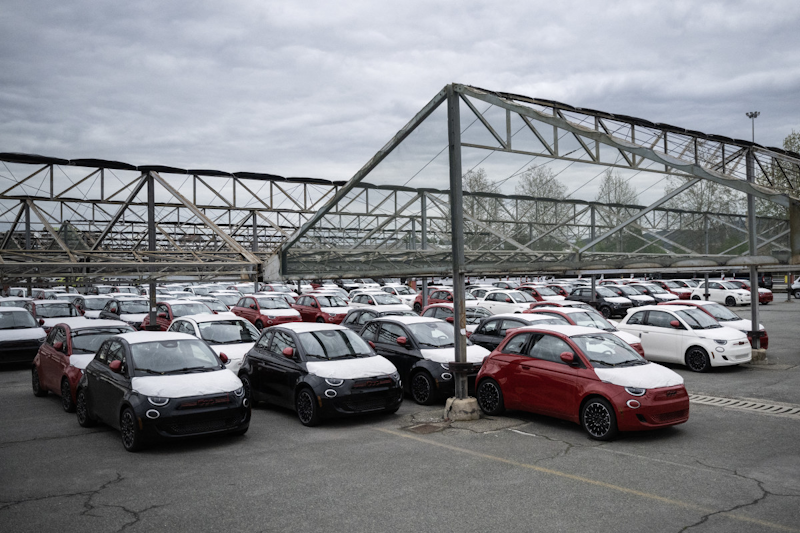
The Mirafiori car plant is the last surviving automobile factory in Turin, the historical engine of the Italian car industry. At Mirafiori’s post-war peak, Fiat manufactured one million vehicles a year, employing 60 000 people. For much of this past year, so few cars have been produced for Stellantis at the plant that one worker recently remarked that “Mirafiori has already been closed. It’s just that it reopens sometimes”.

It has been a terrible few months for most of the world’s once-leading automobile companies. In September, Volkswagen gave notice of plans to shut at least three of its 10 German factories and cut wages by 10%, breaching a 1994 agreement to protect jobs in its home country until at least 2029, prompting rolling two- and four-hour strikes. As production ground to a halt again at Mirafiori in November, Stellantis made public that the Vauxhall plant at Luton would close in April 2025, cancelling the company’s prior plan to produce Vivaro electric vans there. In the same month, Ford indicated it would cut 3,800 jobs in Europe by 2027, while Nissan announced 9,000 job losses and a 20% cut in worldwide production. A senior official at Nissan is reported to have said that the Japanese company has “12 or 14 months to survive”.


Share

Ford faces £100m bill for failing to sell enough electric cars

Ford, for five decades the bestselling car brand in the UK, could be the one of the biggest losers from Britain’s attempt to make manufacturers sell more electric cars.

This week the government began a review of the zero emission vehicle (ZEV) mandate brought in by the previous Tory administration.

Unless there is a substantial revision of the targets, however, Ford could be facing an uphill battle to avoid tens of millions of pounds in penalties in future years for failing to deliver enough electric cars.

Share

Frankie Champers signals collapse of Canada’s EV strategy, as era of chasing big new battery plants comes to an end

Industry Minister signals shift in Canada’s EV strategy, as era of chasing big new battery plants comes to an end

The era of Canada putting down big bets on massive new electric-vehicle battery plants is coming to end.

As Industry Minister, François-Philippe Champagne has led the strategy that’s seen Stellantis N.V., Volkswagen Group and Honda Motor Co. commit to new factories in Ontario that represent some of the biggest investments in the history of Canada’s auto sector.

A few months ago, Mr. Champagne was still talking up the possibility of landing one or two more such commitments from global automakers.

Share

Hertz Asking EV Renters To Buy Their Cars

Hertz is culling its portfolio of EVs in response to the sharp depreciation affecting some of its most popular models, including the Tesla Model 3. In what appears to be an aggressive effort to offload these vehicles, the rental giant has begun reaching out directly to customers currently renting them, offering an opportunity to purchase the cars outright on the spot.

h/t DS

Share