
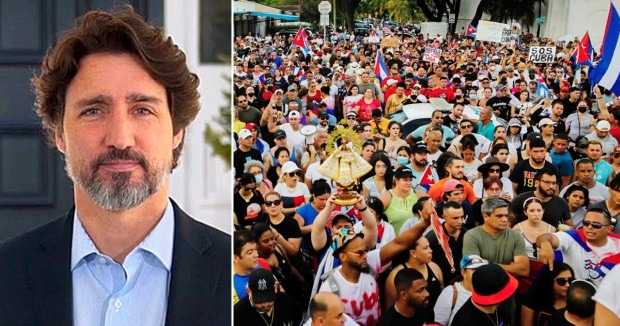
Reports from Cuba indicate that more than 100 people have been arrested or are reported missing after the communist government cracked down on the largest protests in decades. Journalists are also being arrested, including ABC’s Camila Acosta.
Reports from Cuba indicate that more than 100 people have been arrested or are reported missing after the communist government cracked down on the largest protests in decades. Journalists are also being arrested, including ABC’s Camila Acosta.
After six decades of rule, the Cuban government is facing the inevitable generational shift for which it seems ill-prepared
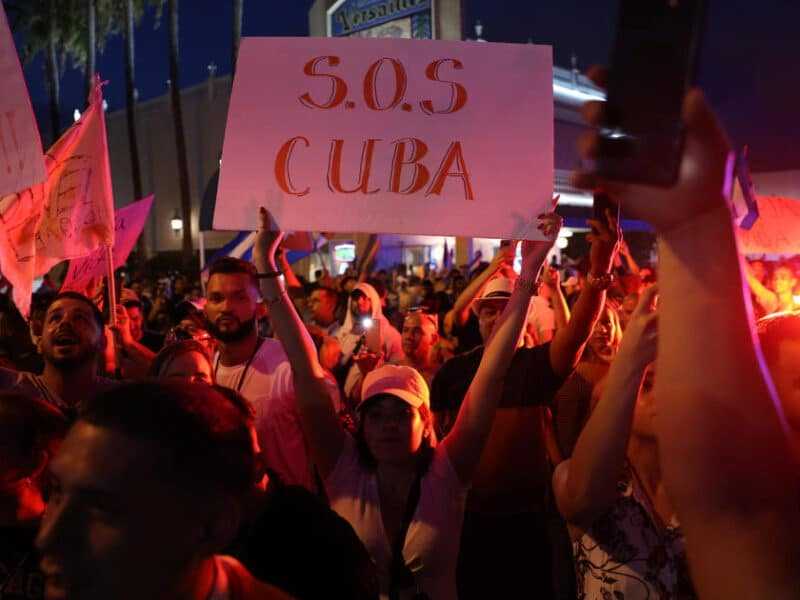
Could the growing tide of street protests finally topple Cuba’s communist government? Cubans are certainly angry: Sunday marked the largest-ever demonstration against the island’s regime. Organized through social media, the protests, which began in a town 20 miles outside Havana, quickly spread across Cuba. Thousands of demonstrators marched along some of Havana’s most iconic streets, chanting ‘Freedom!’, ‘Fatherland and Life’ and ‘Down with the dictatorship!’
It sure has been quiet the last few days among the “democratic socialist” crowd.
Bernie Sanders, who can’t shut up about much of anything most of the time, seems to have lost his tongue and his Twitter. Ditto for Alexandria Ocasio-Cortez and her fellow commie-harpies in the Squad.
Why do you think that is?

On Sunday, thousands of Cubans took to the streets to demand an end to the 62-year-old communist regime, chanting, “Down with the dictatorship,” and “We want liberty,” while waving American flags. Cuban President Miguel Díaz-Canel — the face of the Castro communist regime — responded to the protests by announcing an “order of combat” against peaceful pro-democracy protesters, urging communist civilians to assault them.
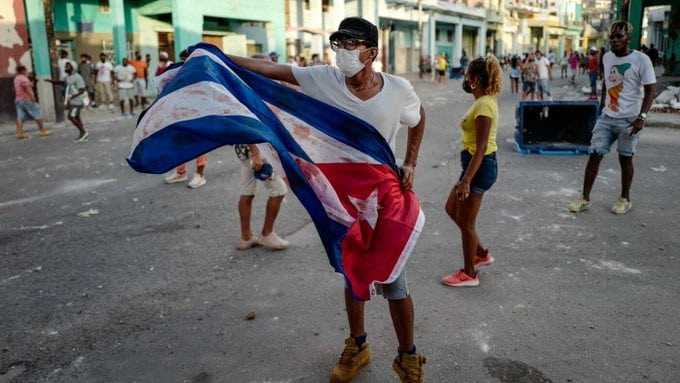
For several hours on Sunday, crowds of angry Cubans took to the streets to protest against the Communist government. They also took to social media, where they not only shared their discontent but tried to galvanise supporters.
The demonstrations, the biggest in decades, were a rare show of dissent in a country where unauthorised public gatherings are illegal.
There was no formal organiser of the rallies, and people found out about where they were happening on online networks. The live broadcast on Facebook of a gathering in San Antonio de los Baños, near the capital Havana, was seen as the starting point for protests that spread quickly across the island.
Until the internet was cut off.

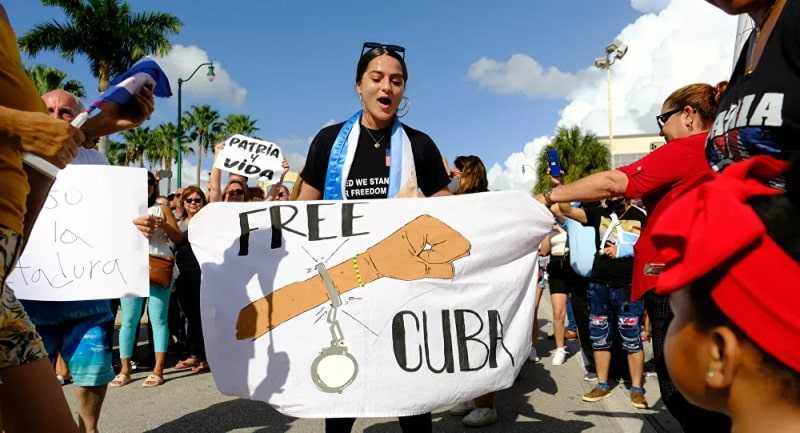
Thousands of Cubans filled the streets of Havana over the weekend in the largest anti-government protest on the communist island in decades.
Chanting “freedom” and “Diaz-Canel step down,” protesters voiced their disdain of the government in light of the worst economic crisis Cuba has faced since the fall of the Soviet Union.
The Cuban regime’s lacklustre handling of the pandemic has resulted in a shortage of basic goods and a curbing of civil liberties and freedoms.
Cuban Foreign Minister Bruno Rodriguez Parrilla has accused US-paid mercenaries of fomenting Sunday’s mass protests across several Cuban cities, and blasted Washington’s “hypocritical” reaction to the unrest, suggesting that if the Biden administration really wanted to “help” Cuba, it should lift its crushing sanctions.
“Yesterday’s events in Cuba were not a social uprising, but disorder, disturbances caused by a communicational operation that had been prepared for some time and to which millions of dollars had been committed,” Rodriguez said in a televised address.
Top far-left figures in American politics were silent on Sunday as Cubans took to the streets crying out for freedom from the nation’s communist dictatorship.
Videos circulated on social media of Cubans marching in the streets, protesting the impoverished conditions of the island and their lack of freedom under the far-left communist regime. They did so while chanting “Liberty” and “Freedom” and waving an American flag. The communist dictatorship later started cracking down on the protests, allegedly inflicting violence on the unarmed protesters and cutting off internet access.
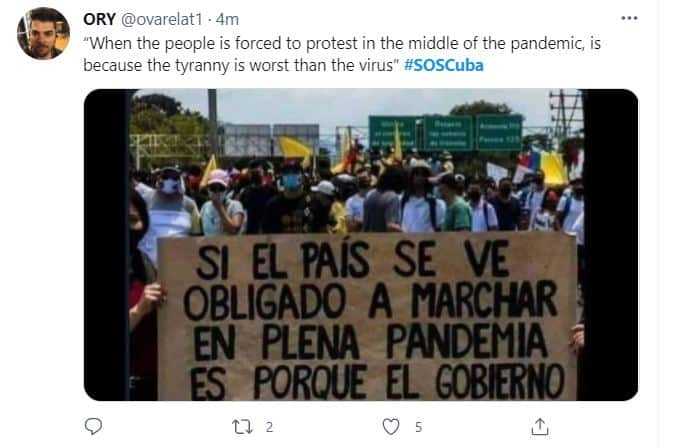
Thousands of people have joined protests against Cuba’s communist government in the capital, Havana, and several other cities.
Videos posted on social media show people calling for freedom, democracy and demanding vaccines to tackle the coronavirus pandemic.
The demonstrations, which are rare in Cuba, come as the country reports a record number of Covid infections.
President Miguel Diaz-Canel blamed the United States for the unrest.
Powerful image: South of Havana, in Bejucal, the townspeople bring out la Virgen de la Caridad, the Patroness of Cuba, as the people shout, “Liberty! Liberty! Liberty.” #SOSCuba #VivaCubaLibre #Libertad pic.twitter.com/tgyP0AkQyq
— Jose Felix Diaz (@josefelixdiaz) July 11, 2021
Cuba needs your help. Right now. Please spread the word #SOSCuba pic.twitter.com/o18Sfva50g
— Natalie Morales (@nataliemorales) July 11, 2021
Global Affairs Canada is “withholding information” on more than two dozen recent cases of Canadian diplomats reportedly being assessed for or reporting symptoms of what’s become known as “Havana syndrome,” according to a letter sent to Foreign Affairs Minister Marc Garneau late last week.
Global News obtained a copy of a letter sent to Garneau on behalf of a group of nine Canadian diplomats and their families who say they are struggling to get answers on the symptoms they say they have experienced since serving at the Canadian embassy in Havana, Cuba.

Sixty years after the Bay of Pigs invasion – the failed attempt to overthrow Fidel Castro’s regime in Cuba – the island continues to celebrate its victory while the invaders who survived live on in the US with the satisfaction of having done their duty. BBC Mundo examines the military plan and the reality of what unfolded.
Johnny López de la Cruz feels deprived of air. Locked up in a lorry with more than 100 other prisoners, he can barely breathe.
Inside the vehicle, the detainees are getting desperate. They sweat. Several faint.
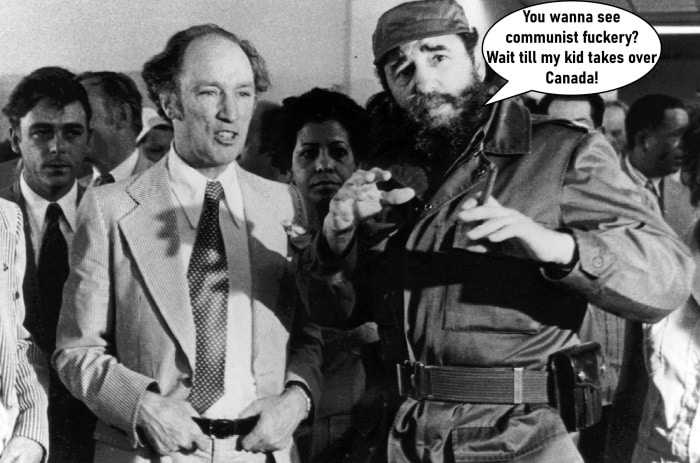
For the first time in more than 60 years, Cuba is poised to have a government without a single Castro.
Raúl Castro, who succeeded his brother Fidel as the Communist Party of Cuba’s first secretary in 2011, is expected to step down from his post as the country begins its eighth Communist Party Congress on Friday.
“We all expect the old generation to step down from all of its functions within the party, including Raúl as first secretary,” said Ricardo Torres Pérez, a professor of economics at University of Havana.
Cuba has announced it will allow private businesses to operate in most sectors, in what is a major reform to its state-controlled economy.
Labour Minister Marta Elena Feito said the list of authorised activities had expanded from 127 to more than 2,000.
Only a minority of sectors would be reserved for the state, she said.
The communist country’s economy has been hit hard by the pandemic and US sanctions introduced by the Trump administration.
Years ago, American diplomats in China and Cuba reported falling ill, all with similar symptoms and all within the same time period. The diplomats reported feeling dizzy, visual impairments, unsteadiness, pressure in their head, and hearing a loud sound.
A new study from the National Academies of Sciences said the symptoms the diplomats experienced, a condition named Havana Syndrome, is consistent with the effects of a type of radiation associated with directed microwave energy. NBC News obtained a copy of the report on Friday, and noted the study did not determine whether the directed microwave energy was intentional through the use of some sort of weapon.
