Carney’s China Deal: Trade, Electioneering, Police Cooperation, and Risks to Canada’s Sovereignty

OTTAWA/TORONTO — In this episode, I catch up with columnist Brian Lilley to unpack Prime Minister Mark Carney’s emerging trade and cooperation agenda with the People’s Republic of China — and why I argue these agreements could accelerate Canada’s decline on multiple fronts.

Before we get into Ottawa’s electric vehicle deal — which I argue risks introducing foreign surveillance platforms onto Canadian roads while aggravating our most important trade partner, the United States — we step back and ask: what is Carney really trying to accomplish?

Share

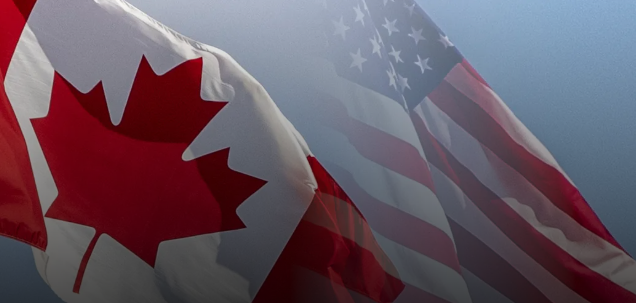
Canada’s Mark Carney Can’t Even Challenge American Hegemony Without American Help

Sometimes a punchline arrives a few weeks after the joke.

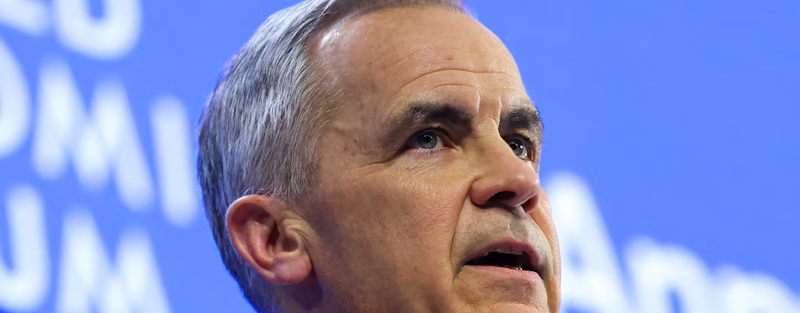
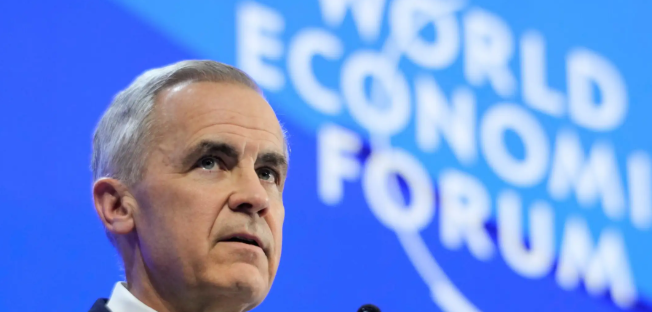
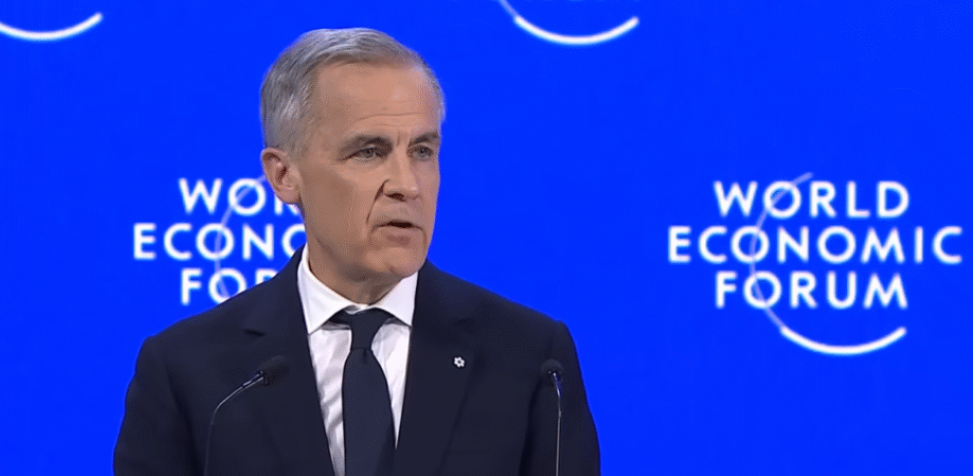
A little less than three weeks ago, Canadian Prime Minister Mark Carney made the globalist media swoon by standing on a stage in Davos and declaring the sudden new limits of American power. For years, Carney said, American hegemony was a stabilizing force in the world, so other countries tolerated America’s many failures to live up to its declared ideals — in Carney’s words, “the gaps between rhetoric and reality.”

Share

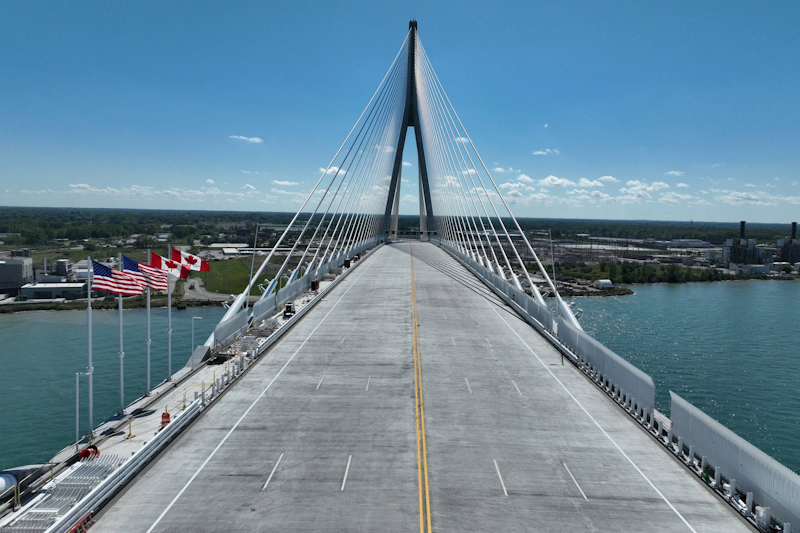
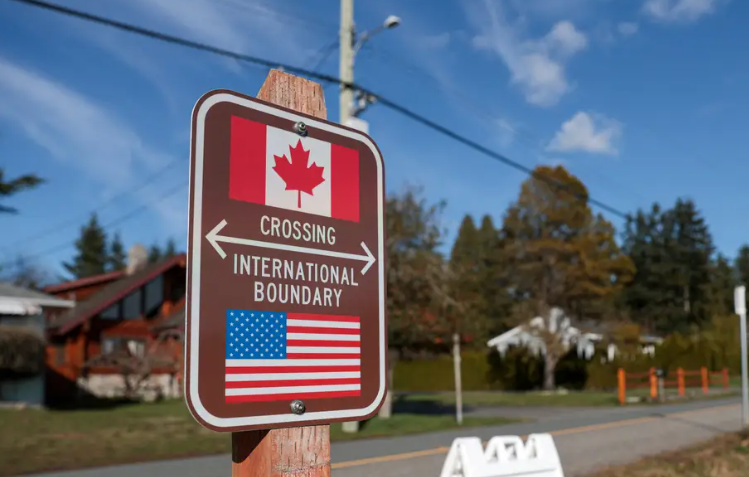
Carney speaks to Trump after president erupts over Gordie Howe Bridge

Prime Minister Mark Carney said he spoke to his U.S. counterpart early Tuesday morning about the Gordie Howe International Bridge, which Donald Trump has threatened to block, explaining to him that Canadians paid for the bridge in full and that the Americans already have an ownership stake.

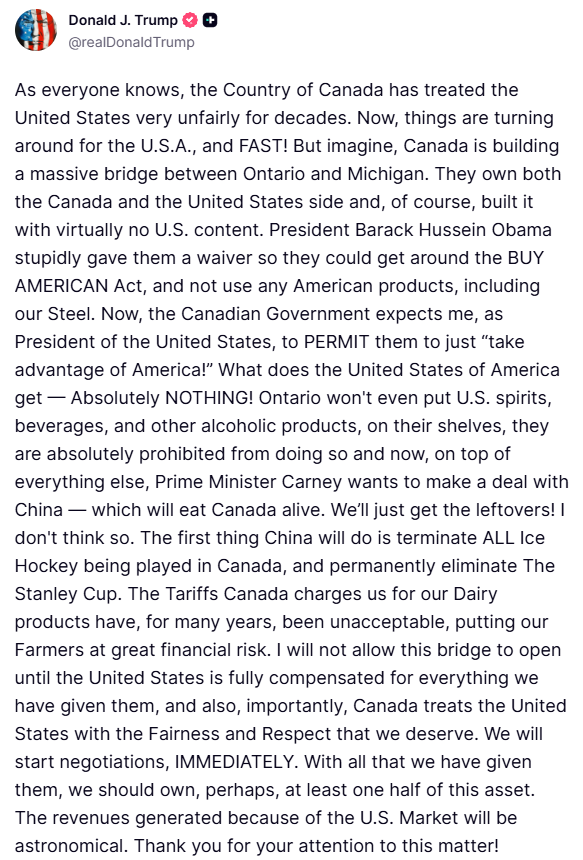
Carney said he told Trump that the federal government paid some $4 billion to build the Windsor-Detroit bridge and that it was built with Canadian and U.S. workers and steel from both countries, despite the president’s bogus claims that there was “virtually no U.S. content” used during construction.

Share

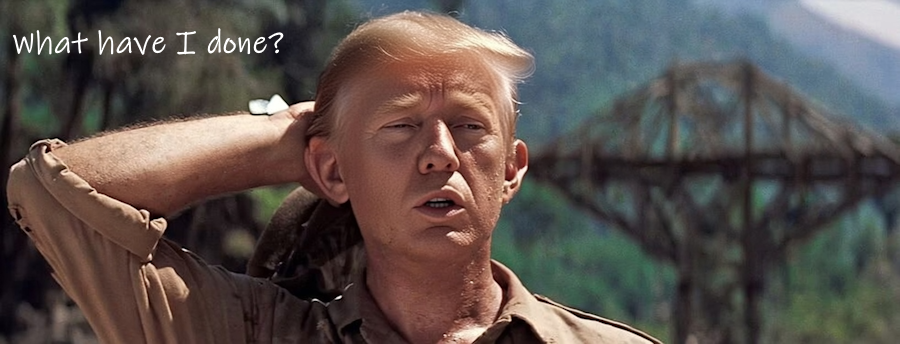
Trump threatens to block opening of new bridge between Windsor and Detroit

U.S. President Donald Trump is threatening to block the opening of the Gordie Howe Bridge, poised to become the newest border crossing between Windsor, Ont., and Detroit.

“I will not allow this bridge to open until the United States is fully compensated for everything we have given them, and also, importantly, Canada treats the United States with the Fairness and Respect that we deserve,” Trump wrote in the post on Monday.

Interesting …

Share

Jamil Jivani: What I learned on my trip to Washington, D.C.

The GM plant in Oshawa often feels like a mythical place. Long-time residents in the region tell stories of a time when it was a hub of prosperity for tens of thousands of families. They say, when shifts would end, there were so many GM employees that some roads would become one-way streets so workers could drive home in an orderly fashion.

Oshawa’s GM plant is still a very important place, but far fewer Canadians work there today. The fighting spirit of a proud union remains in the face of layoffs and shift cuts.

Share

‘He says different things at different times’: Hillman on whether Trump wants to keep CUSMA

Amid a year-long trade war, Canada’s outgoing ambassador to the United States says she doesn’t know whether U.S. President Donald Trump hopes to keep the Canada-U.S.-Mexico Agreement (CUSMA) in place, because his messaging around the deal has been inconsistent.

The agreement, inked during Trump’s first term, is up for review this year. In 2018, Trump called it the “most modern, up-to-date, and balanced trade agreement in the history of (the United States),” but just last month called it “irrelevant.”

Share

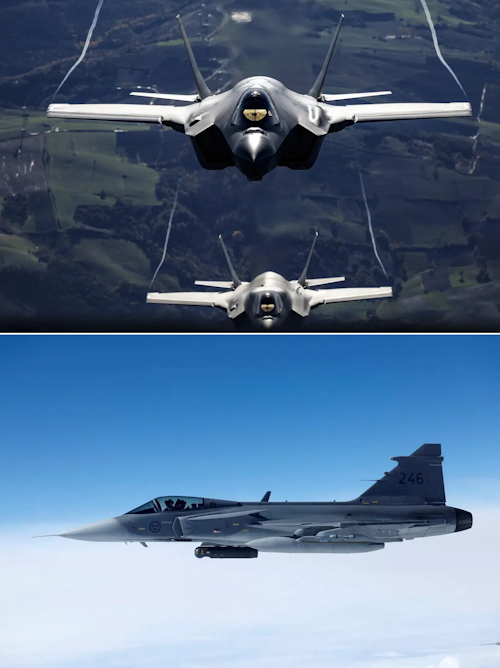
The Canada F-35 Fighter Deal Might Be Close to Collapse

Canadian Prime Minister Mark Carney is inching closer to a possible decision to end Canada’s F-35 procurement plans and accept an offer from Sweden’s Saab, instead, with news this week revealing that the Swedish manufacturer is now providing Ottawa with detailed, technical information on what a JAS 39 Gripen fighter deal would actually look like in practice.
Among the topics currently being discussed in Ottawa are timelines for technology transfers, the speed at which a Canadian production line could be established, and how Canada could participate in future export sales of the aircraft. 

Share

Ottawa says it won’t allow Chinese EVs to be used for spying on Canadians

The federal government will take steps to ensure that imported Chinese electrical vehicles cannot be used to spy on Canadians, a parliamentary committee heard Thursday.

Testifying before the procedures and House affairs committee, Public Safety Minister Gary Anandasangaree said Ottawa will put safeguards in place to make sure that Chinese EVs do not have “the capability to transmit information” back home.

He was responding to questions from Bloc Québécois MP Christine Normandin, who raised concerns that Chinese EVs could become “little spies on the road that could record our calls and take pictures of where we are going.”

Share

Canada is uniquely unprepared for the dire national-security crisis we are now in

It is doubtful any country has ever been in quite the national security dilemma Canada now finds itself in: with so much land and so few people to defend it; wedged between two expansionist superpowers, one of which was until very recently our best defence against the other, but which has since become more or less aligned with it.

The dilemma is particularly acute in light of our charmed history. A country that had always considered itself invulnerable to attack – because of the oceans that surround us, because of the forbidding climate in our North, because of the Americans – wakes up to discover that it has suddenly become peculiarly vulnerable.

Coyne alert!

Share

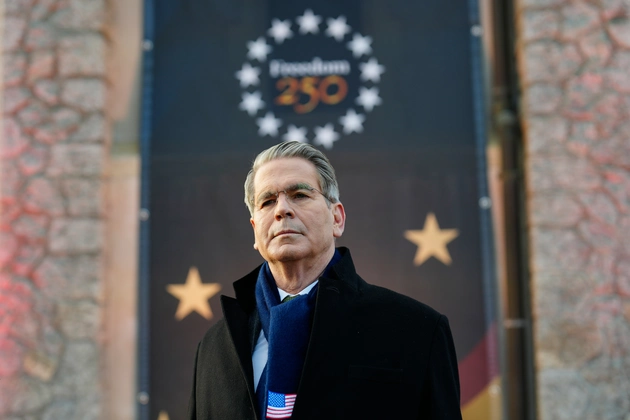
U.S. would ‘absolutely not’ drop all tariffs if Canada did same: Bessent

The Trump administration would “absolutely not” eliminate all of its tariffs on Canada if Ottawa did the same for American goods, U.S. Treasury Secretary Scott Bessent said Thursday, citing Canada’s recent trade agreement with China and the threat of Chinese electric vehicles.

During testimony in front of the U.S. Senate banking committee, Republican Sen. John Kennedy of Louisiana asked Bessent to explain the rationale behind the administration’s tariff strategy.

Kennedy said his understanding is that the “foremost reason” for the tariffs is trying to “stop other countries from taking advantage of us” through their own trade barriers.


Some interesting history here …

Share

In Carney’s world, Canada is more powerful than Trump thinks

U.S. President Donald Trump has reacted harshly to Prime Minister Mark Carney’s acclaimed speech at Davos. First Mr. Trump claimed Canada was a small-power satellite dependent on the U.S. Then Mr. Trump threatened 100-per-cent tariffs if Canada made a deal with China.

Till this day, we are still feeling the aftershock of the speech. Some observers have criticized Mr. Carney for provoking Mr. Trump. McGill University’s Andrew Potter called Mr. Carney “reckless.”


I bet the author of this love letter caught the clap from Carney.

Share

Joel Kotkin: Carney is turning Canada into China’s vassal state


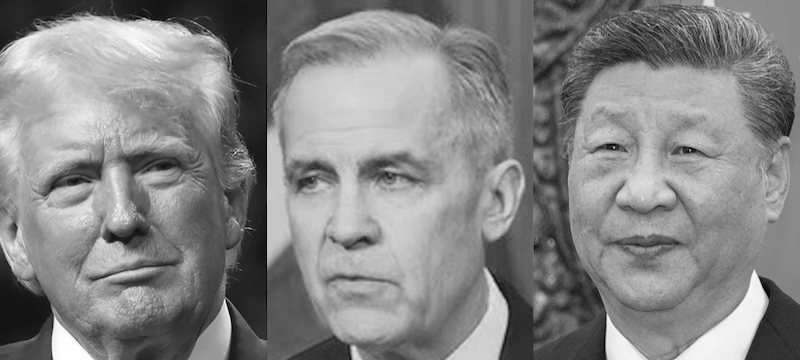
Prime Minister Mark Carney’s speech at the recent Davos conference — where he called for decoupling from the U.S. while entering a “strategic partnership” with China — was greeted rapturously abroad. His tough on Trump rhetoric is certainly winning political points at home as well.

Yet, in listing towards China, Carney is not only ignoring geography, but embracing an authoritarian regime far more dangerous than anything coming from MAGA. China’s clear intention is to seek global hegemony based on trade with an array of vassal states. All are then expected to follow Beijing’s party line.

Share

U.S. interest in Alberta separatism raises red flags over what might come next

Communications between the Trump administration and Alberta’s separatist movement raised alarm at the highest levels in Canada last week. It also raised questions about Washington’s possible intentions.

Some even see dangerous parallels between American efforts to inflame Alberta separatism and the Russian campaign to gin up a separatist movement in eastern Ukraine a decade ago.

Last week, an Alberta separatist group revealed that it was hosted at three meetings by the U.S. State Department.


Honestly as the true nature of the Carney ChiCom alliance is revealed annexation looks better and better.

Energy minister won’t rule out Chinese state-owned companies from buying majority stakes in Canada’s oil patch

Share

U.S. envoy is making Canada’s F-35 decision a no-brainer

OTTAWA—Nobody likes a bully, and at his recent World Economic Forum speech in Davos, Switzerland, Prime Minister Mark Carney garnered international kudos in calling for middle powers to stand up to would-be super-power bullies.

Carney deliberately refrained from naming the United States in his brief address, but President Donald Trump was astute enough to know Carney’s words were aimed at him.

Share