Scott Stinson: Ontario’s crackdown on drugs on public transit has been a long time coming

Scott Stinson: Ontario’s crackdown on drugs on public transit has been a long time coming

After the Progressive Conservative government announced plans this week to grant new powers to public-transit special constables so that they can arrest drug users, there was nary a word of protest from the opposition parties at Queen’s Park.

This was significant. It’s not as though Doug Ford’s counterparts are in a particularly conciliatory mood.

Share

Finally, Ontario is cracking down on drug use on public transit. But then what?

Finally, Ontario is cracking down on drug use on public transit. But then what?

Ontario Premier Doug Ford is engaging in a bit of creative communications with his announcement that special constables will soon be able to arrest those using illicit drugs on public transit.

The reality is that special constables, who patrol transit systems including the TTC in Toronto and OC Transpo in Ottawa, are already authorized to perform arrests for Criminal Code violations based on the way their roles are defined by their specific employers (in Ottawa, for example, as peace officers appointed by the Ottawa Police Services Board). What the Ford government is proposing is to allow these special constables new, simplified provincial authority to make arrests and lay charges via an amendment to the Restructuring Public Consumption of Illegal Substances Act, which was passed last year. It’s just complicated enough to distract everyone from Mr. Ford’s private-jet purchase.


I don’t see anything getting better.

Share

Toronto at the tipping point: Bringing a once-great city back from the brink

Toronto at the tipping point: Bringing a once-great city back from the brink

When Premier Bob Rae asked me to chair the Task Force on the Future of the Greater Toronto Area in 1995, I accepted enthusiastically. The Task Force was created to respond to growing concerns about the health and workability of the city-region.

It was becoming apparent that the secure and satisfying quality of life that people in the Greater Toronto Area (GTA) had been enjoying for the decades following the Second World War was under threat. The region’s lagging economic recovery from the post-1989 recession had revealed its vulnerability in the changing global economy. Torontonians were feeling that the systems they had relied on — from municipal finance to governance to public transit — were breaking down and no longer able to meet their needs.

Here we are 30 years after that, and concerns about Toronto’s viability are back.


No one wants to discuss white flight & the fact that diversity leads to a low trust society.

Share

Ford government to give transit constables power to arrest as part of crackdown on drug use

Ford government to give transit constables power to arrest as part of crackdown on drug use

The Ford government is introducing legislation cracking down on drug use on public transit while also targeting illegal drug production.

Under the new law, special transit constables employed by Metrolinx, the TTC and OC Transpo in Ottawa would have the same powers as police officers to make arrests if anyone uses illegal substances in transit areas.

Share

LILLEY: Toronto desperately needs change at City Hall

LILLEY: Toronto desperately needs change at City Hall

Toronto is a city in decline, we see it everywhere we look every day of the year.

It’s pothole at the end of your street that isn’t being fixed, it’s the overflowing public garbage cans on every street corner, it’s a TTC that doesn’t work except as a homeless shelter. It’s the never-ending congestion, the rising costs despite diminished service, it’s the rising crime.

Share

How some Toronto homeowners are protecting themselves amid rise of home invasions

How some Toronto homeowners are protecting themselves amid rise of home invasions

Riley Mulvihill woke up to a smashing sound in the middle of the night. Masked men were trying to break through the glass window beside the front door of her Toronto home.

“Keys! Keys! I’ll kill you,” said one of them on security video.

The number of home invasion victims in Toronto hit a 10-year high in 2024, with 231 victims across 149 incidents, according to Toronto police data. In 2025, the total dropped to 183 victims across 93 incidents, but the numbers are up again so far this year compared with the same point last year.


I smell diversity.

Share

Matthew Taub: Toronto has lost confidence in its police leadership

Matthew Taub: Toronto has lost confidence in its police leadership

When someone who spent decades inside a police service starts raising concerns publicly, people pay attention. Former Toronto police homicide inspector Hank Idsinga has done exactly that, and what he has alleged should concern every resident of this city.

Idsinga has stated publicly that antisemitism exists within the senior ranks of the Toronto Police Service, describing incidents in which officers used antisemitic language toward Jewish colleagues and community members. He has also pointed to anti-Black racism within policing culture and described broader dysfunction at senior levels. More troubling still, he suggested that those same senior figures were involved in decision-making around policing protests that affected Jewish communities, raising serious questions about whether bias may have influenced operational responses.

Share

The number of Toronto homeless encampments has fallen by 70%. City Hall says that’s progress — but others aren’t so sure

The number of Toronto homeless encampments has fallen by 70%. City Hall says that’s progress — but others aren’t so sure

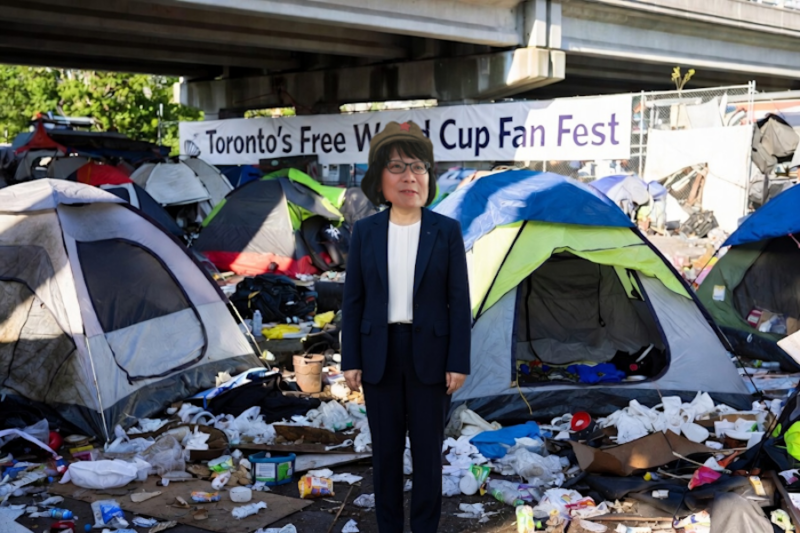
The number of known homeless encampments across Toronto this spring has plunged dramatically from last year, new city data shows — with their official count in March more than 70 per cent lower than at the same time last year.

This dramatic downswing is seen by city hall as a sign of progress, as demand has eased on the shelter system and more people were housed in 2025 than 2024. But several community workers warn that they’re seeing more people sleeping rough without a tent to stay under the radar, sheltering instead in places like transit stations or beneath doorways.

Share

Ex-top homicide cop Hank Idsinga says he won’t do interview with Toronto police after explosive allegations in memoir

Ex-top homicide cop Hank Idsinga says he won’t do interview with Toronto police after explosive allegations in memoir

Hank Idsinga says he won’t be going for an interview with Toronto police over allegations he’s raised of dysfunction, racism and antisemitism in their ranks.

“I’ll let the book speak for itself,” Idsinga told the Star, referencing “The High Road: Confessions of a Homicide Cop,” his memoir of 34 years as a police officer, which ended with him walking away from a celebrated career as leader of Toronto’s homicide unit. Toronto police have this week written Idsinga and sent uniformed officers to his door in an attempt to get him to appear for an interview.

Share

Months after $16M deal, city may give away building tied to top bureaucrat

Months after $16M deal, city may give away building tied to top bureaucrat

The City of Toronto bought a five-storey building from an organization co-founded by a top bureaucrat – and it appears it may already be planning to give it away.

Just months after last year’s $16-million purchase of 720 Bathurst St., City Hall has indicated it may hand over the deed to a group that has signed on to run a homeless shelter, exclusively for indigenous men, out of that brick building.

Share

Toronto police want to talk to ex-cop who alleged antisemitism, corruption in senior ranks

Toronto police want to talk to ex-cop who alleged antisemitism, corruption in senior ranks

Toronto police officials say they are reaching out to a high-ranking former officer who this week made explosive allegations of antisemitism, racism, and corruption in the service’s senior ranks.

Retired homicide inspector Hank Idsinga made the claims in an interview with CBC News and other news outlets surrounding the release of his new book.

Speaking at an unrelated news conference Thursday, Deputy Chief Robert Johnson told reporters the service is looking to talk with Idsinga “so that we can investigate these serious allegations.”

Share

Former Toronto police homicide boss details antisemitism, racism on the force in new memoir

Former Toronto police homicide boss details antisemitism, racism on the force in new memoir

Longtime homicide investigator and former unit commander Hank Idsinga says internal antisemitism, racism and a lack of leadership led to his decision to leave Toronto police after a storied career.

He’s no whistleblower, Idsinga insists, as he sits across from a reporter in a west-end restaurant to discuss his upcoming memoir, “The High Road: Confessions of a Homicide Cop.” This was all part of his story.

Share

How can Toronto expect to fix its serious problems if we can’t even take out the trash?

How can Toronto expect to fix its serious problems if we can’t even take out the trash?

I was in Vienna last month and stumbling back to my hotel late one evening I came across something that surprised and impressed me.

It was a street cleaning machine, scouring away grime and scooping up every trace of the litter that had accumulated during the busy day. The crew was out again the next night, and the night after that. Not surprisingly, the streets were spotless.

Share