
Jon Stewart’s Real Legacy Is A Generation Of Smug, Lazy, Dishonest News Consumers

In a recent tweet critiquing the legacy of Jon Stewart, I summarized that for my generation, who were coming of age during 9/11 and the war in Iraq, we were desperately in search of anyone who could cut through the corporate media partisanship. We craved an everyman to tell it like it was. We were given Jon Stewart. And just like he taught us, we became smug, disingenuous, and lazy thinkers.

The post went viral with Elon Musk weighing in, stating, “I rather liked the old Daily Show and Colbert Report. But now they’ve gone off in a direction that is…” Thousands agreed.

Share

How is Meta’s news ban affecting communications amid Canada wildfires?

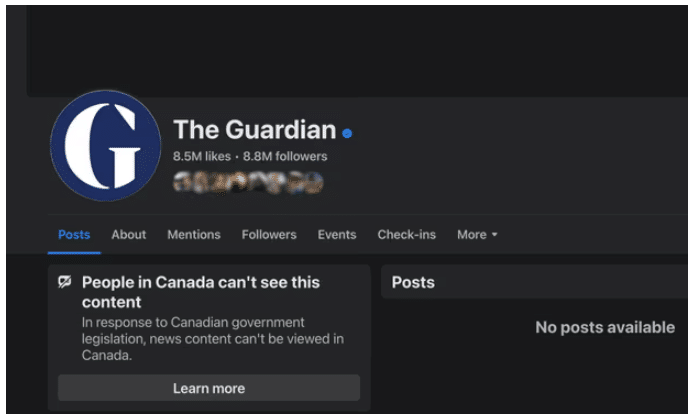
Meta began blocking news from appearing across its platforms in Canada this month after prolonged negotiations with the government over Canada’s new Online News Act.

As Canada grapples with its worst ever wildfire season, thousands of Canadians are could now be affected by a shortage of news content across Meta’s platforms.

Update – Canada demands Meta lift news ban to allow wildfire info sharing

Share

Canada is on the verge of destroying far more journalism jobs than it ever could have hoped to save.

Here’s a word of caution for policy-makers looking to help publishers retrieve some of their advertising revenue lost to web giants such as Google and Meta: Whatever you do, don’t look to Canada for inspiration.

Canada’s efforts to “defend democracy,” as Prime Minister Justin Trudeau put it, have turned out to be a counterproductive fiasco. The government hoped the Online News Act would salvage a struggling legacy news industry and become a model to be copied globally. But it is the most spectacular legislative failure in Canada’s living political memory.


Gee, soon the only media in Canada will be the CBC. How terrible for Justin!

Share

CBC, media groups ask Competition Bureau to investigate Meta’s move to block news in Canada

CBC/Radio-Canada has joined other news publishers and broadcasters in requesting that Canada’s Competition Bureau investigate Meta’s decision to block news content on its digital platforms in Canada, describing the social media giant’s decision as “anticompetitive.”

Meta, which owns platforms like Facebook and Instagram, announced recently that it is permanently ending news availability for users in Canada in response to the country’s Online News Act, or Bill C-18, a law that requires tech companies like Google and Meta to pay media outlets for news content they share or otherwise repurpose on their platforms.

Share

Keldon Bester: Canada must not allow itself to be bullied by Big Tech

In a political environment where global firms are increasingly willing to withhold key services, a principled stand today will protect our sovereignty tomorrow

This week, the technology firm Meta began blocking Canadian news on its Facebook and Instagram platforms, with Google anticipated to follow suit shortly, in response to the government’s recently introduced news media funding law, previously known as Bill C-18.

We are not alone. Read the comments, few seem to give a crap about Trudeau’s bill and the effect on media. It’s not that anyone has a favourite it’s just that everyone hates Trudeau more than Big Tech.

Share

‘Disaster’: warning for democracy as experts condemn Meta over Canada news ban

Social media giant Meta’s ban on news access on its platforms in Canada is an “epic miscalculation” that could damage journalism and promote the spread of misinformation and fake news, experts are warning.

The company announced the move on Tuesday, saying they had begun the process to end access to news on Facebook and Instagram for users in Canada.

The policy came in retaliation for a new law, the Online News Act, created in an effort to help shore up revenue at Canadian journalism outlets by forcing intermediaries such as Meta and Google’s parent company Alphabet to chip in.

Share

Australia made a deal to keep news on Facebook. Why couldn’t Canada?

Back in February 2021, Facebook blocked news on its platforms across Australia to protest a proposed law that would have forced it, along with Google, to pay media companies for stories appearing on their sites.

About a week later, Facebook and Google struck a deal with the Australian government and the restriction stopped. Yet in Canada, such a deal never materialized.

Instead, Ottawa passed the Online News Act in June, requiring tech giants to pay news outlets for content they share or otherwise repurpose.

Share

Tucker Carlson Is Creating a New Media Company

Former Fox News host Tucker Carlson and former White House adviser Neil Patel are seeking to raise funds to start a new media company that would potentially use Twitter as its backbone, according to people familiar with the matter.

The new company would be anchored by longer versions of the free videos that Carlson has been posting regularly on Twitter since shortly after his departure from Fox News, but would ultimately be driven by subscriptions, some of the people said.


Share

What can Canada learn from Australia’s bid to make big tech pay for news?

Canadian lawmakers are locked in a dispute with internet technology companies over a law that would compel them to pay news publishers for content, years after a similar regulatory saga played out in Australia.

On Thursday, Google followed Meta in announcing plans to block news for Canadian users now that the Online News Act has become law. It is expected to take effect later this year.

I don’t think this is a an overwhelming hardship for end users, but it’s likely not so good for the news organizations that may go out of business thanks to Junior.

Share

Conrad Black: How the Postmedia-Nordstar merger can save journalism

It was announced this week that advanced negotiations are underway for an effective merger between Nordstar Capital, the publisher of the Toronto Star and the Metroland suburban newspapers, and Postmedia, which publishes this newspaper as well as the Sun newspapers and the principal English-language daily newspapers in Montreal, Ottawa, Calgary, Edmonton and Vancouver. This is not surprising, as both companies have been losing money, which is a process that even our governments in all their profligacy will eventually discover cannot continue indefinitely. The commercial advantage of such an arrangement would be to merge the business aspects of the two companies, while maintaining editorial separation: the savings would be considerable, at no cost to editorial quality.

Share

Heartbreak City: Here’s How ABC/CBS/NBC Handled Friday’s SCOTUS Cases (Hint: Not Well)

Just as they did on Thursday morning, the major broadcast networks of ABC, CBS, and NBC each broke in Friday morning for the final Supreme Court cases of the session, which were President Biden’s student loan forgiveness plan (Biden v. Nebraska) and a free speech case involving a  Christian web designer and LGBTQ individuals (303 Creative LLC v. Elenis).

While the takes weren’t as scorching as Thursday, Friday featured slanted takes bemoaning what the Court striking down multi-hundred billion dollar student loan forgiveness will do to the economy and claiming without evidence that ruling for webmaster Lorie Smith will open the doors to LGBTQ discrimination.

Share

Why Canada’s Attempt to Save Journalism May End Up Crushing It Instead

On June 22, the Canadian Parliament passed Bill C-18, also known as the Online News Act. The new law, according to a government news release, “will require the largest digital platforms”—in effect, calling out Facebook, Instagram, and Google without naming them—“to bargain fairly with Canadian news businesses for the use of their news content.” The intent here is to even out the skewed market imbalance between Canadian journalism and Big Tech platforms, many of which have offered distribution pathways and occasional payment agreements to digital news sites while also sapping them of revenue from native advertising—a sector dominated by those very corporations.

Share

When will Canadian news disappear from Google, Facebook? What the Bill C-18 rift means for you

How will you get the news now?

That’s a question many Canadians may be asking after tech companies Google and Meta, which owns the social media giants Facebook and Instagram, vowed to remove links to Canadian journalism.

It’s in retaliation for the Online News Act, also known as Bill C-18, that will make them strike agreements with media outlets for “fair compensation” when their news content is shared on the tech companies’ platforms.

I’m not sure this is a bad thing.

Share