
Canadian law endorsed by Trudeau government could imprison people for life for advocating genocide

A Canadian law that aims to make social media platforms safer is getting flak for what some decry as government overreach.

Introduced late last month, the Online Harms Act, or Bill C-63, would allow judges to imprison adults for life if they advocate for genocide.

The law would also allow a provincial judge to impose house arrest and a fine if there were reasonable grounds to believe a defendant “will commit” an offense – a provision Wall Street Journal columnist Michael Taube likened to the 2002 film, The Minority Report.

Share

I chaired the Human Rights Tribunal. It has no business policing ‘hate speech’

The Liberal government’s proposed Bill C-63, the online harms act, is terrible law that will unduly impose restrictions on Canadians’ sacred Charter right to freedom of expression. That is what the Liberals intend. By drafting a vague law creating a draconian regime to address online “harms,” they will win their wars without firing a bullet.

The STASI would approve Bill C-63.

Share

Canada’s descent into tyranny is almost complete

Handing judges the ability to put people under house arrest because they might commit a hate crime isn’t progressive, it’s North Korean

Canadian Prime Minister Justin Trudeau is threatening his most tyrannical attack on freedom yet through his government’s proposed Online Harms Act (currently Bill C-63). Brought to you by the same farcically-named “Liberal” party who froze the bank accounts of the truckers who protested vaccine-mandates, the OHA is the government’s overzealous attempt to promote online safety.

It’s only Justin vote whoring to the usual suspects again.

Share

Margaret Atwood calls online harms bill ‘Orwellian,’ notes potential for abuse

I can’t remember why I put a rodent in her hair. Perhaps she was going to San Francisco.

Acclaimed author Margaret Atwood has warned that the federal government’s online harms bill is “Orwellian” and its definitions of punishable hate speech are vague and could invite abuse, such as unwarranted complaints under the Canadian Human Rights Act.

Ms. Atwood said she has been the frequent target of “hate speech, online vilification, lies, threats and doxxing” and is “no fan of this kind of online behaviour.” But, in an e-mail exchange with The Globe and Mail, she said she is “also no fan of unsupervised authority acting under vague laws, without any oversight.”

Share

‘Government gone overboard’: Experts concerned by Ottawa’s attempts to rein in hate speech

OTTAWA — Some of the Liberal government’s proposed efforts to crack down on hate speech and hateful conduct has some experts wondering whether Ottawa has gone too far in introducing legislation that was initially meant to address dangerous content on social media.

Last week, Justice Minister Arif Virani introduced Bill C-63, a sweeping piece of legislation largely aimed at regulating how social media platforms should respond to harmful content online. That part of the legislation, the Online Harms Act, would focus on egregious content that targets youth, disseminates intimate images without consent, promotes hatred, or incites violence, terrorism or violent extremism.

Share

How Canada became a cauldron of authoritarianism

It seems Justin Trudeau isn’t only a dick – he also gets his ideas from one. Philip K Dick, to be precise. Trudeau’s government has proposed a new law that would give judges the power to put an individual under house arrest if they fear he might commit a hate crime. That’s right – might. It’s right out of The Minority Report, Dick’s 1956 dystopian tale of a future America in which a ‘Precrime’ police division uses intelligence from mutants known as ‘precogs’ to arrest people before they’ve committed an offence. Welcome to woke Canada, where Dickian nightmares come true.

Share

Justin Trudeau, am I guilty of pre-crime?

Tim Berners-Lee, the man who invented the internet, intended it to be a place for everyone. But now the web is being used to undermine democracy and free speech. It has become a tool for the powerful to suppress dissent. ‘That feeling of individual control, that empowerment, is something we’ve lost,’ Berners-Lee told Vanity Fair in 2018. Today, not only do corporations like Google and Meta dictate what we see online, but, in places like Canada, the government is quickly making itself the gatekeeper.

Share

Jordan Peterson: even the Left isn’t safe from surveillance

The psychologist and author Jordan Peterson warned that “no one will escape the purview” of government surveillance as new technology emerges, making a statement to a Congressional committee yesterday.

Peterson expanded by saying that while the US government is currently targeting people with “more conservative leanings”, it would change “in a moment when the political tides shift”, in a warning to those on the Left.

Share

Christine Van Geyn: Under Bill C-63, an online comment could cost you thousands

H/T DA

Proceedings at the Canadian Parliament are beginning to feel like a zombie film: a monster was killed, it came back, was killed again and yet returns a third time. But this isn’t your typical horror flick. This one involves a group of government bureaucrats investigating complaints about your speech, prosecuting you at their own tribunal and ordering you to pay tens of thousands of dollars to people who don’t like what you say or write. The undead antagonist at the centre of it all is the civil penalty for hate speech, proposed last week in Prime Minister Justin Trudeau’s newly tabled Bill C-63.

Share

Lunatic Trudeau Minister defends precrime house arrest power for people feared to commit a hate crime in future

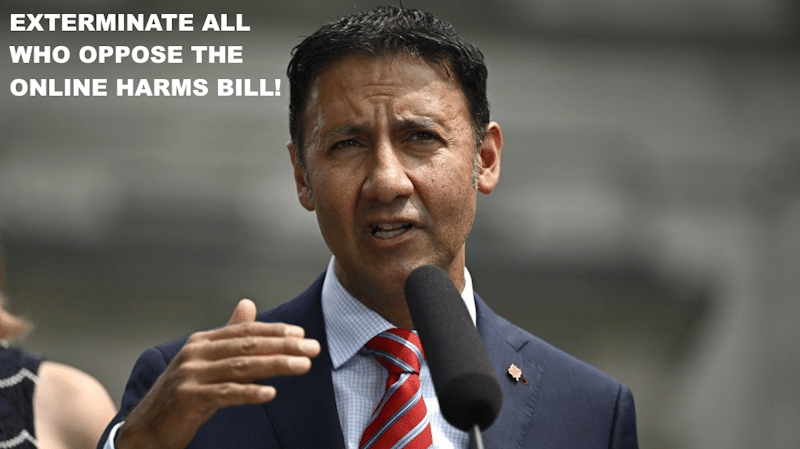
Justice Minister Arif Virani has defended a new power in the online harms bill to impose house arrest on someone who is feared to commit a hate crime in the future – even if they have not yet done so already.

The person could be made to wear an electronic tag, if the attorney-general requests it, or ordered by a judge to remain at home, the bill says.

Mr. Virani, who is Attorney-General as well as Justice Minister, said it is important that any peace bond be “calibrated carefully,” saying it would have to meet a high threshold to apply.

We need to march on parliament and burn it down, in fact burn down all of Ottawa.

Share

Jamie Sarkonak: Trudeau’s digital bureaucracy is coming for your social media posts

Bureaucracies usually have a purpose. The public health system cares for the physical bodies of citizens; the justice system (ideally) keeps the dangerous from the normal; the immigration system controls entry and exit.

Soon, you may have to add to the list a “digital safety” bureaucracy, designed to regulate feelings and ideas, and the places where these things are expressed. This is what the forthcoming online harms act, tabled Monday in the Liberals’ Bill C-63, will do. Individuals who value their ability to discuss controversy online should be wary — as should any major social media company that happens to operate in Canada.

Share

Canadian university vending machine error reveals use of facial recognition

A malfunctioning vending machine at a Canadian university has inadvertently revealed that a number of them have been using facial recognition technology in secret.

Earlier this month, a snack dispenser at the University of Waterloo showed an error message – Invenda.Vending.FacialRecognition.App.exe – on the screen.

There was no prior indication that the machine was using the technology, nor that a camera was monitoring student movement and purchases. Users were not asked for permission for their faces to be scanned or analysed.

Share

German Leftist Newspaper Spied on Its Own Journalists

A media scandal is rocking the left-liberal German daily newspaper Süddeutsche Zeitung (SZ) after it emerged that bosses spied on their own staff and reporters to find a “mole” who had leaked info about the plagiarism affair of the deputy editor of the paper.

Süddeutsche Zeitung is now accused of bigotry and double standards when it comes to ‘whistleblowers.’ NGO Reporters Without Borders criticized the paper’s management and wrote that the protection of confidential sources is in danger.

The scandal has put the reputation of SZ seriously at risk.

Share