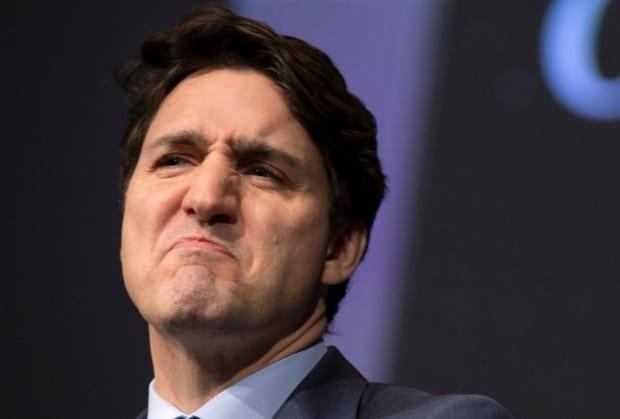
Trudeau Liberals monitored ̷d̷o̷m̷e̷s̷t̷i̷c̷ ̷e̷x̷t̷r̷e̷m̷i̷s̷t̷s̷ people who disagreed with them as possible threats to 2021 election: docs

A “significant” spike in threats to Prime Minister Justin Trudeau and other senior public figures during the 2021 federal election led to concerns that domestic extremist groups and anti-vaccine protestors could pose a threat to the vote, newly-released documents suggest.

The documents, prepared by a multi-agency committee tasked with safeguarding federal elections from interference, show it wasn’t just hostile foreign states and their proxies that had officials concerned about the integrity of the vote.

Share

London Mayor Won’t Reveal the Cost of ULEZ Protection ‘Bullies’

London Mayor Sadiq Khan believes it is not “appropriate” to reveal the cost of the security personnel hired to defend London’s controversial Ultra Low Emission Zone (ULEZ) because doing so “risks encouraging those intent on carrying out … criminal activity.”

This evasive claim—which follows a 100-word ULEZ sales pitch ignoring a very direct question on the scheme’s cost—likely indicates such high security costs that they are seen as capable of  provoking “criminal activity”.

Share

How Meta’s New Face Camera Heralds a New Age of Surveillance

For the past two weeks, I’ve been using a new camera to secretly snap photos and record videos of strangers in parks, on trains, inside stores and at restaurants. (I promise it was all in the name of journalism.) I wasn’t hiding the camera, but I was wearing it, and no one noticed.

I was testing the recently released $300 Ray-Ban Meta glasses that Mark Zuckerberg’s social networking empire made in collaboration with the iconic eyewear maker. The high-tech glasses include a camera for shooting photos and videos, and an array of speakers and microphones for listening to music and talking on the phone.

Share

Cory Morgan: Why Digital ID for Canadians Is a Really Bad Idea

My wallet is stuffed with cards. I have a driver’s licence, firearms licence, health-care card, social insurance card, and several credit and debit cards. It’s annoying keeping up with the expiry dates on all these cards and it can be a catastrophe if they are lost. It tempts a person to embrace the concept of some kind of universal digital ID, and we have governments eager to set up such a system.

We can’t let ourselves succumb to the temptation of handing it all off to the state, however. The potential loss of privacy and personal liberty is too high a price in exchange for convenience.

Share

The White House Goes Rogue: Secret Surveillance Program Breaks All the Laws

The government wants us to believe that we have nothing to fear from its mass spying programs as long as we’ve done nothing wrong.

Don’t believe it.

It doesn’t matter whether you obey every law. The government’s definition of a “bad” guy is extraordinarily broad, and it results in the warrantless surveillance of innocent, law-abiding Americans on a staggering scale

h/t Mauser

Share

Spyware being used by 13 federal departments, documents show

Spyware normally associated with the intelligence world is being used by 13 federal departments and agencies, according to contracts obtained under access to information legislation and shared with Radio-Canada.

Radio-Canada has also learned those departments’ use of the spyware did not undergo a privacy impact assessment as required by federal government directive.

The tools in question can be used to recover and analyze data found on computers, tablets and mobile phones, including information that has been encrypted and password-protected.

Share

Inside the UN Plan to Control Speech Online

The UN is escalating its war against ‘conspiracy theories’ and ‘misinformation’ by creating an ‘internet of trust.’

A powerful United Nations agency has unveiled a plan to regulate social media and online communication while cracking down on what it describes as “false information” and “conspiracy theories,” sparking alarm among free-speech advocates and top U.S. lawmakers.

In its 59-page report released this month, the U.N. Educational, Cultural, and Scientific Organization (UNESCO) outlined a series of “concrete measures which must be implemented by all stakeholders: governments, regulatory authorities, civil society, and the platforms themselves.”

Share

Privacy Fears as EU Moves Forward With Digital ID

The European Parliament and the majority of the member states reached a provisional agreement on the establishment of the “European digital ID” or “eID”—the first central and fully digital identification system for all Europeans—on Thursday, November 9th. Conservative lawmakers and cybersecurity experts are sounding the alarms, citing concerns for potential large-scale abuse.

“We are taking a fundamental step so that citizens can have a unique and secure European digital identity,” Nadia Calvino, the Spanish minister for economy and digitalization, representing the European Council’s Spanish presidency, said.

Share

Ottawa under pressure to publish online safety bill to tackle rising antisemitism

Ottawa is under pressure from Jewish groups to bring forward a long-promised bill to tackle online hate, amid warnings that rising antisemitism is making Jews in Canada, especially on university and college campuses, feel unsafe.

Jewish groups are saying that an upsurge in antisemitic abuse online makes the bill more urgent, saying that some social media platforms are too slow to take down antisemitic insults, comments and abuse, which have escalated since attacks on Israel by Hamas militants set off a Middle East war earlier this month.

I am not for this bill. All such legislation ends up being contorted into censorship of dissent.

Share

Police in Canada look into tech that accesses your home security cameras

An officer looks at a screen showing a network of security cameras from people’s homes and businesses around the city, which can be watched all at once, in real-time. They access areas from which emergency calls come in, or scenes of crimes.

That’s how policing is done in some U.S. cities — and police forces in Canadian cities are looking into it.

“We foresee a progression for the Hamilton police to incorporate this technology in the future, however there are currently no timelines for implementing this,” Jackie Penman, a spokesperson for the police service in Hamilton, told CBC News.

Share

We need to know when government is trying to alter our behaviour

You think you’re always the one making your own decisions? Think again.

For some years now, governments have been using a new tool that allows them to guide our choices furtively, without the need for regulation, coercion, or taxation. It’s the nudge, a technique that mobilizes the cognitive biases of individuals, which is to say the unconscious and emotional part of the human mind, to influence our behaviour.

Share

Geofencing: How The Government Used Cell Phone Data To Try To Drive Calvary Chapel Out Of Business

We are in the space between the emergence of this technological practice and courts having ruled on its constitutionality,” said Alex Marthews, national chair for Restore the 4th, a nonprofit organization dedicated to the protection of the Fourth Amendment, which protects Americans’ rights against “unreasonable search and seizure.”

“Geofencing” often begins with an innocent click. Smartphone apps ask if they can access location to improve service. When users say they yes, they often don’t realize that the apps that help them drive, cook, or pray are likely reselling their information to far-flung for-profit entities. This and other information detailing people’s behaviors and preferences is valuable for businesses trying to target customers. The global location intelligence market was estimated at $16 billion last year, according to Grand View Research, which predicts that figure will grow to $51 billion by 2030.

h/t XC

Share