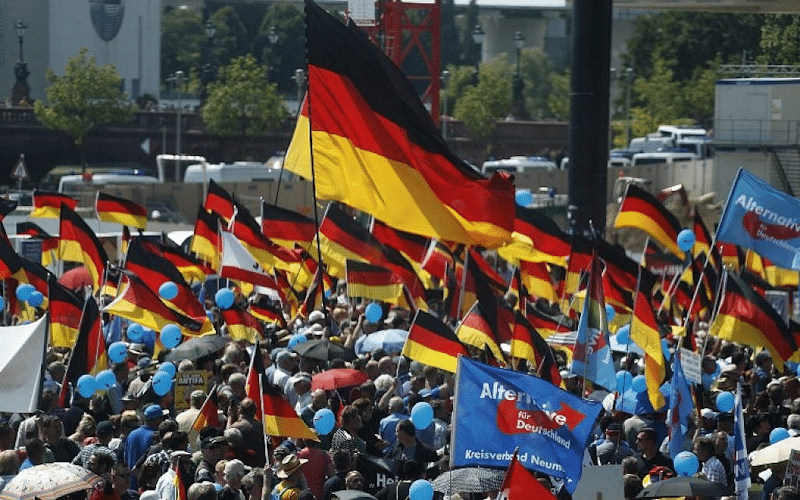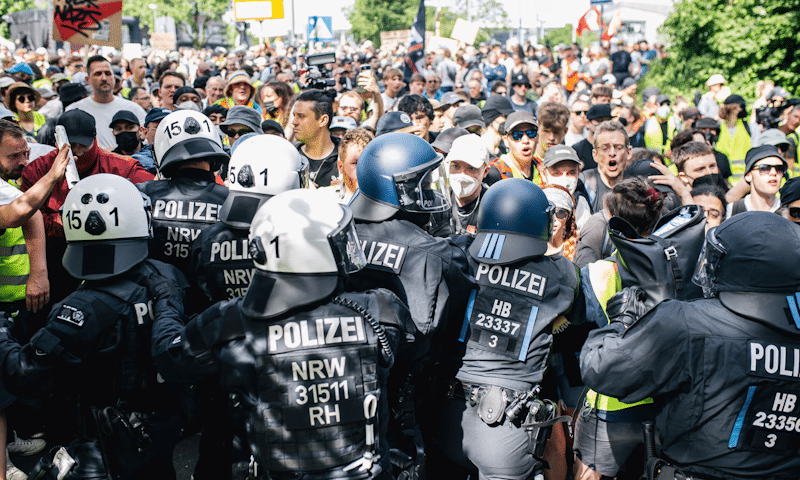
Far-Left Extremists clash with police at start of AfD congress in Essen

Clashes between hooded demonstrators and police marked the start of a party congress of Germany’s far-right Alternative für Deutschland (AfD), weeks after it scored record EU election results despite multiple scandals.

About 1,000 police were deployed in the western city of Essen as about 600 delegates began a two-day meeting, with authorities expecting up to 80,000 people to join demonstrations.

“Several disruptive violent actions occurred in the Rüttenscheid quarter. Demonstrators, some of them hooded, attacked security forces. Several arrests were made,” said the police of North Rhine-Westphalia region on X.


Translation: “It is always astonishing how the useful idiots of #Bunten yell ‘against fascism’, #widersetzen violently prevent democratic assemblies and do not even begin to realize that they themselves are the fascists.”

Translation: “How white can a demonstration be? Almost no migrants take part in the counter-demonstrations.”

More video

Share

Germany: Security Threat Looms Over AfD Meeting in Essen

Left-wing militants, private companies, and municipal officials are all conspiring to harass Alternative für Deutschland’s (AfD) annual conference, which will go ahead this weekend in the west German city of Essen—after failed attempts by the city to completely stop it.

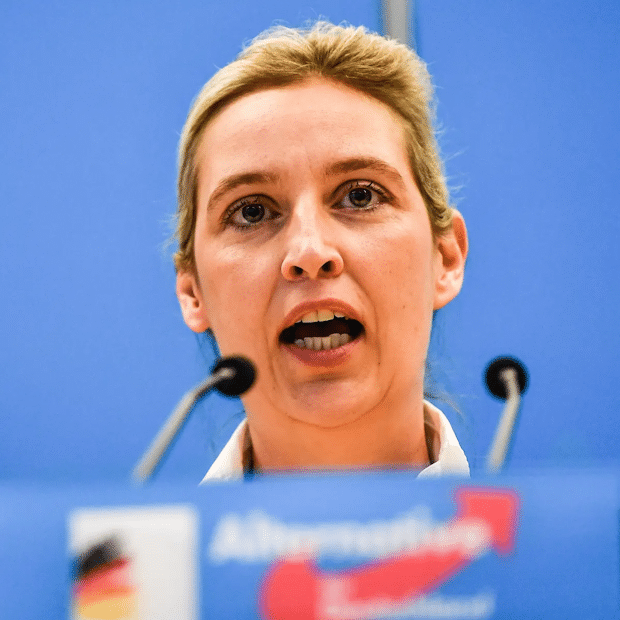
Fresh off the back of electoral wins that saw the populist party come in second in European elections—despite multiple scandals and near-constant state harassment—AfD top brass Alice Weidel and Tino Chrupalla will seek to renew their mandate at the head of the populist party against increasingly radical grassroots. Additional security protocols are being implemented to fend off “several tens of thousands” expected left-wing protestors.

Share

Germany: Far-right AfD’s gains driving immigration debate

In the European Parliament elections on June 9, the far-right, anti-immigration Alternative for Germany (AfD) party came second in Germany — and in the five states in the east of the country, the party, which has extremist factions, even came first. The results alarmed both federal and state governments across all parties.

In September, three of those eastern states — Saxony, Thuringia and Brandenburg — are holding elections. If the AfD becomes the strongest party, as is expected, the others will find it difficult to form a governing coalition to outnumber it, especially as Olaf Scholz’s Social Democrats (SPD) and the Greens are so weak that in Saxony and Thuringia they may not even clear the 5% threshold to enter the state parliament.

Share

Germans Say They’re Fed Up, Nazi Accusations Be Damned

There’s a populist revolution in Germany.

In her political ads in the leadup to last week’s EU parliamentary elections, European Commissioner Ursula von der Leyen bizarrely walks and jogs through a forest in her native Germany as she explains why she’s running. That she would retreat to the woods to make her electoral pitch is fitting for the ruling class she represents.

Share

Why young Germans vote for the AfD

In the aftermath of the European elections last Sunday, the German establishment has been trying to come to terms with radically altered political realities. Despite advance polls predicting a notable shift to the Right, the result still shook the country. Less than a third of voters stuck with the parties of the ruling centre-left coalition, and the Right-wing Alternative für Deutschland (AfD) became the second largest political force after the conservative Union. Young people in particular defied expectations, many turning their backs on the Greens and switching to the Right.

Share

Germany’s domestic secret service battles far-right AfD

The Federal Office for the Protection of the Constitution (Bundesamt für Verfassungsschutz, or BfV), Germany’s domestic intelligence service, has argued that the populist far-right Alternative for Germany party (AfD) is anti-constitutional. It therefore classified the political party as a “suspected case” in 2021.

The party took legal action against this decision at the Cologne Administrative Court, but was unsuccessful. A higher regional court in western Germany has now confirmed that ruling, meaning the AfD may be classified as a “suspected” far-right extremist organization.

The court proceedings have drawn attention to a state organization that acts as an early warning system to detect threats to democracy, and is one of Germany’s most important intelligence agencies. It gathers intelligence while coordinating information gathered by the 16 state-level intelligence agencies.

Share

Germany: 2 AfD politicians attacked in Stuttgart

Police in the southwestern German state of Baden-Württemberg said two politicians were attacked in the city of Stuttgart on Wednesday evening.

The two, who were identified as state lawmakers from the far-right party Alternative for Germany (AfD), suffered slight injuries, police said.

The incident is the latest attack on politicians in Germany, following days of violence against multiple left-leaning and Greens politicians.

“Far Right”

Share

German Politicians and Media Blame ‘Far-Right’ for Political Violence

German federal interior minister Nancy Faeser and the interior ministers of Germany’s sixteen states are debating on the evening of Tuesday, May 7th, whether to increase the police presence at political events in order to protect politicians from physical assaults.

The extraordinary meeting was called after Matthias Ecke, a Social Democrat member of the European Parliament, was brutally attacked by four teenagers on Friday, leaving him hospitalised and in need of surgery. The incident provoked uproar all across the country, and violence against politicians was widely condemned. However, mainstream parties immediately blamed the opposition anti-immigration, anti-globalist Alternative für Deutschland (AfD) for the attack—not for actual involvement in any form, but for “sowing discord” within society.

Share

Pessimistic young Germans turning to far right, says study

Young people are more likely to vote for the far-right Alternative for Germany (AfD) than previously, a study on Tuesday showed.

Authors of the “Youth in Germany 2024” study said that under-30s were increasingly disgruntled with their social and economic situation, and that fears about future prosperity were driving a shift to the right.

The AfD’s signature issue is a hard-line anti-immigration stance, and the data showed that migration was among young people’s main concerns.

Share

German Establishment Parties Unite To ‘Protect’ Constitutional Court from ‘Extremists’

The German Union parties (CDU/CSU) are again considering backing an initiative by the left-globalist ‘traffic light’ coalition to amend Germany’s constitution in an attempt to keep the anti-establishment Alternative für Deutschland (AfD) party from influencing the Federal Constitutional Court.

Negotiations between the Union and the governing parties concerning the latter’s proposed draft law—framed as necessary to ‘protect’ the court from ‘extremists’—began in late January but concluded shortly thereafter when the CDU and CSU stated that they found no compelling reason for the constitutional amendment.

Share

Germany: Globalist Press Portrays 16 year old Loretta as an Extremist

Former Stasi memorial chief says the case is reminiscent of “East Germany when pacifist patches or a plastic bag from the West led to interrogation.”

In service of Germany’s increasingly anti-pluralistic state apparatus, the country’s mainstream press is striving to justify the state’s political intimidation of Loretta, a 16-year-old student who recently was removed from class and questioned by police for expressing support for Alternative für Deutschland (AfD) and posting right-wing content online.

This week, in the wake of widespread indignation sparked by an interview with Loretta and her mother where the two discussed the incident at the 16-year-old’s high school in Mecklenburg-Western Pomerania, Die Welt published an article with the police description of screenshots from social media that instigated the police operation.

Share

German Court To Rule on AfD’s ‘Extremist’ Designation

A court in Germany is set to rule this week on whether the anti-globalist, anti-immigration party AfD (Alternative für Deutschland) can be designated as a suspected extremist organisation, in what is seen as another attempt to delegitimise the party which is riding high in the polls amid voter disenchantment with the policies of the left-liberal coalition government.

Share

Germany: Politicized Spy Agency to Label Entire AfD as ‘Right-Wing Extremist’

With past and ongoing attempts by Germany’s political establishment to diminish the support base of Alternative für Deutschland (AfD) having failed, Germany’s highly politicized domestic intelligence agency is stepping up its efforts to deal a death blow to the country’s second-largest party.
Plans to stamp the entire AfD party with the ‘extremist’ label come ahead of critical elections in East Germany and at the European level, where the AfD is poised to place first—by a large margin—in Saxony, Brandenburg, and Thuringia, and second in EU parliamentary elections.

Share

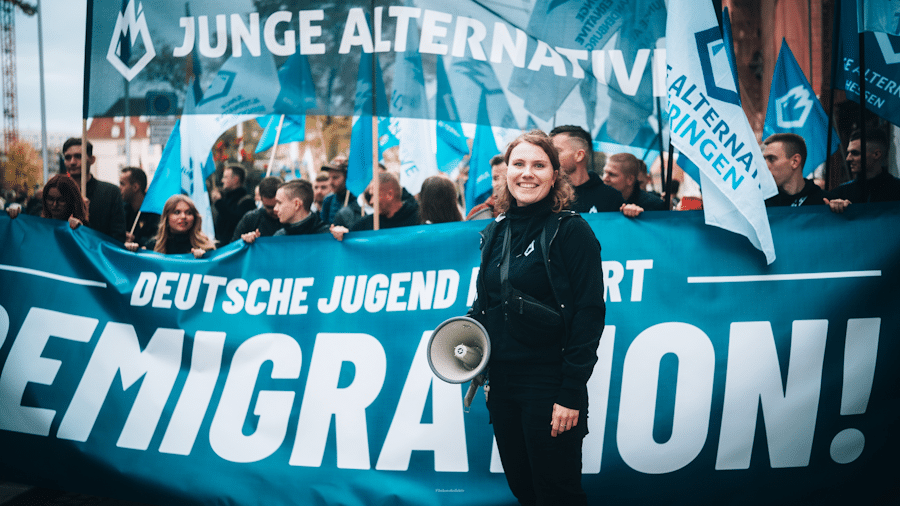
Why Germany’s far-right AfD youth wing faces a ban

Anna Leisten is cheerful, young and radical. That’s how she appears in the many images she’s posted on Instagram, at least.

She’s one of the best-known faces of Germany’s Junge Alternative (JA), or Young Alternative, the youth wing of the far-right Alternative for Germany (AfD) party. Her social media profile says she can be anything “from a braid-wearing sweetie pie to a forged-iron soldier.”

Share