The Third Opium War

In the mid-1800s, Great Britain engaged in two wars against China’s Qing dynasty. The conflicts began when the emperor attempted to crack down on the illegal opium trade that was causing widespread addiction with devastating economic and social upheaval in China.

By 1820, Britain’s East India Company was importing huge amounts of opium from India into China. In 1839, agents of the emperor confiscated and destroyed 1,400 tons of opium warehoused in Canton by British merchants. In response, British warships sailed up the Pearl River and attacked and occupied Canton, overwhelming the inferior Qing forces. This became known as the First Opium War. As a result, China was forced to cede Hong Kong to the British and expand their access from one to four ports. A Second Opium War in 1856 saw British warships capture Peking and burn the emperor’s summer palace, gaining access to many more mainland Chinese ports and the legalization of opium in a forced settlement. These became known as the Unequal Treaties. Merchants in other European nations, as well as the U.S., soon joined in the opium trade.

Share

Canadian Heritage Department Bought Maple Leaf Pins Made in China

The Department of Canadian Heritage bought over $300,000 worth of maple leaf pins made in China, according to records presented in the House of Commons, despite MPs condemning the Chinese Communist Party (CCP) for genocide last year.

According to a House “Inquiry of Ministry” obtained by Blacklock’s Reporter, the department has spent exactly $344,513 over the past two years on Chinese-manufactured Canada flag pins.

Not an accident, just everyday Liberal corruption.

Share

Can the US live in Xi Jinping’s world?

Ten days ago Xi Jinping walked out in front of the world’s media – depleted somewhat by his government’s growing intolerance of foreign reporters – as the most powerful Chinese leader in decades.

A tradition that limited his recent predecessors to two terms had been broken. And third term in hand, he had cemented his power over China, perhaps indefinitely.

But even as Mr Xi’s grip tightens at home, on the international stage the situation has rarely looked more unsettled.

The more the Communist Party leader has reinforced China’s authoritarian model, the more he has challenged a defining assumption of our age of globalisation – as China got richer, it would become freer.

Share

Germany Selling Critical Infrastructure to China

Germany’s Chancellor Olaf Scholz has apparently learned nothing from Germany’s fatal mistake of becoming dependent on Russian gas.

On October 26, Germany’s government decided to let the Chinese state-owned enterprise COSCO Shipping Ports, which has links to China’s People’s Liberation Army, buy a stake in the Port of Hamburg. COSCO is the world’s third-largest container carrier measured by capacity, and the fifth-largest port terminal operator in terms of the amount of cargo and vessels that it handles, according to German think-tank Merics. The Port of Hamburg is Germany’s largest port and the second-largest port in Europe, making it part of Europe’s most critical infrastructure.

Share

Alleged Chinese Police Stations in Canada: How Did They Get Here? And Why Aren’t They Shut Down Yet?

Of all the countries where China has purportedly set up unofficial police stations, only Ireland has so far ordered its local one to be closed. Authorities in other countries, including in Canada, have at most said they are “investigating” the issue.

This came after a Spanish NGO, Safeguard Defenders, published a report in September alerting countries like Canada to these stations on their soil. The station in Dublin, Ireland, displayed a public sign, “Fuzhou Police Overseas Service Station.” Other stations, such as the reported three in Toronto, are more subtle.

Share

UN Sides with China Despite Its Own Report Condemning Xinjiang Abuses

The recent United Nations Human Rights Council (UNHRC) vote — rejecting the West’s proposal to debate China’s possible “crimes against humanity” in its treatment of its Muslim minority in Xinjiang — covered up Beijing’s gruesome treatment of its Uyghur Population. This vote, saving face for the Chinese Communist Party at its recently concluded 20th National Congress, shields the Chinese regime’s true nature and indicates its increasing influence in international affairs.

The 19 to 17 vote with 11 abstentions was a stinging defeat for UN High Commissioner for Human Rights Michelle Bachelet, who had released on August 31 a damning report on China’s inhuman treatment of Xinjiang’s Uyghurs.

Share

TikTok tells European users its staff in China get access to their data

TikTok is spelling out to its European users of the platform that their data can be accessed by employees outside the continent, including in China, amid political and regulatory concerns about Chinese access to user information on the site.

The Chinese-owned social video app is updating its privacy policy to confirm that staff in countries, including China, are allowed to access user data to ensure their experience of the platform is “consistent, enjoyable and safe”.

The other countries where European user data could be accessed by TikTok staff include Brazil, Canada and Israel as well as the US and Singapore, where European user data is stored currently.

Share

Canada’s Ability to Detect Chinese, Russian Incursions in Arctic ‘Very Limited,’ Says CAF General

Canada’s ability to detect foreign incursions in its Arctic territories is “very limited” and in need of modernization, says a high-ranking Canadian Armed Forces (CAF) general.

“The North Warning System is very limited in its ability to actually detect the current threat presented by Russia right now and China in the future,” said Lt. Gen. Alain Pelletier, deputy commander of the North American Aerospace Defense Command (NORAD), while testifying before the House of Commons national defence committee on Nov. 1.

Share

CSIS is ‘increasingly concerned’ about China’s interference in Canada

Canada’s spy agency is growing “increasingly concerned” about China’s attempts to influence Canadian politics, a senior official told members of Parliament on Tuesday.

That’s because the Chinese Communist Party (CCP) is “involved and interested in promoting their own national interests” in Canada, Michelle Tessier, the deputy director of operations for the Canadian Security Intelligence Service (CSIS) told the procedure and House affairs committee on Tuesday.

Share

Special committee of MPs will see secret documents on firing of two Winnipeg infectious disease scientists

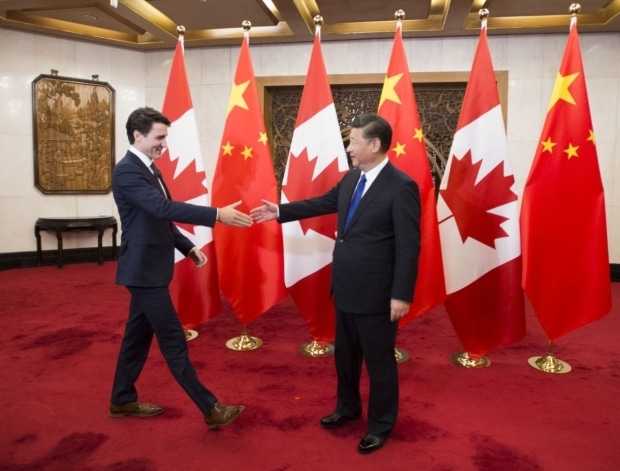
Justin Trudeau Xiangguo Qiu Keding Cheng – Everybody say Xi

The federal government and the three main opposition parties have agreed to set up a special committee of MPs that will have unfettered access to all national security documents related to the firing of two infectious disease scientists at the National Microbiology Laboratory in Winnipeg.

Government House Leader Mark Holland said Tuesday that his Conservative, Bloc Québécois and NDP counterparts have signed a memorandum of understanding that will allow MPs on an ad hoc committee to learn why Xiangguo Qiu and her husband, Keding Cheng, were dismissed in January, 2021. The committee will also see all secret documents involving the transfer of Ebola and Henipah viruses, overseen by Dr. Qiu, to China’s Wuhan Institute of Virology in March, 2019.

Share

America’s military isn’t ready for a war with China

It’s facing a readiness crisis and underfunding, among other issues

China’s 20th Party Congress concluded on October 23, and President Xi Jinping secured a norm-breaking third term as leader of the Chinese Communist Party (CCP). With the Politburo Standing Committee stacked with close confidants and dissent virtually wiped out, Xi is the strongest he has ever been.

Xi has also redoubled the Party’s commitment to taking the island of Taiwan, by force if necessary. Secretary of State Antony Blinken recently said that China “was determined to pursue reunification on a much faster timeline.” The alarm has been repeatedly sounded by American military officials, with speculation that a Chinese invasion of Taiwan could occur as soon as 2023.

Share

Axis of Evil: Chinese Tech Powering Iranian Drones in Russia-Ukraine War

The Iranian-made drones Russia is using to kill Ukrainians are being powered by Chinese technology, showing that the Communist regime is playing a larger role in the conflict than previously known, according to a watchdog group.

Chinese Communist technology is “enabling Iran to manufacture and supply drones to Russian forces,” according to the Institute for Science and International Security, a think tank that closely monitors Iran’s military infrastructure. “It appears that Chinese companies are supplying Iran with copies of Western commodities to produce UAV combat drones.” Components used to power these drones also appear to originate from companies based in the United States and Europe.

Share

Indictment of 7 Chinese Nationals for ‘Forced Repatriation’ of US Resident to China Indicates Similar Operations in Canada

A federal court in New York has charged seven Chinese nationals for harassing and coercing a U.S. resident to return to China as part of Beijing’s international extralegal repatriation campaign known as Operation Fox Hunt.

The indictment, recently unsealed by a Brooklyn, N.Y. court, shows that similar operations were carried out on Canadian soil.


I’m beginning to suspect that our armed forces recruiting failure is due to Canada no longer being viewed as a nation, let alone one worth defending. Thanks Liberals.

Share

Olaf Scholz won’t dump China. Will Europe ever learn?

It was early fall, 1959. A senior official from Mao’s China was leading a mission to Kyiv, then part of the Soviet Union. He inspected factories, learned about state planning, and took an afternoon boat trip on the Dnipro River with his 30-plus comrades. It’s nothing like the Ukraine his son has to deal with today.

Xi Zhongxun, father of the current Chinese President Xi Jinping, led the visit. As secretary-general of the State Council, the government arm of the Communist Party, Xi the senior spent a total of four days in what is now Ukraine’s capital. The trip also took him to Moscow and Prague, and apparently left a mark on the boy who would one day run the only powerful Communist Party left standing on earth.

Share

Will China inspire Trudeau to expand fossil-fuel resources?

Much of the international news coverage of the Chinese Communist Party’s quinquennial congress, which wrapped up last weekend, focused on the ruling autocrats’ increasingly belligerent foreign policy.

Also, the way President Xi Jinping’s ruthless enforcement of his “zero-COVID” policy still has more than 200 million citizens under complete lockdown (no leaving their apartments, no ordering in meals or groceries), which is affecting international supply chains.

Our government functions beneath high-school level intelligence.

Share