
A China Deal That Trades Leverage for Illusion

Canada’s newly announced trade memorandum with China has been presented by the federal government as pragmatic statecraft in a turbulent world. Lower tariffs on canola and seafood in exchange for the entry of nearly 50,000 Chinese electric vehicles, we are told, will diversify exports, lower consumer prices, and signal Canada’s independence from American protectionism.

This framing is incomplete. More troublingly, it is strategically naive. Trade policy is not merely about price and volume. It is about leverage, reciprocity, industrial resilience, and alignment with trusted partners. On those measures, this agreement falls short.

Share

CHARLEBOIS: Carney’s trip to China revealed Ottawa knows CUSMA could collapse before year’s end

The trade feud between Canada and China is finally thawing — and it was long overdue.

The rupture began in 2018 with the arrest of Meng Wanzhou, a senior executive of Huawei, in Vancouver. What followed was not merely a diplomatic dispute, but a calculated economic response: China weaponized trade, and Canadian agriculture became collateral damage. Canola, pork, lobster, and other agri-food exports faced punitive tariffs and informal barriers that reverberated across rural Canada for years.


Climate finance? With Coal King China? Globalist Gibberish.

Share

China EV deal puts Canada’s entire auto sector at risk, industry leaders say

The Canada-China trade deal announced early Friday puts the future of Canada’s entire automotive industry at risk and concedes ground to “hostile” players in the market, say Canadian automotive industry leaders.

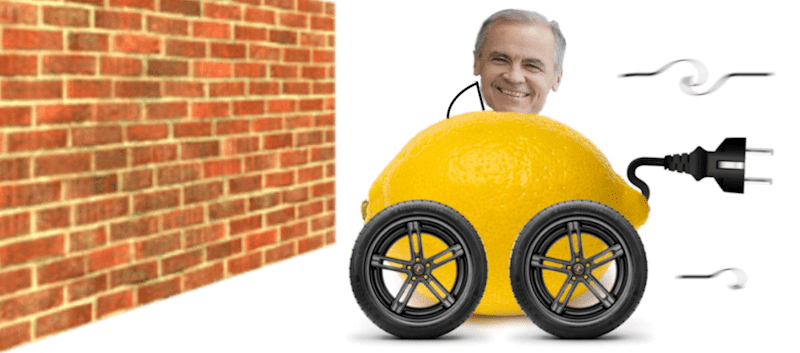
“This is a self-inflicted wound to an already injured Canadian auto industry,” said Unifor national president Lana Payne in a press release reacting to news of the deal, which allows 49,000 Chinese EVs a year into Canada, at the “most-favoured nation” tariff rate of 6.1 per cent.

Share

Doug Speaks!

Ontario premier slams Canada’s ‘lopsided’ new EV deal with China

Ontario Premier Doug Ford isn’t mincing words about Canada’s new electric vehicle deal with China, saying Friday that Chinese manufacturers are gaining a foothold in the country’s auto market at the expense of workers in this country.

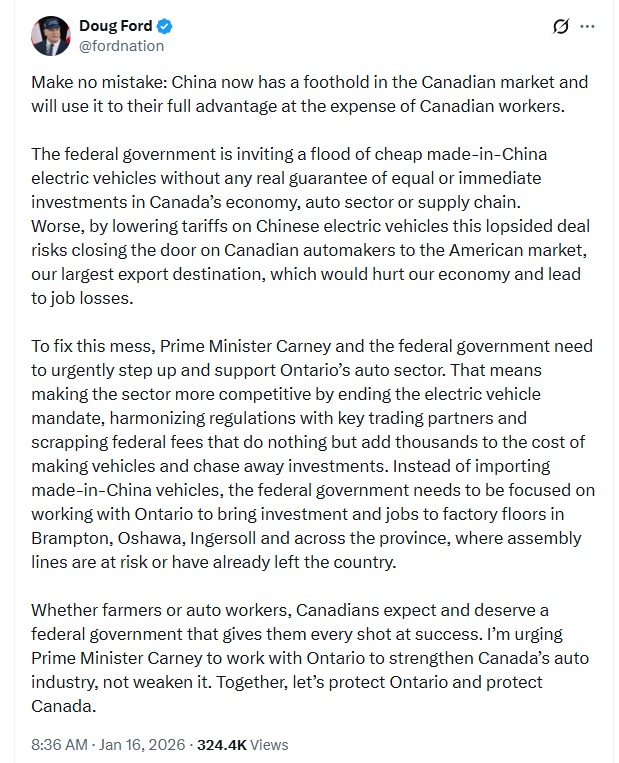
“The federal government is inviting a flood of cheap made-in-China electric vehicles without any real guarantee of equal or immediate investments in Canada’s economy, auto sector or supply chain,” Ford said in a statement issued shortly after news of the deal broke.

Share

Doug Ford blasts Mark Carney’s EV deal with China

Premier Doug Ford is panning Prime Minister Mark Carney’s slashing of Canada’s 100 per cent tariff on Chinese electric vehicles.

“Make no mistake: China now has a foothold in the Canadian market and will use it to their full advantage at the expense of Canadian workers,” Ford warned Friday after Carney reached a deal with Beijing in exchange for China cutting retaliatory levies on Canadian canola and seafood.

“The federal government is inviting a flood of cheap made-in-China electric vehicles without any real guarantee of equal or immediate investments in Canada’s economy, auto sector or supply chain,” the premier said in a statement.


The loss of Canada’s automotive industry is inevitable assuming Trump holds true to course and reshores manufacturing.

And EV’s are not the future but that won’t stop Carney and his plans to turn bad policy into profit for the China class.


This may be a tacit admission by Ford that the Great EV Gamble came up snake eyes.

“To fix this mess, Prime Minister Carney and the federal government need to urgently step up and support Ontario’s auto sector,” he added.

“That means making the sector more competitive by ending the electric vehicle mandate, harmonizing regulations with key trading partners and scrapping federal fees that do nothing but add thousands to the cost of making vehicles and chase away investments,” stressed Ford”

Share

ChiCom EV’s On The Way! A Victory For Carney’s New World Order!

Of course … Canada and China reach tariff deal on electric vehicles, canola

BEIJING — Canada will lower its U.S.-aligned tariffs against Chinese electric vehicles in exchange for China reducing tit-for-tat tariffs against Canadian canola and seafood, a deal that has the potential to anger U.S. President Donald Trump.

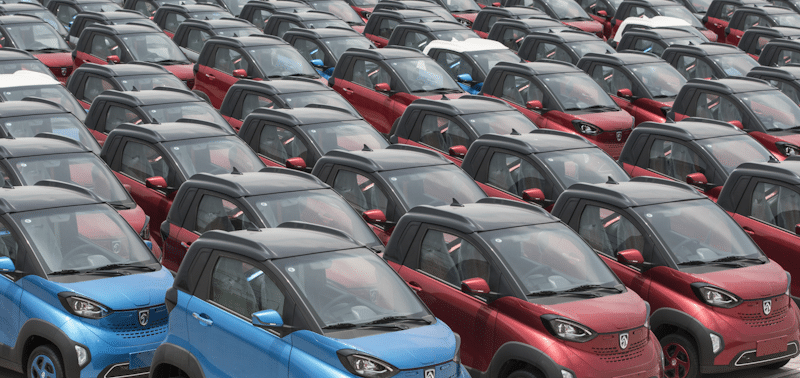
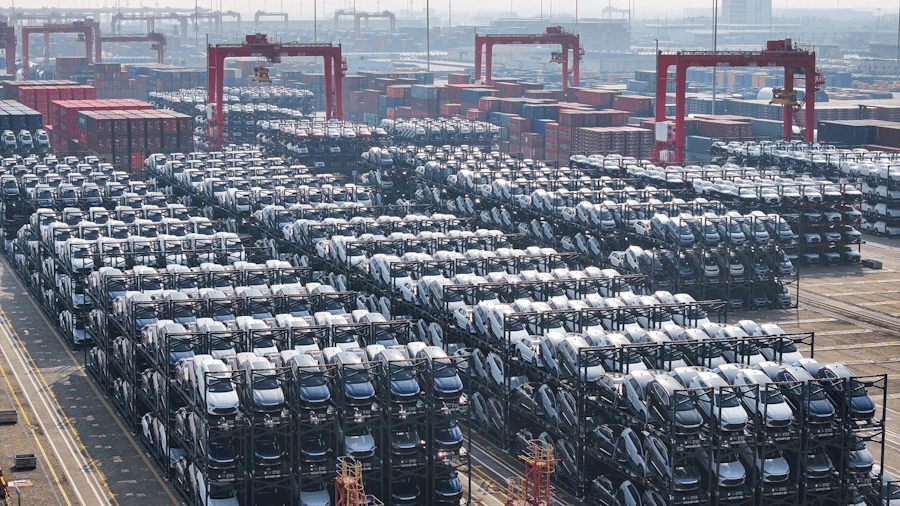
Under the agreement, Canada will allow a small toehold for up to 49,000 Chinese EVs to enter the Canadian market at a tariff rate of 6.1 percent, down from the current tariff rate of 100 per cent that Ottawa applied on Chinese-made EVs in fall 2024.

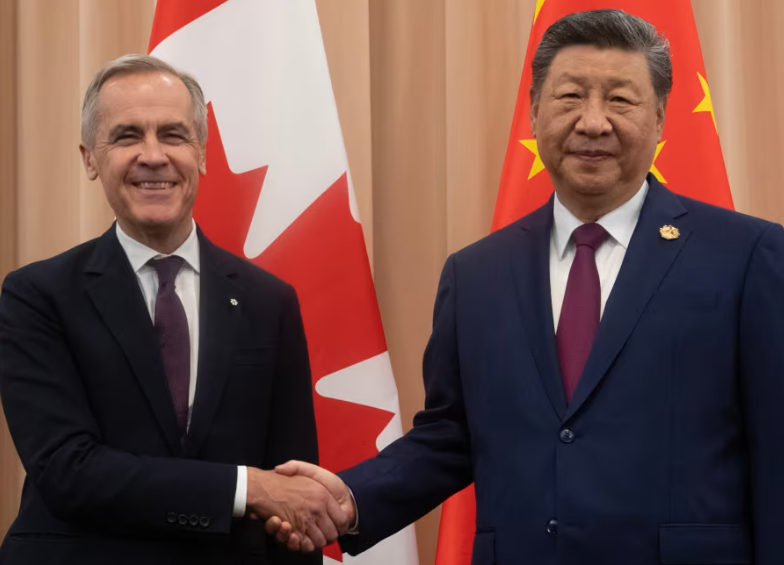
Prime Minister Mark Carney said it simply returns to a rate that Canada once had with China in 2023 prior to its “recent trade frictions.”

He underscored Chinese manufacturers — who churn out electric cars far more cheaply than North American-made EVs — will invest in auto production in Canada.


WARMINGTON: Mark Carney tells China, Canada ready for ‘New World Order’

When you have Prime Minister Mark Carney talking to leaders in China about the “new world order,” one has to wonder what could be coming next.

Social credit scores? Digital ID? More carbon taxes? More net zero talk? Fifteen minute cities?

Share

Joly Hints Ottawa Seeking Free Trade With China

Industry Minister Mélanie Joly says Canada should pursue free trade with other countries, including China, in the face of rising U.S. protectionism.
Joly made the comment in Beijing on Jan. 15 after a day of meetings in the Chinese capital, which included the signing of bilateral agreements and a meeting between Prime Minister Mark Carney and Chinese Premier Li Qiang.

Carney in running to be the next Maduro …

Free Trade with China? Say goodbye to the auto industry.

h/t Hermes, Clink9, Auntie Polly and XC

Share

Every country for itself: The chilling message in Mark Carney’s snub of Taiwan

Imagine for a moment that a delegation of friendly foreign lawmakers has been urgently summoned back home in the middle of an all-expenses-paid visit to Ottawa.

Invited to Canada in the hope of building relationships and nurturing alliances in a hostile world, they’ve fled to avoid angering U.S. President Donald Trump, or to be seen as fraternizing with a territory he claims as the 51st American state.

The insult to Canada and to Canadians would be obvious.

Share

Mark Carney wants to boost trade with China without angering Donald Trump

VANCOUVER—At a critical time of upheaval in global politics, Prime Minister Mark Carney is trying to court the attention of one great power and avoid the ire of another, all while holding his political ground at home.

Carney was to leave Canada Tuesday afternoon. En route to Beijing, the prime minister detoured to do the thing he’s accused of not doing enough: listen to the political leaders who could make or break a key part of his ambitious trade agenda.

Share

Carney government in talks with China about EV tariffs

OTTAWA — Canadian negotiators are in “active discussions” with China about lowering or dropping tariffs on Chinese-made electric vehicles in exchange for easing punitive Chinese counter-tariffs on Canadian canola and seafood, but government officials declined to say how it might affect Canada’s trade tensions with a U.S. administration that is hawkish on blocking China’s EVs from North America.

On the eve of Prime Minister Mark Carney’s trip to Beijing, the talks are considered so politically sensitive as the U.S. and Canada navigate the upcoming negotiation to renew the North American free trade pact that Canadian officials would say very little about the tariff dispute that is jamming Ottawa between China and the U.S. and opened a double trade war for this country.


It appears Ford was not asked for comment.

Share

Small majority of Canadians want more trade with China: Ipsos poll

As Prime Minister Mark Carney prepares to travel to China and seeks to restore trade and diplomatic ties, a small majority of Canadians say they support more trade with Beijing, a new poll suggests.

The Ipsos poll conducted exclusively for Global News, released Saturday, found that 54 per cent expressed support for closer trade ties and economic agreements with China.

The Elbow People are driven mad with TDS.

Share

Carney’s Beijing Visit Sends a ‘Deeply Troubling Signal’: China Watchers Alarmed by PM’s Trip

Chinese Canadian pro-democracy activist Sheng Xue says the timing of Prime Minister Mark Carney’s visit to China next week “sends a deeply troubling signal,” given the United States, Canada’s closest ally, is taking action to curb the regime’s reach in the Western Hemisphere.

Carney will meet with Chinese leader Xi Jinping, Premier Li Qiang, and business leaders during his visit to China from Jan. 13 to Jan. 17, the Prime Minister’s Office (PMO) said. Discussions are expected to revolve around trade, energy, agriculture, and international security.

Share

Ontario Premier Ford asks Carney not to cut tariffs on China EVs

Ontario Premier Doug Ford, whose province is home to much of Canada’s auto industry, is warning the Prime Minister against reducing the 100-per-cent tariffs on Chinese electric vehicles during Mark Carney’s trip to Beijing next week.

He said China should instead set up EV factories in Ontario. A Chinese EV-maker opened an electric-bus assembly plant in Newmarket, Ont., in 2019, for instance.

Share

Tasha Kheiriddin: Venezuela proves Trump wants China out. Carney better take notice

Happy New Year. Or not, depending on where you find yourself these days. If you’re deposed Venezuelan dictator Nicolás Maduro, that’s in a cell in Brooklyn, N.Y. If you’re U.S. President Donald Trump, that’s on the catbird seat in Washington, D.C. And if you’re Canadian Prime Minister Mark Carney, that’s on a tightrope in Ottawa, trying to strike the right note with an ally that looks more like an aggressor every day.

Share

China’s Economic Miracle Was Built on Mass Displacement

Editor’s Note: The Bureau is publishing the following testimony to Canada’s House of Commons committee on International Human Rights from Dimon Liu, a China-born, Washington, D.C.-based democracy advocate who testified in Parliament on December 8, 2025, about the human cost of China’s economic rise. Submitted to The Bureau as an op-ed, Liu’s testimony argues that the Canadian government should tighten scrutiny of high-risk trade and investment, and ensure Canada’s foreign policy does not inadvertently reward coercion. Liu also warns that the Chinese Communist Party could gain leverage over Canadians and treat them as it has done to its own subjugated population—an implied message to Prime Minister Mark Carney, who has pledged to engage China as a strategic partner without making that position clear to Canadians during his election campaign.

This is what Carney wants for Canada.

Share