Is opening Canada’s market to Chinese EVs a strategic necessity or a costly mistake?

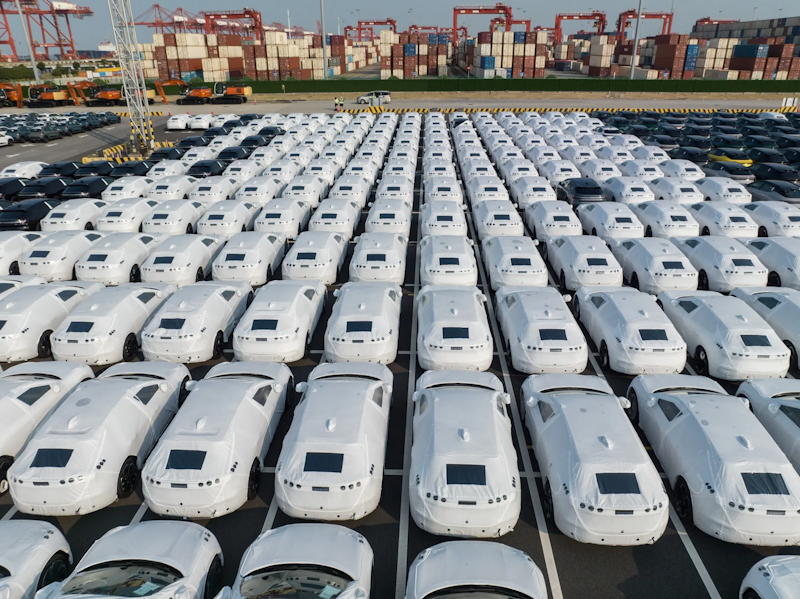
During a January visit to Beijing, Prime Minister Mark Carney announced a sharp cut to tariffs on Chinese electric vehicles, opening the door to 49,000 imports a year and sparking a debate over trade, security and Canada’s auto future.

Brian Kingston, president and chief executive officer of the Canadian Vehicle Manufacturers’ Association, argues the decision risks Canada’s most important trade relationship and undermines domestic manufacturing. Heather Exner-Pirot, senior fellow and director of energy, natural resources and environment at the Macdonald-Laurier Institute, counters that the tradeoff is justified to diversify export markets and support Canada’s agricultural and oil and gas sectors.


Share

The U.S. no longer believes that trade can be a win-win. Buckle up, Canada

Trade negotiations used to be underpinned by an unspoken assumption: that trade barriers were lose-lose propositions. All sides could gain something if they mutually disarmed.

Each country would agree to lower its tariffs, a little or a lot, in return for others doing likewise. Trade negotiations were always about how much tariffs and other walls would go down, not how much they would go up.


Trade deals hollowed out manufacturing in Canada and the US, no one but the connected made money.

Share

Poilievre says China is no substitute for the United States as Canada grapples with Trump

OTTAWA — Conservative Leader Pierre Poilievre said trade with China is no substitute for trade with the United States and Canada should build on its leverage to secure a tariff-free trade deal with our neighbour to the south.

“Canada’s prosperity and security are inseparable from a stable relationship with the United States,” said Poilievre, during a speech at the Economic Club of Canada in Toronto on Thursday.

Share

Any trade deal with Canada will include tariffs, says Trump’s trade rep

U.S. President Donald Trump’s point man on trade talks says Canada needs to accept that tariffs will be a part of any deal with the administration, including renewal of the Canada-U.S.-Mexico Agreement (CUSMA).

In interviews with two CBC News journalists on Capitol Hill just after Trump’s state of the union address Tuesday night, U.S. trade representative Jamieson Greer suggested Canada can’t expect to land a trade agreement that is free of tariffs.

“When we go to other countries, and we make a deal with them … they agree that we can have a tariff on them,” Greer told CBC News correspondent Katie Simpson.

Share

Poilievre to pitch new policies aimed at dealing with Trump in speech to business leaders

Conservative Leader Pierre Poilievre is set to unveil a suite of policy proposals meant to address the uncertainty caused by U.S. President Donald Trump’s administration, according to a member of his senior staff.

Poilievre will deliver a speech to business leaders at the Economic Club of Canada in Toronto on Thursday that the organization is billing as a “vision for Canada-U.S. relations.”

Katy Merrifield, Poilievre’s head of communications, told CBC News that the speech will include new policy proposals that are intended to be realistic and aimed at restoring Canada’s leverage in an unstable geopolitical environment.

Share

‘It’s just insane.’ New Trump tariff confusion sparks border mayhem for Canadian businesses

It’s another day of chaos thanks to Donald Trump’s trade war.

Confusion and frustration reigned for Canadian businesses Tuesday as the U.S. Customs and Border Patrol started charging a new global tariff on imports Tuesday at 10 per cent, rather than the

15 per cent threatened by the U.S. president on Saturday.

That bump to 15 per cent, in turn, came just a day after an angry Trump lashed out at a U.S. Supreme Court ruling against some of his other tariffs, and vowed a new global tariff — at 10 per cent.

Share

John Ivison: Trump’s tariffs on Canada are about to get worse

The 6-3 majority U.S. Supreme Court decision on the unlawful nature of President Donald Trump’s emergency act tariffs suggests democracy is still alive in the Great Republic.

Friday’s decision reaffirmed the basic constitutional principle about the separation of powers between Congress and the president, clarifying that Trump has no authority on his own to impose tariffs using the International Emergency Economic Powers Act (IEEPA) because the Constitution gives that power to Congress.

The ruling drops the average “posted” tariff rate to around seven per cent from 16 per cent.

Share

A chance for Poilievre to flip the Trump script

When one of Pierre Poilievre’s Conservative MPs, Jamil Jivani, travelled to Washington to meet with Trump administration officials, he chose to chastise Canadians for having an anti-American “hissy fit” in an interview with MAGA site Breitbart News.

It’s hard to imagine a more harmful piece of public relations for the Conservatives.

And it is a golden opportunity for Mr. Poilievre.


The “Hissy Fit” comment only upsets the Elbow people who somehow can’t see that in the LPC they support the very people who have made Canada “Poorer than Alabama”.

Share

Canada’s great American breakup: Most now see U.S. as a risk, not an ally, poll finds

Canadians currently view the United States as more of a risk than a partner, according to a new poll that finds three-quarters dispute the idea that our southern neighbour is a trustworthy ally.

A survey by Nanos Research for The Globe and Mail took stock of deteriorating Canadian opinions of the United States after U.S. President Donald Trump’s first year back in office.

The findings suggest a profound level of distrust and a significant recasting of how Canadians see the United States.

Share

Warning shot: How Canada fits into Washington’s rebuke of the EU’s ‘buy European’ defence drive

The ink isn’t even dry on Canada’s new defence industrial strategy, and there are already uneasy rumblings from Washington. The objections are not aimed at Canada — at least not yet — but they could eventually spill across an already strained border.

A week ago, both the U.S. State Department and the Department of Defence quietly fired a shot across the bow of the European Union over its rearmament plans.

The Trump administration warned European allies against defence policies that favour domestic producers — commonly known as the “buy European” clauses in a security directive recently revised by the EU.

Share

The Ruling Striking Down Trump’s Tariffs Changes Little for Canada

For Canadians, the United States Supreme Court ruling on Friday striking down many of President Trump’s tariffs changes very little.

A 35 percent tariff on most Canadian exports to the United States was put in place last year, and that tariff has now been struck down.

It was brought in because Mr. Trump claimed, all evidence to the contrary, that vast quantities of fentanyl and large numbers of migrants were crossing into the United States from Canada.

Share

How Trump plans to continue his trade war with Canada without IEEPA

U.S. President Donald Trump vowed to ramp up his use of sector-based duties and others after the Supreme Court ruled against a swath of his existing tariffs on Friday, raising new risks for a Canadian economy that’s struggled mightily with duties that target specific industries.

Sectoral tariffs implemented under Section 232 of the U.S. Trade Expansion Act of 1962 – including those on autos, steel and aluminum – have delivered the harshest blow to Canada, because most other products continue to trade tariff-free under a crucial exemption.

Share

Canada looks to trade talks after US Supreme Court tosses Trump’s tariffs

Celebrations in Canada over the decision by the US Supreme Court to strike down President Donald Trump’s global tariffs were both brief and muted.

The high court’s decision, which included the “fentanyl” tariffs Trump imposed on Canada, China and Mexico, reinforced Canada’s position that the levies were “unjustified”, US-Canada Trade Minister Dominic LeBlanc said on X.

But LeBlanc noted the challenges ahead in Ottawa. There is the “critical work” to do in dealing with impacts from levies on steel, aluminium and automobiles, which Trump said will remain.

There is also the upcoming review of the Canada-US-Mexico trade deal, the USMCA, which covers a market of more than 500 million people.

Share

J.D. Tuccille: Trump’s trade war merely weakened

U.S. President Donald Trump’s trade war against American consumers (and Canada and the rest of the world) isn’t over, but it just suffered a major setback. In a 6-3 decision, the U.S. Supreme Court ruled that the law on which the president relied to unilaterally impose high tariffs without seeking congressional approval awards him no such authority. With two of the three justices Trump appointed to the high court joining the decision, it’s a decisive blow against the Trump administration’s neo-mercantilist trade policies and also against the growth of executive power, which has been stretched beyond constitutional bounds by presidents from both major political parties.

What does the U.S. court ruling on Trump’s tariffs mean for Canada?

U.S. President Donald Trump vowed to use alternative ways to carry out his economic agenda on Friday after the U.S. Supreme Court struck down his use of global tariffs, and experts say Canada will likely continue to experience trade uncertainty with its southern neighbour.

Trump used the International Emergency Economic Powers Act (IEEPA) to justify imposing sweeping tariffs on several countries, including Canada and Mexico. On Friday, the top U.S. court ruled 6-3 that this emergency powers act does not give the president the power to impose what Trump called “reciprocal” tariffs.

and this…

LILLEY: Trump’s court loss on tariffs doesn’t mean much for Canada

Share