Peter Shurman: We can dislike Trump, but that shouldn’t define us

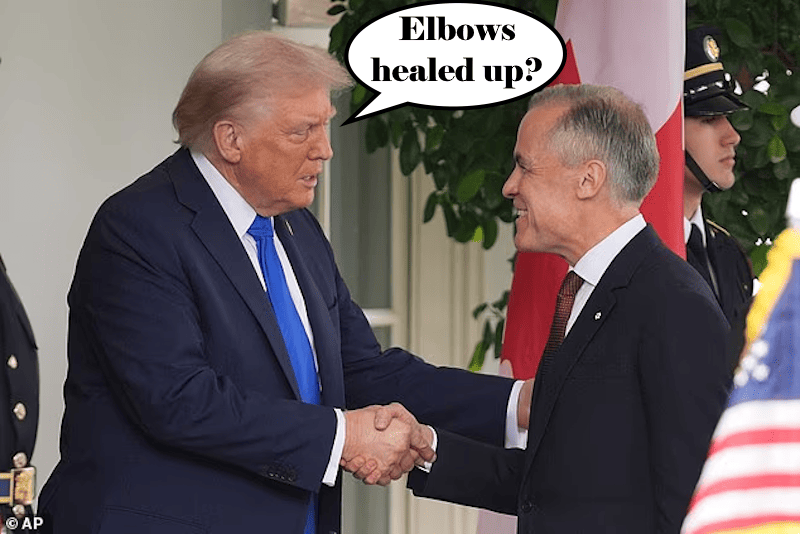
Let’s begin with a blunt question: Does Donald Trump hate Canada?

There is no evidence that he does. During his presidency, he did not sever diplomatic ties, cancel trade outright or threaten military action. What he did do, repeatedly and unapologetically, was put American interests first. He drove a hard bargain in trade negotiations, imposed tariffs on Canadian steel and aluminum, pressured NATO allies (including Canada) to increase defence spending and used language that many Canadians found abrasive, even offensive.

Share

U.S. could hold a ‘red card’ over Canada’s Gripen fighter jet option

There is a way the U.S. could play hardball with Canada, if the Liberal government of Prime Minister Mark Carney decides it wants to limit its purchase of F-35s in favour of the Gripen.

Critics who favour the Lockheed-Martin stealth fighter have long argued that the Swedish-built Gripen would not be interoperable with American aircraft and the North American Aerospace Defence Command (NORAD).

That’s not what you see at the NATO air policing mission in Iceland, where Danish-owned F-35s have been training and operating alongside Swedish JAS-39 Gripens-Cs.

Share

Fewer Than Half of Canadians See the End of CUSMA as Bad for Canada

Between February 18 and 23, 2026, Abacus Data surveyed 1,500 Canadian adults to understand how Canadians view Prime Minister Mark Carney’s approach to dealing with President Donald Trump and how they see the risks and stakes as the 2026 CUSMA joint review approaches.

The results point to a striking and potentially underappreciated dynamic.

Share

Carney to push his middle power strategy during Australia visit

Prime Minister Mark Carney has touched down on Tuesday in Sydney, Australia — the next stop on his Indo-Pacific tour aimed at shoring up investment in Canada and building new trade alliances.

On the agenda is a meeting with Prime Minister Anthony Albanese, a leader with whom Carney shares much common ground.

Carney will also address Australia’s parliament, becoming the first Canadian prime minister to do so in nearly 20 years. His remarks are expected to echo the themes of his widely noted speech in Davos, which urged “middle powers” to stand together.

Share

When it comes to the U.S., here is why Doug Ford should let others do the talking

“I’m going to be on the phone full steam, and later on, do a U.S. trip,” Premier Doug Ford told reporters at Queen’s Park on Monday. The Toronto Sun responded with its trademark headline treatment: “Doug, you’re not helping,” warning his CNN appearance risked inflaming an already bad situation.

There’s no doubt Premier Ford’s plain speaking makes for good television. But he must walk a fine line: advocate for Ontario’s interests, yes, but without handing U.S. politicians an excuse to dismiss Canada’s case as foreign meddling. On Monday, on Wolf Blitzer’s Situation Room, he crossed that line.

Share

Poilievre says he’s offered to go to U.S. to make Canada’s case

Conservative Leader Pierre Poilievre said he’s open to meeting with U.S. leaders if it will help Canada’s efforts to end the continuing trade dispute.

Mr. Poilievre also said he “can’t stand” U.S. President Donald Trump’s talk about Canada becoming the 51st state, doesn’t like Mr. Trump’s tariffs and doesn’t like the way he’s treating Canada.

Share

Canada’s Leader Heads to Asia and Australia to Build ‘Middle Power’ Bonds

Prime Minister Mark Carney of Canada, in a high-profile speech last month, described the Trump era as a rupture for countries like his, and called on global “middle powers” to band together to survive in the tumult of a changing United States.

This week, he is building on his plan to construct a middle-power sphere of trade and deep bonds by visiting India, Australia and Japan.

Accompanied by several ministers and provincial leaders, Mr. Carney wants to seal agreements to sell more oil, gas, and other natural resources abundant in Canada, secure investments and finalize defense deals with key Indo-Pacific countries.

Share

Is opening Canada’s market to Chinese EVs a strategic necessity or a costly mistake?

During a January visit to Beijing, Prime Minister Mark Carney announced a sharp cut to tariffs on Chinese electric vehicles, opening the door to 49,000 imports a year and sparking a debate over trade, security and Canada’s auto future.

Brian Kingston, president and chief executive officer of the Canadian Vehicle Manufacturers’ Association, argues the decision risks Canada’s most important trade relationship and undermines domestic manufacturing. Heather Exner-Pirot, senior fellow and director of energy, natural resources and environment at the Macdonald-Laurier Institute, counters that the tradeoff is justified to diversify export markets and support Canada’s agricultural and oil and gas sectors.

Share

The U.S. no longer believes that trade can be a win-win. Buckle up, Canada

Trade negotiations used to be underpinned by an unspoken assumption: that trade barriers were lose-lose propositions. All sides could gain something if they mutually disarmed.

Each country would agree to lower its tariffs, a little or a lot, in return for others doing likewise. Trade negotiations were always about how much tariffs and other walls would go down, not how much they would go up.


Trade deals hollowed out manufacturing in Canada and the US, no one but the connected made money.

Share

Poilievre says China is no substitute for the United States as Canada grapples with Trump

OTTAWA — Conservative Leader Pierre Poilievre said trade with China is no substitute for trade with the United States and Canada should build on its leverage to secure a tariff-free trade deal with our neighbour to the south.

“Canada’s prosperity and security are inseparable from a stable relationship with the United States,” said Poilievre, during a speech at the Economic Club of Canada in Toronto on Thursday.

Share

Any trade deal with Canada will include tariffs, says Trump’s trade rep

U.S. President Donald Trump’s point man on trade talks says Canada needs to accept that tariffs will be a part of any deal with the administration, including renewal of the Canada-U.S.-Mexico Agreement (CUSMA).

In interviews with two CBC News journalists on Capitol Hill just after Trump’s state of the union address Tuesday night, U.S. trade representative Jamieson Greer suggested Canada can’t expect to land a trade agreement that is free of tariffs.

“When we go to other countries, and we make a deal with them … they agree that we can have a tariff on them,” Greer told CBC News correspondent Katie Simpson.

Share

Poilievre to pitch new policies aimed at dealing with Trump in speech to business leaders

Conservative Leader Pierre Poilievre is set to unveil a suite of policy proposals meant to address the uncertainty caused by U.S. President Donald Trump’s administration, according to a member of his senior staff.

Poilievre will deliver a speech to business leaders at the Economic Club of Canada in Toronto on Thursday that the organization is billing as a “vision for Canada-U.S. relations.”

Katy Merrifield, Poilievre’s head of communications, told CBC News that the speech will include new policy proposals that are intended to be realistic and aimed at restoring Canada’s leverage in an unstable geopolitical environment.

Share

‘It’s just insane.’ New Trump tariff confusion sparks border mayhem for Canadian businesses

It’s another day of chaos thanks to Donald Trump’s trade war.

Confusion and frustration reigned for Canadian businesses Tuesday as the U.S. Customs and Border Patrol started charging a new global tariff on imports Tuesday at 10 per cent, rather than the

15 per cent threatened by the U.S. president on Saturday.

That bump to 15 per cent, in turn, came just a day after an angry Trump lashed out at a U.S. Supreme Court ruling against some of his other tariffs, and vowed a new global tariff — at 10 per cent.

Share