Was the money the US sent to Ukraine spent with the US military-industrial complex?

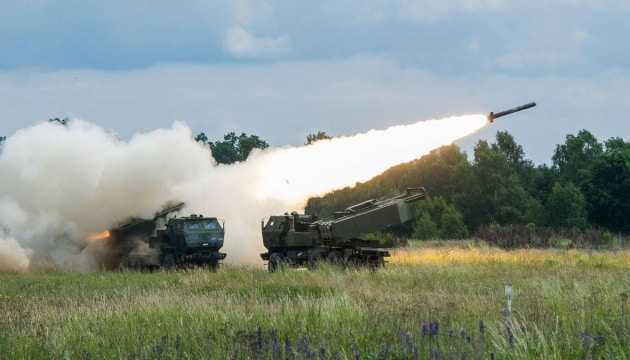
A significant portion of the money the U.S. allocated for Ukraine aid was indeed spent within the U.S., particularly with the military-industrial complex, rather than being directly transferred to Ukraine as cash. Here’s how it breaks down based on available information:

The U.S. has committed substantial aid to Ukraine since Russia’s invasion in February 2022, with Congress approving around $175 billion in emergency funding by mid-2024. This aid includes military, economic, and humanitarian support. However, the military component—channeled through mechanisms like the Presidential Drawdown Authority (PDA) and the Ukraine Security Assistance Initiative (USAI)—is where the connection to the U.S. military-industrial complex becomes clear.


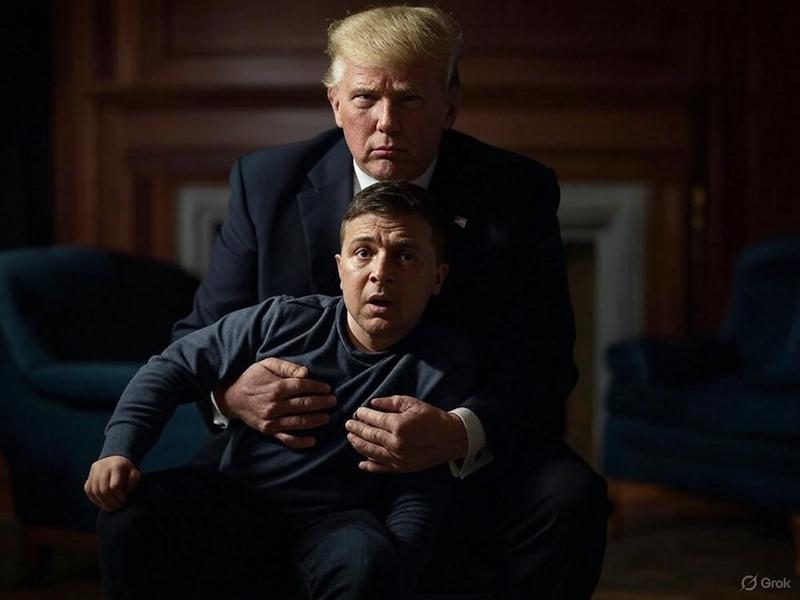
This is a Grok answer.

Europe seeks economic salvation via rearmament.

h/t XC

Share

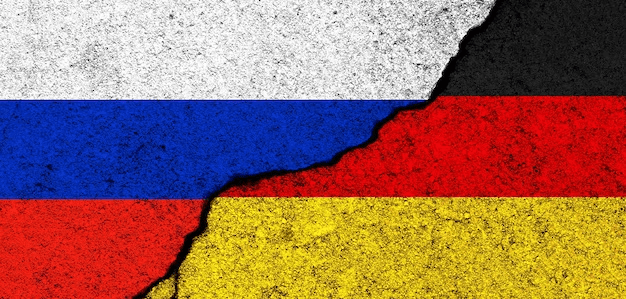
Germany’s soft spot for Russia

Business deals inform the nation’s politics

Mounted atop a former warehouse in Hamburg’s industrial-era docklands, the billowing form of the Elbphilharmonie concert hall rises above Germany’s second-largest city like an ocean wave. The glass-panelled building crowns a new, forward-looking section of the city, a modern and elegant counterpoint to the seedy Reeperbahn nearby. Built with the help of taxes raised from round-the-clock trade from the sprawling port it overlooks, it’s a testament to the country’s remarkable success as a trading nation, as globalisation opened new markets for “Made in Germany” goods.

The building’s scope and ambition echo the Victorian grandeur that can be found in Liverpool and London, and the epic public buildings of Paris, Antwerp and Amsterdam. It’s a building that marks a golden age. Its foundation stone was laid in 2007, when Germany was still Exportweltmeister (world’s top exporter) and before the convulsions of Brexit, Donald Trump’s trade wars, and Vladimir Putin’s efforts to carve up and control Ukraine. The opulent venue was finally finished in 2017, the same year Angela Merkel secured her final term as chancellor and the far-Right AfD showed signs of its political potential. Less than a decade later, it looks like a totem to a bygone era.

Share

Is MAGA Wrong on Ukraine? Douglas Murray thinks so. I don’t.

I am hardly alone among conservatives in stating that I greatly admire Douglas Murray, a fierce opponent of wokeness, defender of Israel, and author of such must-reads as The Strange Death of Europe and The War on the West. And that is why his latest piece in The Spectator, titled “The MAGA Movement is Wrong on Ukraine” is such a disappointment that I felt compelled to respond (the article is behind a paywall, unfortunately, but I have excerpted the key selections below).

“How can the right be so wrong? Or at least portions of the right – especially the American right – when it comes to Ukraine?” Murray asks and then explains.


No one wants Ukraine to fall but those attacking the US should validate their concern by helping pay the bills.

Share

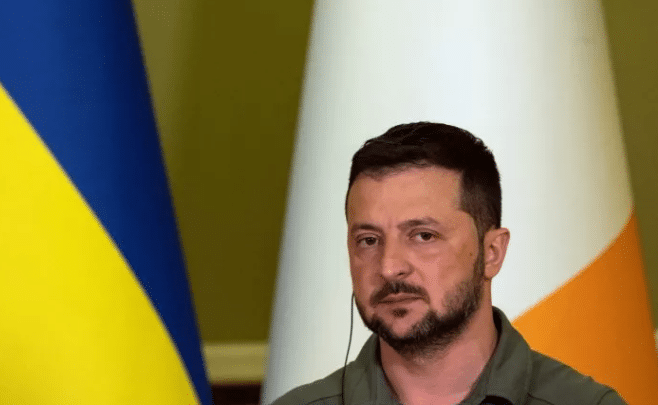
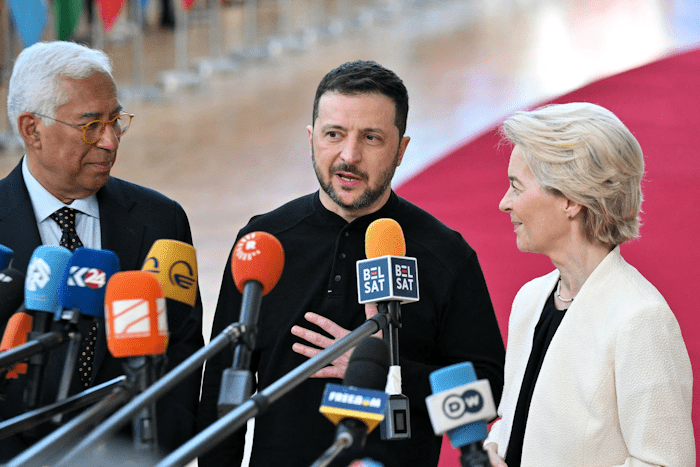
Zelensky will not attend high-level talks with Americans at Saudi peace summit

Volodymyr Zelensky will not attend high-level talks between Ukrainian and US negotiators next week but insisted his country is “fully committed” to peace talks.

The Ukrainian leader said that he would visit Saudi Arabia for talks with the Arabian kingdom’s crown prince on Monday but would not stay on for talks with representatives of the US government aimed at ending the war.

“Ukraine has been seeking peace from the very first second of this war. Realistic proposals are on the table,” he said in a statement posted to X.

Share

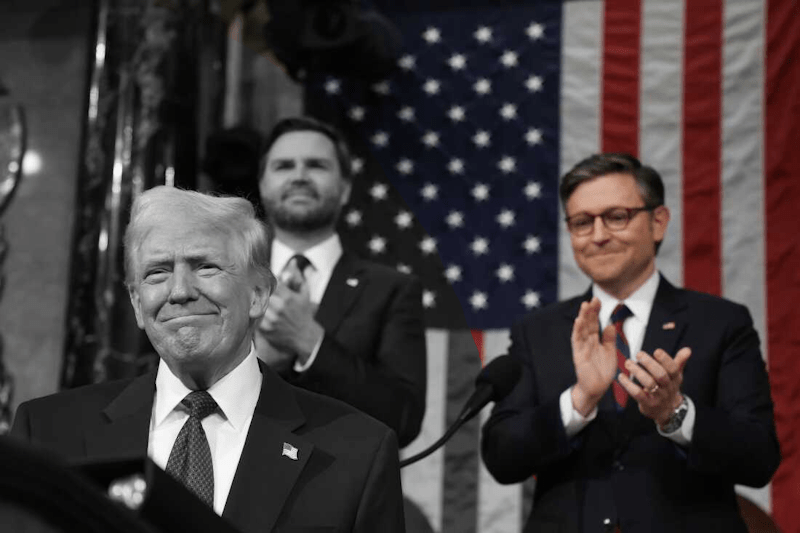
Trump says Ukraine ‘more difficult’ to deal with than Russia

US President Donald Trump has said he is finding it “more difficult, frankly, to deal with Ukraine” than Russia in attempts to broker peace between the two nations.

The US is “doing very well with Russia”, and “it may be easier dealing with” Moscow than Kyiv, Trump told reporters in the Oval Office on Friday.

Hours earlier, Trump had said he was “strongly considering” large-scale sanctions and tariffs on Russia until a ceasefire with Ukraine was reached.

Share

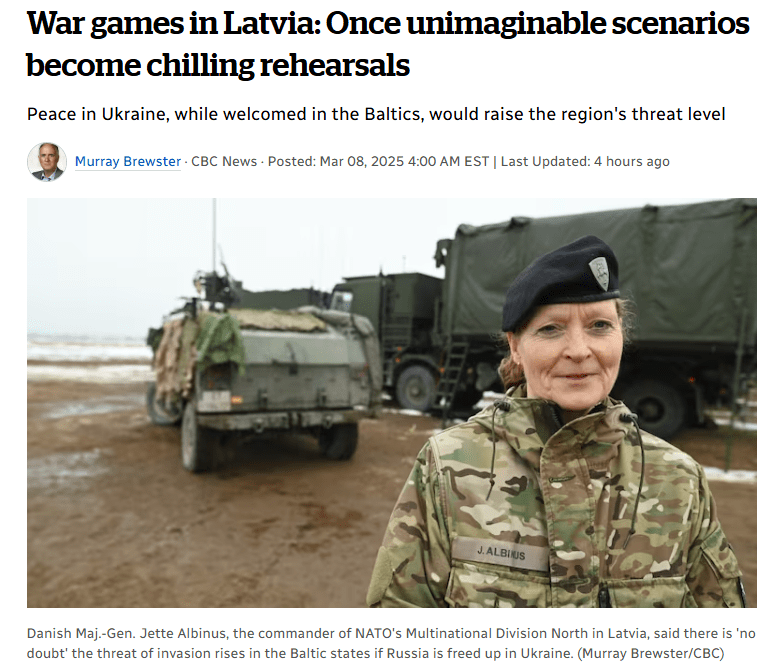
WAR IS PEACE! Commander of NATO’s Multinational Division North in Latvia Says Peace In Ukraine Would Be Destabilizing

A few years ago, the scenario which Canadian and other NATO troops rehearsed in Latvia last week might have seemed unthinkable — even alarmist to the untrained eye.

On a mud-soaked, winter-scorched training range a few dozen kilometres outside of Riga, roughly 3,400 troops from 14 nations — under the brigade leadership of a Canadian commander — exercised how they would conduct a last-ditch defence of the Latvian capital.

… The Western military alliance has organized the defence of Latvia under a multinational division, which includes the Canadian-led brigade. The division is led by Danish Maj.-Gen. Jette Albinus, who also told CBC News in a recent interview that a ceasefire — or full peace settlement in Ukraine — would allow Russia to turn its full attention to the Baltic region.

If fellow NATO members feel that way then they should spend whatever it takes to maintain their war. But they won’t they want the US to pay the freight.

Share

The perils and delusions of Europe’s new war economy

EU leaders can’t defend their own borders, let alone Ukraine’s.

The last time European states were embarking on rearmament, we were well down the road towards a world war. This time, it’s the war in Ukraine and the unravelling of the Western military alliance that are driving European rearmament. Suddenly, virtually every European head of state has become converted to the virtue of increasing defence spending and boosting the arms industry.

Share

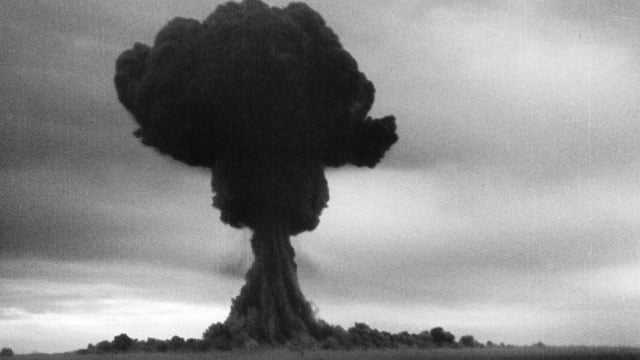
Europe’s nuclear delusion

Macron would never risk Paris for Vilnius

He’s not even chancellor yet, but Friedrich Merz already wants to revolutionise European security. In a recent interview on German television, he called for a European nuclear umbrella, with the Federal Republic swapping US protection for the backing of Britain and France. His geopolitical gambit isn’t surprising: the current generation of European political elites has never experienced such a crisis of confidence in the transatlantic relationship, with Donald Trump smashing the certainties they’ve held dear since the fall of the Berlin Wall.

Share

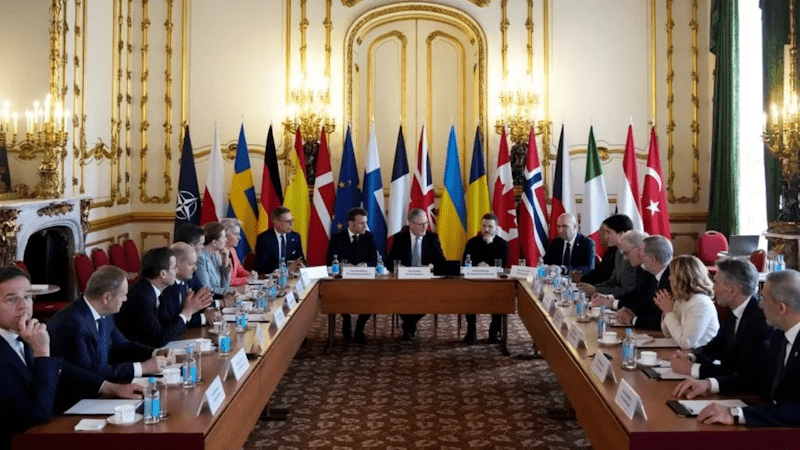
Europe Must Fully Cooperate with Trump’s Ukraine Peace Efforts

Coalition of the unarmed

Although a ceasefire to stop the killing in Ukraine appeared closer this week after Ukrainian President Zelensky sent President Trump a letter promising to cooperate with his peace efforts, European states are floating several unhelpful proposals that could hurt the peace process.

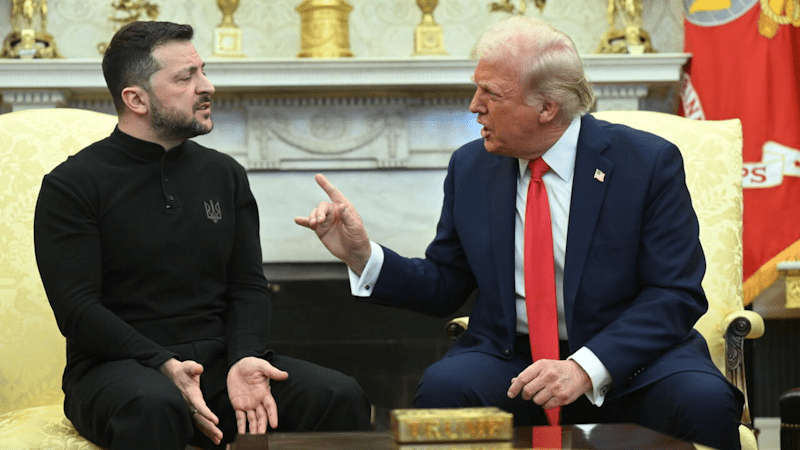
Zelensky was supposed to sign a deal at the White House last Friday, giving the U.S. access to his country’s rare earth mineral deposits. However, Zelensky’s insistence on first resolving other issues and his rude behavior during an Oval Office meeting with President Trump and Vice President Vance caused him to be booted from the White House and his relationship with Trump to break down.

Share

This is why you never take a sip from Andrew Coyne’s drink

Canada’s frightening new reality: our next door neighbour has upended the world order

The spectacle of U.S. President Donald Trump and his toady acolyte, Vice-President JD Vance, berating Ukrainian President Volodymyr Zelensky in the Oval Office last week was many things: embarrassing, shameful, shocking, reckless. But to Canadians watching their performance, the astonishing scene should have evoked another reaction: fear.

“Security guarantee” means the US picks up the defense tab while Europe continues to buy Russian Oil and Gas. She’s been ratio’d and deservedly so.

Share

Attacks on Ukraine’s draft officers on the rise, fueled by social tension and Russian interference

Within a single week in February, several attacks against enlistment offices and personnel in Ukraine took place, resulting in injuries among both military and civilians. The most striking was the murder of an enlistment officer at a gas station in Poltava Oblast.

A man killed the officer during an attempt to kidnap his acquaintance who had recently been mobilized into the army. The soldier died immediately from the gunshot wounds. Two accomplices were detained later the same day.

“Killing military personnel in the rear is a red line that cannot be crossed,” Mykhailo Drapatyi, commander of Ukraine’s Ground Forces, wrote on Facebook, reacting to the recent attacks.

Share

Ukraine opposition leaders confirm talks with US but deny plotting to oust Zelensky

Ukraine’s opposition leaders have confirmed they have held discussions with members of Donald Trump’s entourage, but denied on Thursday they were part of a reported White House plot to remove Volodymyr Zelenskyy from power.

The former president Petro Poroshenko said he had held talks with US representatives but added that he opposed Trump’s demands for wartime elections. Poroshenko, who lost to Zelenskyy in the 2019 presidential vote, said a poll should only be held once martial law ends.

Yulia Tymoshenko, Ukraine’s former prime minister, said she also opposes elections while fighting continues. She said her team was “talking with all our allies who can help in securing a just peace as soon as possible”.

Share

EU’s €150 billion defence plan won’t make up for US exit

Answers to Mrs. Hitler

Far too many times in recent history, the European Union has pledged to get serious, only to defer the process to some future date. When announcements come out, as with the Juncker investment fund a decade ago or the EU’s post-Covid recovery plan, there tends to be a flashy headline figure. But a closer look usually reveals that the numbers are underwhelming.

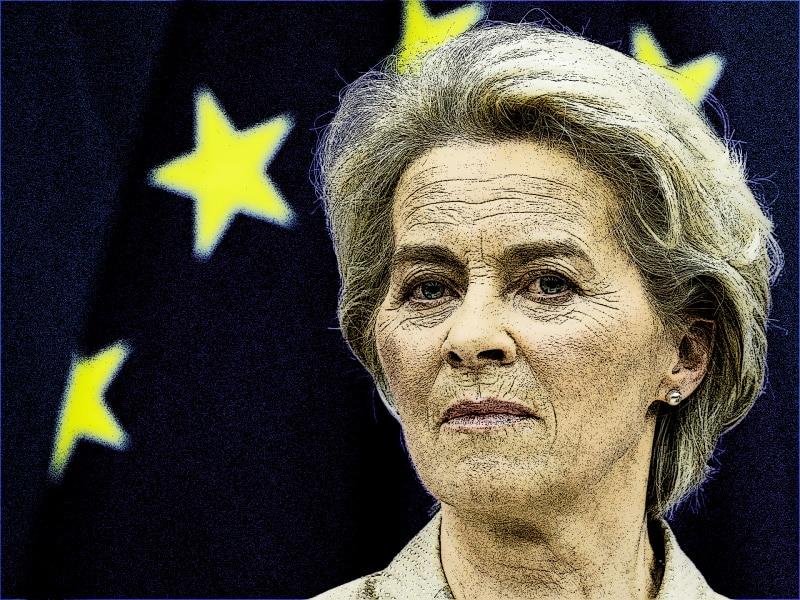
So it will likely prove for the defence package announced by European Commission President Ursula von der Leyen this week. There are two key elements to the plan. One involves using Commission powers to issue €150 billion in new loans for defence spending via joint procurement, using the “exceptional circumstances justification” to bypass both the European Parliament and unanimous approval from the EU Council.

Share

A Tale of Two Ceasefires

Ukraine should heed the main lesson of the Israel/Gaza ceasefire: Europe is not prepared for an all-out fight to defend its allies, or even itself, when they are threatened.

A sovereign democracy is invaded, its citizens murdered, abducted, and raped. After many months of bloody fighting, its main ally, the United States, says it must have a ceasefire, even though its enemy is still threatening to vanquish it, and it will take away U.S. military support if it does not agree to a ceasefire deal.

How do European leaders respond? Do they embrace the leader of the invaded country? Do they offer to turn their economies upside down to compensate for loss of U.S. support? Do they offer ‘boots on the ground’ to help protect the invaded state? In the case of Ukraine, many have, but Israel is a quite different story.

Share