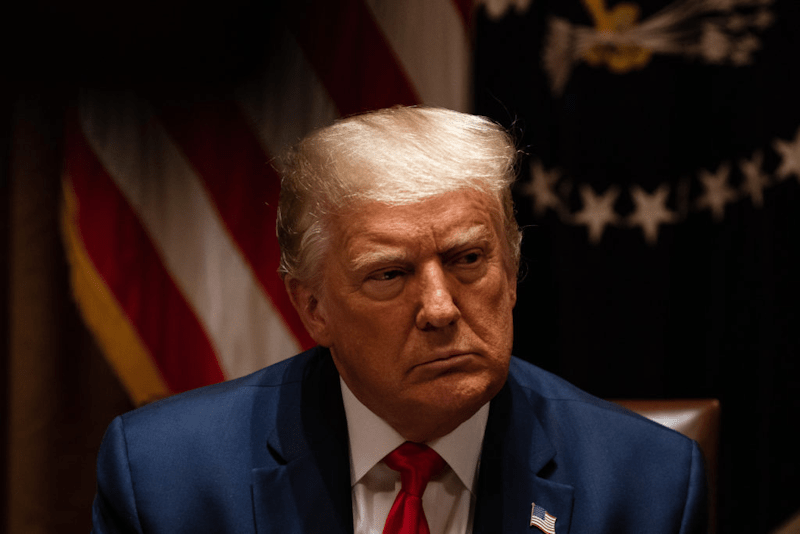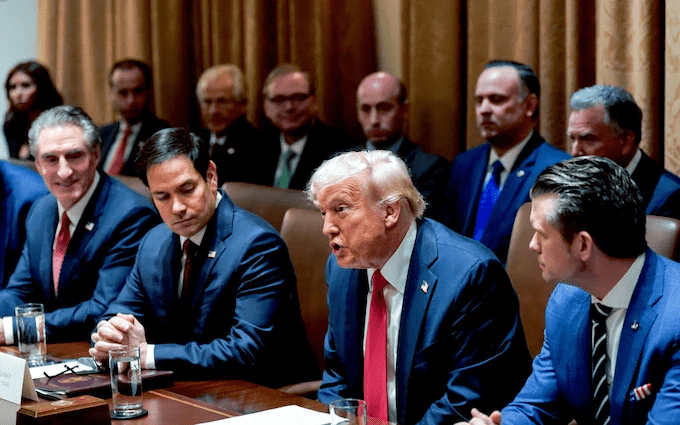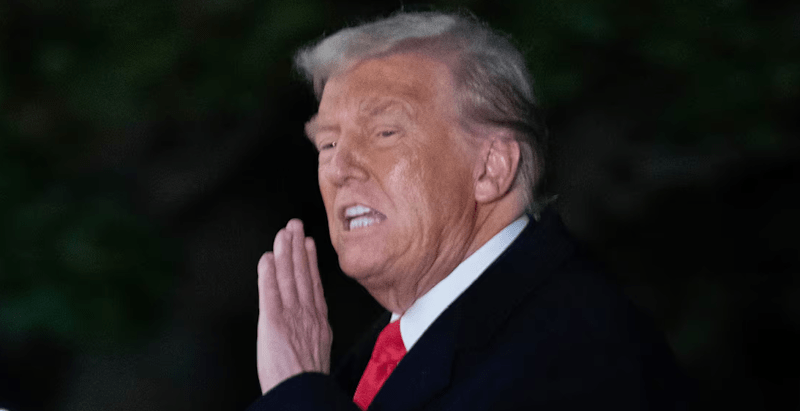
Donald Trump’s first month as U.S. president was planned political disruption not chaos

It only looks like chaos.

In just a month in office, Donald Trump has sown disorder if not bedlam at home and worldwide by promulgating a dizzying number of executive orders, attacking long-time United States allies, imperiling many of the globe’s principal trade patterns, throwing tens of thousands of government workers out of work, ending long-time foreign-aid programs, questioning established notions of American civic life – and more.

Share

Jamie Sarkonak: Trump’s empire dismantling should please woke decolonialists

Decolonization is one idea that has fuelled, and now, doomed the left. The prospect of dismantling western states and ceding ground to new, morally just, decolonized successors excited its members and inspired a certain revolutionary excitement; the pleasure from blaming the world’s problems on nebulous racial forces was all-consuming.

The ascendant right can’t allow itself to fall into the same kind of self-sabotaging death spiral. But boy, will it be tempted. You can already see it happening to the south.

Share

From Murdered White Farmers to ‘Racially Disfavored Landowners’: Why Trump and Musk Are Targeting South Africa

In October 2016, heavily pregnant Mariandra Heunis was putting her youngest to bed in their remote South African farmhouse when she heard the chilling sound of a gun cocking. Turning around, she saw two intruders standing before her.

“They started shouting aggressively; my husband woke up. They demanded money, to which we, in turn, responded that we don’t have money and do not have money in the house, but they could take whatever they want if they just leave us unharmed,” Ms. Heunis, who, like the rest of her family, is white, told me when I interviewed her in 2018. “But he just started shooting. I was terrified. I couldn’t stop the bullets.”

Share

Europe’s Leaders, Dazed by an Ally Acting Like an Adversary, Recalculate

Faced with undisguised hostility from the Trump administration, Europeans are preparing for what is shaping up to be a go-it-alone era.

For years, European leaders have fretted about reducing their dependence on a wayward United States. On Monday, at a hastily arranged meeting in Paris, the hand-wringing gave way to harried acceptance of a new world in which Europe’s most powerful ally has begun acting more like an adversary.

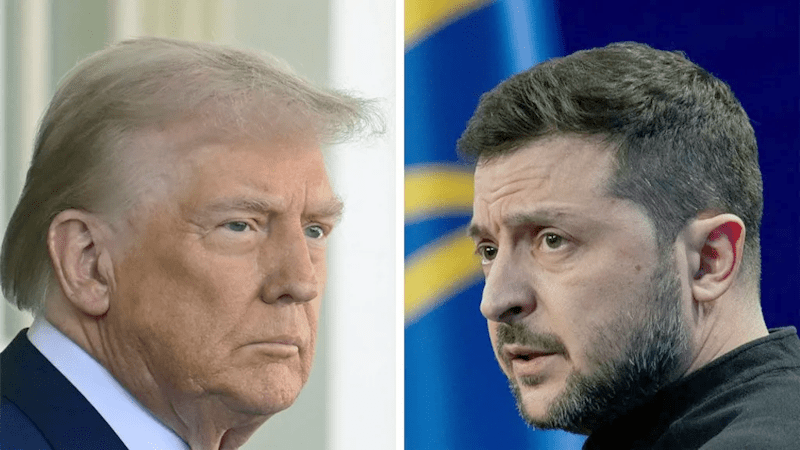
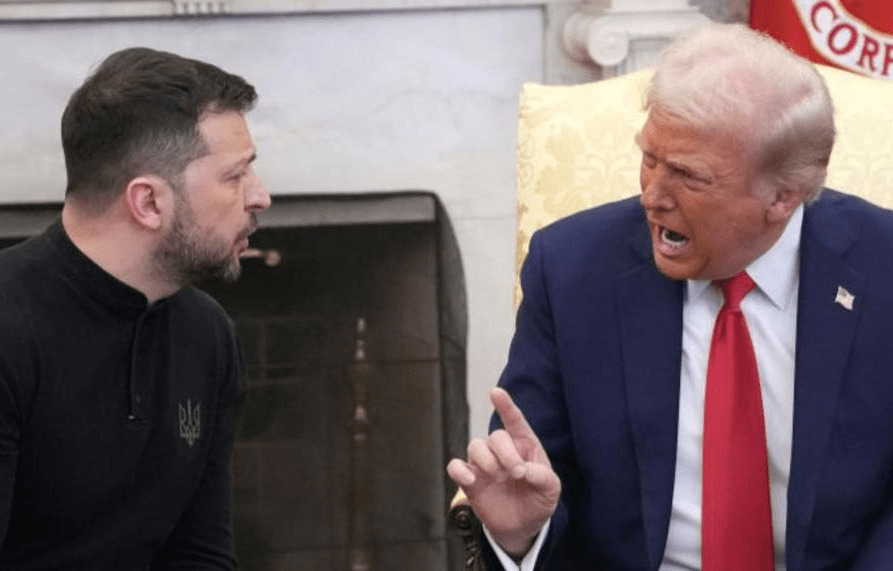
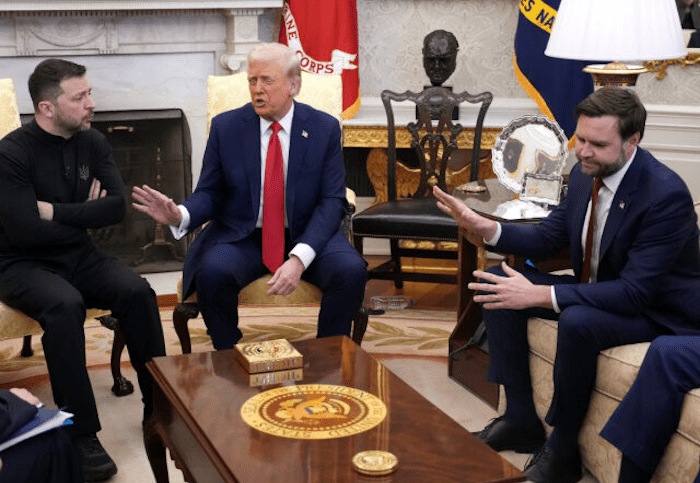
President Trump’s plan to negotiate a peace settlement in Ukraine with President Vladimir V. Putin of Russia, with neither the Ukrainians nor Europeans invited to take part, has forced dazed leaders in capitals like Berlin, London and Paris to confront a series of hard choices, painful trade-offs and costly new burdens.


So the emerging consensus narrative is to smear President Trump’s administration as “adversarial” for asking fellow NATO members to pony up their fair share if they want a seat at the table.

No pay no play was inevitable and they’ve known it for years.

Share

Trump Is Displacing the Old Ruling Class

Trump’s instincts are Machiavellian in the best sense of that word. His massive changes have produced great resistance from the old order.

Jim Holmes, Chair of Maritime Strategy at the Naval War College and Distinguished Fellow at the Krulak Center at the Marine Corps University, is one of our country’s leading public intellectuals. He is a throwback to Alfred Thayer Mahan, a naval officer and perhaps our country’s greatest public intellectual of the late 19th-early 20th century. Holmes has an interesting take on President Donald Trump’s approach to governing in his second term, comparing Trump to Niccolo Machiavelli, the brilliant Florentine statesman and the author of timeless classics on politics, including The Prince and Discourses on Livy.

Burnham understood that political change often results from … the “circulation of elites” — when a new ruling class takes power from the old ruling class.

Share

A Trump peace deal on Ukraine would signal his plans for the rest of us

So, just like that, the fate of a nation is decided. After three years of bloody warfare Ukraine may finally have peace, something it desperately needs. But how, and on what terms? If Donald Trump gets his way, which is very likely, it will be imposed from above, with conditions highly favourable to the country that started the war in the first place.

The amateur historians out there can’t quite decide if this is Trump’s “Munich” (i.e. a sell-out of a small country to an aggressor, à la Neville Chamberlain’s deal with Hitler in 1938 to dismember Czechoslovakia) or his “Yalta” (the summit meeting in 1945 where the victorious American, British and Soviet leaders divvied up Europe into spheres of influence).

Share

42% of black men support Trump

… Now then, in August 2016, while Hillary was hobnobbing with millionaires at fundraisers, Donald Trump was out in the hustings holding rallies in places that the experts said he had no chance of winning. Michigan, for example. The fool.

On August 19, he went to a tiny suburb of Lansing—Dimondale, population 1,134—to make an obligatory pitch to black voters. The town is 96% white and less than 1% black.

My how the press laughed at this amateur.

h/t DS

Share

Trump has the measure of Harry and Meghan

Deporting the peevish princeling would only fuel the couple’s sense of victimhood.

‘The gaiety of nations’ is a lovely phrase, as nations are generally in the news when they are in a state of woe. Originally, it was Samuel Johnson’s tribute to actor and playwright David Garrick (‘I am disappointed by that stroke of death, which has eclipsed the gaiety of nations and impoverished the public stock of harmless pleasure’), but I can’t help associating it with political leaders.

Share

‘I feel angry and betrayed’: Ukrainians react to Donald Trump’s call to Putin

The first thing Olena Litovchenko thought, when she read the news of Donald Trump’s phone call to Vladimir Putin on Wednesday evening, was that it may finally be time for her to leave Ukraine.

“It feels like Ukraine is being screwed,” said Litovchenko, a personal trainer who was born in Kyiv and has stayed in the city throughout the three years of full-scale war. Believing the prospect of a Ukrainian defeat to be closer after Trump’s call and statements on Wednesday, she thought for the first time that she perhaps ought to leave, for the sake of her daughter. “But then, leave and go where? Europe is most certainly going to be next. Go to Australia? I don’t know. I feel angry and betrayed.”


Hegseth softens stance on Ukraine’s potential NATO membership

BRUSSELS — Defense Secretary Pete Hegseth on Thursday walked back a key piece of his dramatic remarks here at NATO headquarters a day prior, leaving open the possibility of Ukraine joining the military alliance after previously saying the United States does not believe membership for Kyiv is a “realistic outcome” in any peace deal with Russia.

Hegseth’s clarification appeared designed to assuage the backlash, in Washington and in Europe, ignited by his remarks hours before President Donald Trump announced his administration had jump-started negotiations to end the three-year war.

Share

Next, Defund the United Nations

The U.S. underwrites a variety of international organizations that make up a global deep state.

President Trump has cut funding to some egregious United Nations agencies and ordered a review of all funding for the U.N. and other international organizations. Executive orders cutting taxpayer funding for diversity, equity and inclusion initiatives and trans ideology won’t fully ensure the U.S. taxpayer isn’t paying for such programs without taking on the global deep state. These priorities are baked in to the institutional structure of international organizations that the U.S. underwrites.

In fiscal 2022, the U.S. government provided more than $21 billion to 179 international organizations and multilateral entities. The entries fill 455 pages of a State Department report. This is on top of the direct foreign aid that went to radical progressive causes via the U.S. Agency for International Development.

h/t DS

Share

Trump says he has spoken to Putin and agreed to negotiate Ukraine ceasefire

Donald Trump has said that he and Vladimir Putin have spoken directly and agreed to begin negotiations to broker a ceasefire to the war in Ukraine.

In a social media post, Trump said that held a “lengthy and highly productive phone call” with Putin and that they agreed to “have our respective teams start negotiations immediately”.

He also said that he and Putin had agreed to visit each other’s nations.

“As we both agreed, we want to stop the millions of deaths taking place in the War with Russia/Ukraine,” Trump wrote on TruthSocial. “President Putin even used my very strong Campaign motto of, ‘COMMON SENSE.’ We both believe very strongly in it. We agreed to work together, very closely, including visiting each other’s Nations.”

Share

Most Europeans see Trump’s US as more a necessary partner than ally, poll finds

Donald Trump’s return to the White House has led to a “remarkable shift” in Europeans’ view of the US, according to a survey, with even the most America-friendly no longer seeing Washington primarily as an ally.

The polling, of 11 EU member states plus Ukraine, Switzerland and the UK, found most people now regarded the US as merely a “necessary partner” – even in countries such as Poland and Denmark that barely 18 months ago had considered the US an ally.

An average of 50% of Europeans across the member states surveyed viewed the US this way, the study revealed, with an average of only 21% seeing it as an ally, leading the report’s authors to urge a more “realistic, transactional” EU approach.

It’s called paying your own freight rather trying to get a free ride as Canada does in NATO.

Share