
Family sues hospital because institution wouldn’t kill their daughter

The family of a Vancouver woman who was forced to transfer hospitals before she could receive medical assistance in dying (MAID) is suing the province of British Columbia and Providence Health Care, saying the health authority’s policy to ban MAID in its facilities violates patients’ Charter rights.

Gaye O’Neill, the mother of 34-year-old Samantha O’Neill, is the lead plaintiff in the case, along with Dr. Jyothi Jayaraman, a palliative care doctor who quit over Providence’s policy that bars patients from accessing MAID in its facilities.

Share

Why the Dutch are euthanising physically healthy young adults – and could the UK be next?

Lisa, 40, is waiting to hear if she will be allowed to die. She is married and has two young children who don’t know she plans to end her life. There is just one more medication she has been told to try to treat her chronic depression, and then, she says, her request for euthanasia will be approved. The hardest part will be leaving her children, but she feels she has no choice. She plans to tell them, with the help of a grief counsellor, when she has set a date for her death.

“It’s not that I want to die, it’s that I don’t want to live this life anymore,” she says. “I’ve tried everything there is.”

Share

Father’s desperate battle to stop his autistic daughter, 27, from killing herself through Canada’s lax euthanasia laws

A Calgary woman whose father has challenged her euthanasia request in court is starving herself to death and expects to die within weeks.

The 27-year-old autistic woman, who can only be identified as MV because of a court order, has asked judges to let her get a lethal injection — despite objections from her dad.

She’s now starving herself to death, and wants judges to greenlight her euthanasia request so she doesn’t perish in an ‘incredibly unpleasant’ manner.

Share

‘I was offered assisted dying over cancer treatment’ – In Canada, a broken healthcare system is killing patients

Two years ago, over the Thanksgiving holiday, Allison Ducluzeau started to feel pain in her stomach. At first, she assumed she had eaten too much turkey, but the pain persisted. A couple of weeks later, she saw her family doctor who requested CT scans, although none were sorted. Soon after, as the agony worsened, her partner insisted she went to the emergency unit at their local hospital on Vancouver Island. Finally, doctors confirmed the couple’s worst fears: she was almost certainly suffering from advanced abdominal cancer.

Bastards.

Share

Canadian euthanasia doctor gushes about how much she enjoys killing people

In the recently released BBC documentary Better Off Dead?, disability rights activist Liz Carr interviewed Dr. Ellen Wiebe, Canada’s most notorious euthanasia doctor. Wiebe is also an abortionist and an activist with Dying With Dignity, the euthanasia lobby group seeking to expand eligibility for assisted suicide in Canada even further. Wiebe’s attempted defence of Canada’s euthanasia regime backfired when throughout her interview, she laughed and smiled as she discussed ending the lives of patients.

Share

Dutch woman, 29, granted euthanasia approval on grounds of mental suffering

A 29-year-old Dutch woman who has been granted her request for assisted dying on the grounds of unbearable mental suffering is expected to end her life in the coming weeks, fuelling a debate across Europe over the issue.

Zoraya ter Beek received the final approval last week for assisted dying after a three and a half year process under a law passed in the Netherlands in 2002.

Her case has caused controversy as assisted dying for people with psychiatric illnesses in the Netherlands remains unusual, although the numbers are increasing. In 2010, there were two cases involving psychiatric suffering; in 2023, there were 138: 1.5% of the 9,068 euthanasia deaths.

Share

In Trudeau’s Canada’s the broken social safety net pushes people toward assisted dying

A recent example of the use of medical assistance in dying (MAID) is setting off alarm bells. The CBC reported that Normand Meunier, a quadriplegic man from Quebec, was hospitalized in January for a respiratory virus. Mr. Meunier was left on a stretcher in the ER for four days despite communicating his need for a special mattress. He developed a severe bedsore with exposed bone and muscle, tragically leading him to seek out medical assistance in dying. Mr. Meunier told the CBC, “I don’t want to be a burden.” On March 29, he underwent assisted dying at home. The Canadian health care system’s failure to care for Mr. Meunier contributed to his death.

Share

If You Thought Assisted Suicide Would Guarantee a Quick, Painless Death, Data from Oregon Will Make You Think Again

Suicide is a bit of a hit and miss affair. I can think of six cases of people I’ve known who’ve taken their own lives. One, a very successful business executive, threw himself out an office window; he survived the fall, only to hang himself a couple of years later. The girlfriend of a lodger survived throwing herself in front of an underground train: she left it too late and got blown back onto the platform, breaking a hip. She too, some while later completed the job by jumping off Beachy Head. A business acquaintance, having been diagnosed with Parkinson’s blew his brains out with a shot gun, literally, leaving his wife to clear up the mess. The girlfriend of another acquaintance killed herself when her boyfriend went off to university, only for the boyfriend, my acquaintance, to follow suit on the anniversary of her death. Finally, a university fresher I knew, depressed and alone in his halls of residence, killed himself during the first lockdown. Apparently a grim and drawn-out death. I blame Ferguson, Whitty, Boris and the other nutters for that one.

Share

Why are 15 times more Canadians than Californians choosing assisted death?

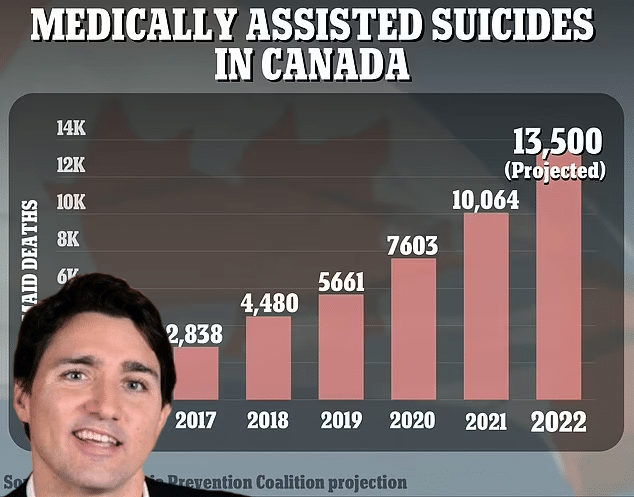
As a Calgary father’s legal battle to block his autistic daughter’s assisted death ignites debate over whether Canada’s euthanasia regime is expanding beyond what Canadians may be comfortable with, a new study suggests MAID deaths in Canada could continue to expand for another decade, until one in 10 deaths involve a doctor-administered lethal injection.

Share

Belgium: Christian mutual insurance provider suggests euthanizing old people

Expand Belgian euthanasia laws to prevent social care crisis, says insurance boss

Belgium’s euthanasia laws should cover elderly people who are “tired of life” or who feel they are a burden on the public purse, a health insurance chief has urged.

Luc Van Gorp, 57, the president of the CM health fund, a Christian mutual insurance provider, said that the number of Belgians over 80 would double to 1.2 million by 2050.

“Many elderly people are tired of life. Why would you necessarily want to prolong such a life? Those people don’t want that themselves, and when it comes to budgets: it only costs the government money,” he told the Nieuwsblad newspaper. “We must remove the stigma.”


Share

‘I’m 28. And I’m Scheduled to Die in May.’

Some right-to-die activists want everyone to have access to euthanasia—even young people with mental illness. Are they also making suicide contagious?

Zoraya ter Beek, 28, expects to be euthanized in early May.

Her plan, she said, is to be cremated.

“I did not want to burden my partner with having to keep the grave tidy,” ter Beek texted me. “We have not picked an urn yet, but that will be my new house!”
She added an urn emoji after “house!”

Share

Now Canada is euthanising autistic people

Imagine one day you discover that your adult daughter, who still lives with you, wants to be euthanised. As far as you are aware, she is healthy. She suffers from autism and ADHD, but no physical illnesses or disabilities that you know of. You know that she has faced many difficulties in her life, but you love her and desperately want to prevent her death. You are left fighting against her doctors, who encourage her decision and are perfectly happy to help her go through with this. To make this nightmare even worse, no one will even tell you why your daughter has been approved to die.

Share

Calgary judge rules 27-year-old can go ahead with MAID death despite father’s concerns

Her only known diagnoses described in court earlier this month are autism and ADHD.

A Calgary judge has issued a ruling that clears the way for a 27-year-old woman to receive medical assistance in dying (MAID) despite her father’s attempts through the courts to prevent that from happening.

A publication ban protects the identities of the parties and the medical professionals. CBC News will identify the daughter as M.V. and the father as W.V.

While Justice Colin Feasby acknowledged the “profound grief” that W.V. would suffer with the death of his child, he ruled the loss of M.V.’s autonomy was more important.

Share