
Pope says assisted dying not ‘normal’

Pope says assisted dying not ‘normal’

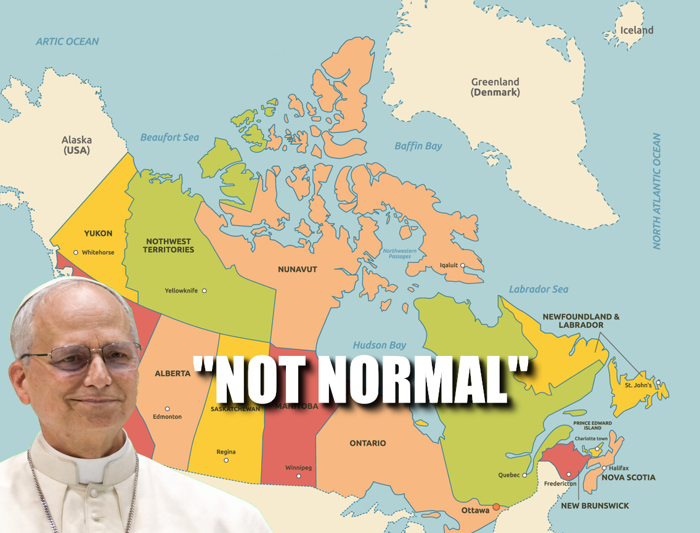
Pope Leo XIV on Sunday said assisted dying was not “normal”, as he continued a landmark visit to France, where parliament has legalized the practice for certain patients.

“No human law should ever make you lose the certainty of your dignity,” he told believers who were sick or suffered from disabilities, at the French pilgrimage site of Lourdes.

“We must reject the temptation to cause death under the guise of false compassion. It is impossible to regard causing death as something normal,” he added.

Share

Assisted suicides now make up more than 1 in 10 deaths in parts of Canada — and rates are rising

Assisted suicides now make up more than 1 in 10 deaths in parts of Canada — and rates are rising

These people are dying to leave Canada.

Canada’s medically assisted suicide is responsible for nearly one in 10 deaths in some parts of the country — with one area seeing rates over 13%.

Lanaudière — a mountainous region of Quebec just north of Montreal — had 13.4% of its deaths come from Canada’s medical assistance in dying program (MAID) in 2025, official records showed.

Share

Canada’s euthanasia crisis: you can now die for ‘basically any reason’

Canada’s euthanasia crisis: you can now die for ‘basically any reason’

When Canadian pensioner Brigitte Stegemann died in July at her care home, it was hardly the dignified and peaceful passing that families and friends hope for a fading loved one.

The 83-year-old German-born cancer sufferer was hooked up to an IV by a nurse who’d allegedly struggled to connect a needle and hadn’t even been wearing gloves and then given a lethal drug.

And even as she died, members of her family – led by a devoted granddaughter, Brigitte Kranendonk – were locked in a bitter battle with Stegemann’s carers and practitioners of Canada’s controversial euthanasia program over whether the deeply religious octogenarian actually wanted to die at all.

Share

First Toddler Euthanized in the Netherlands

First Toddler Euthanized in the Netherlands

Nobody would deny that the situation was tragic.

The toddler — whose name and sex are not disclosed in the official government report (this article will use masculine pronouns for simplicity) — was clearly suffering. Born extremely prematurely, he’d suffered several rounds of sepsis and had been left with damage to the brain’s white matter (periventricular leukomalacia), spastic cerebral palsy, and severe visual limitations. By the time he was eight months old, he’d developed infantile epileptic spasms syndrome (IESS) and was experiencing severe seizures several times a day. Understandably, he struggled to sleep as his lungs filled with fluid, making eating, swallowing, and breathing difficult.

Share

My mum wasn’t terminally ill – she needed help… We had 48 hours to stop Canada’s assisted-dying system but failed and days later she was given a lethal injection

My mum wasn’t terminally ill – she needed help… We had 48 hours to stop Canada’s assisted-dying system but failed and days later she was given a lethal injection

Sisters Alicia and Christie Duncan were originally only granted 48 hours notice that their mother was going to be euthanised.

It was Sunday, October 24, 2021, when 61-year-old Donna confessed to her family that she had been approved for Canada’s assisted-dying programme, officially known as Medical Assistance in Dying (MAiD).

Her death was scheduled for the following Tuesday – expedited due to her having qualified for Canada’s streamlined ‘Track 1’ pathway, reserved for individuals whose natural death is reasonably foreseeable.

Share

Ottawa’s MAID Plan Undermines Suicide Prevention

Ottawa’s MAID Plan Undermines Suicide Prevention

Canada’s 9-8-8 suicide prevention helpline has received more than 1 million calls and text messages since its launch in late 2023. That averages out to more than 300,000 per year.

Yet under current law, Canada is set to expand euthanasia, or medical assistance in dying (MAID), to people with mental illness as their sole underlying condition beginning March 17, 2027. If that expansion happens, some will be deemed worthy of suicide assistance while others will receive suicide prevention.

Share

UK: The end of the rush towards assisted dying? MPs vote down controversial law

UK: The end of the rush towards assisted dying? MPs vote down controversial law

A fresh bid to legalise assisted dying was defeated in the House of Commons today as efforts to revive the controversial Bill fell at the first major hurdle.

MPs voted by 286 to 270, a majority of 16, to reject the Terminally Ill Adults (End of Life) Bill at its Second Reading.

There were cheers and a shout of ‘good’ as the result was announced in the chamber, while some MPs could be seen hugging and pumping their fists.

h/t Patti Jo

Share

Canadian Government Euthanizes ‘Young and Healthy’ 26-Year-Old

Canadian Government Euthanizes ‘Young and Healthy’ 26-Year-Old

The death certificate of a 26-year-old man who was euthanized by the Canadian government, despite being described by his doctor as “young and healthy,” has been released, revealing disturbing details about his final hours.

Ontario resident Kiano Vafaeian died under Canada’s taxpayer-funded Medical Assistance in Dying (MAiD) program on December 30, 2025.

Share

Court Rejects Toronto Woman’s Attempt to Access MAID for Mental Illness

Court Rejects Toronto Woman’s Attempt to Access MAID for Mental Illness

The Ontario Superior Court of Justice has rejected a Toronto woman’s request for an exemption from federal law that would have allowed her to apply for medical assistance in dying (MAID) solely on the basis of mental illness.

Justice Carissima Mathen dismissed the motion this week, which was filed in May by 49-year-old Claire Brosseau.

Share

Euthanasia and Organ Donation: When Death Becomes a Medical Resource

Euthanasia and Organ Donation: When Death Becomes a Medical Resource

No one envies Karen Duncan her diagnosis.

Motor Neuron Disease attacks the body’s nerve cells, and in Duncan’s case, it was doing so quickly. Her muscles ached and cramped; then she had to walk with a cane; then she had to motor around in a wheelchair; meanwhile, she stopped being able to trust her thoughts and emotions. Her prognosis wasn’t good either: things would get progressively worse, she would eventually be paralyzed, and then she would die.

Share

The only difference between a serial killer and a Canadian MAiD practitioner is a licence

The only difference between a serial killer and a Canadian MAiD practitioner is a licence

There are two people in Canada who have caused the deaths of hundreds through poison.

The first poisoner held no medical licence and operated outside of Canadian law. He sold and shipped toxic chemicals with tracking numbers after having advertised on suicide forums. He killed more than 50 people a year. In May 2026, he pleaded guilty to counselling or aiding suicide.

Share

Canada Cannot Ignore MAID’s Warning Signs Any Longer

Canada Cannot Ignore MAID’s Warning Signs Any Longer

Ten years after Canada legalized medical assistance in dying (MAID), the safeguards Canadians were promised are looking increasingly shaky. Troubling cases and serious questions about oversight should give Canadians reason to pause before the system is expanded again.

Since 2016, there have been more than 100,000 MAID deaths and Canada has gained an international reputation as a prolific provider of death.

Share

MAID Increasingly Used as Alternative to Health Care in Canada, Activist Says

MAID Increasingly Used as Alternative to Health Care in Canada, Activist Says

LINCOLN, Ont.—A Canadian activist against euthanasia says the procedure is increasingly being used as a solution to address gaps in health care and mental health services, criticizing Canada’s ever-expanding medical assistance in dying (MAID) regime.

“I think that euthanasia and assisted suicide are basically the cynical solution to everything that ails us. Palliative beds are really expensive—body bags are not,” said Jonathon Van Maren, author and communications director at the Canadian Centre for Bio-Ethical Reform.

Share