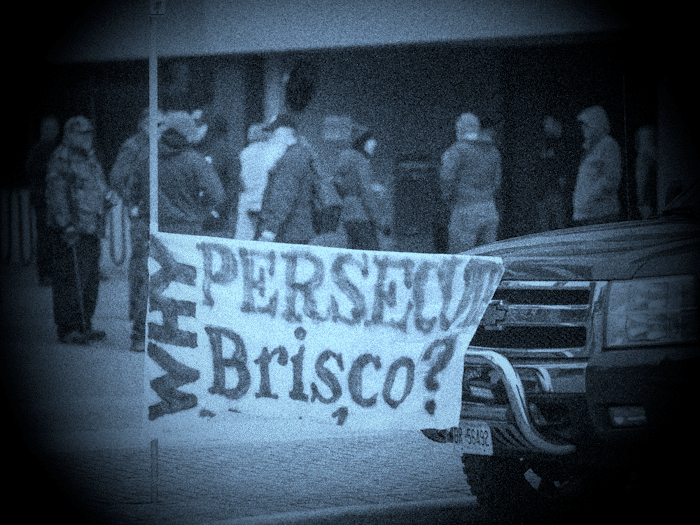

“The obvious injustice perpetrated against Cst. Brisco by less-than-ethical police management and pseudo-jurists at the police commission is an odious display of malicious prosecution of Brisco and by implication of any honest police officer….”

“The obvious injustice perpetrated against Cst. Brisco by less-than-ethical police management and pseudo-jurists at the police commission is an odious display of malicious prosecution of Brisco and by implication of any honest police officer….”
![]()
Cait Alexander does not consider herself a victim of domestic violence, but rather, a victim of the Canadian justice system.
The criminal case for her ex-boyfriend, accused of trying to kill her in 2021, was rescheduled twice before it was ultimately dropped. She was granted a restraining order and sent on her way.
“I was told my attempted murder is not a priority,” Alexander told reporters at a press conference at Queen’s Park Thursday. “This means an extremely violent abuser is freed without a single consequence.”
Four Years and Counting…
As a former police officer I’ve personally witnessed an abhorrent amount of suffering from those who lost their businesses, homes, and careers in the last four years. While a small minority of ultra wealthy gamed the system to the tune of billions, the vast majority of Canadians have not done well financially or otherwise – the result of tyrannical government decisions and those who supported the decisions by remaining silent.

It’s an article of faith among Democrats/socialists/communists (D/s/cs) that minorities, particularly black people, are far more harshly treated by the Criminal Justice System than whites. The “evidence” usually cited for this, apart from “because we say so,” or “experts say,” is disparate impact. If black people are arrested and convicted in greater numbers than their percentage of the population, that’s prima facie evidence of racism and disparate impact. Why else could so many black people become “justice system-involved individuals?”

Glynn Simmons took a long glance out the window of the car passenger seat as he drove with a friend along the freeway to Tulsa, Oklahoma. His gaze was fixated on the night sky, lit up with stars.
It was a sight the 70-year-old had not been able to witness for nearly half a century, after spending most of his life in prison for a murder he did not commit.
“It’s things like that … watching the seasons change, the foliage, simple things that you couldn’t do in prison. You couldn’t enjoy it. You couldn’t see it,” Mr Simmons told the BBC. “It’s exhilarating.”

The family of a woman shot by an officer in Edmonton during a wellness check says her death was unnecessary, as the number of police shootings across Canada show little sign of relenting over the past four years.

Across America, the social fabric looks increasingly threadbare.
Whatever else it may be, crime is mostly neither glamorous nor mysterious. A quotient of antisocial behavior has figured in every known society. In the Denmark of the human soul there is something eternally rotten. Some have peered into the dark heart of criminality and found, not inscrutable evil or anguished reaction to an oppressive system, but untrammeled self-interest. “All the lofty talk about the ‘root causes’ of crime,” writes social thinker Thomas Sowell, “fail[s] to notice the obvious: People commit crimes because they are people—because they are innately selfish and do not care how their behavior affects other people, unless they have been raised to behave otherwise or unless they fear the criminal justice system.”

Reflections on the impact that lawlessness—and an inescapable awareness of it—has on society and the psyche
The man in the green hoodie wanted to show off his knife. The weapon he flicked open was a large foldaway with a curved blade, illegal in New York City, no matter its length; the setting for his performance was the uptown D train, going express from Columbus Circle to 125th Street. There was a full moon in the sky, and underground, as so often now, there were disturbances: fights broke out, insults were hurled, the air was thick with barely suppressed violence. Protests earlier that day had brought part of the metropolis to a standstill. A group of demonstrators, riled by the accidental death of a mentally ill homeless man with an outstanding arrest warrant and a history of violence, had shut down the subway at East 63rd Street and Lexington Avenue for nearly an hour, blocking doors and occupying the tracks to prevent trains from entering or leaving the station. Now, a late Saturday night was bleeding into predawn Sunday, a fragile metal shell was hurtling through a lighted tunnel under the earth, and in the conductor’s car, a show of prowess was being put on. “My arm doesn’t move, bro.” Holding the knife at his side, the man in the green hoodie opened the blade discreetly, with a small movement of his hand. “If my arm doesn’t move and you’re making eye contact with me, you won’t see shit until it’s too late.” Several times he opened and closed the blade before his friend’s eyes, feinting with it, brandishing it in full view of half a dozen riders. His dreadlocks swung heavily as he moved. He explained with gusto how he might stab someone to death.

An Oklahoma judge has exonerated a man who spent 48 years in prison for a murder he didn’t commit, the longest known wrongful sentence in the US.
Glynn Simmons, 70, was freed in July after a district court found that crucial evidence in his case was not turned over to his defence lawyers.
On Monday, a county district attorney said there was not enough evidence to warrant a new trial.
In an order on Tuesday, Judge Amy Palumbo declared Mr Simmons innocent.
h/t Mauser
![]()
More than one-third of Canadians lack confidence in the youth criminal justice system, according to government research, which the Department of Justice describes as a “cause for concern.”
Research by the Department of Justice revealed that 39 percent of Canadians have little confidence that the youth criminal justice system (YCJS) is fair. Only 22 percent of those surveyed said they were confident the system is fair while 29 percent said they were moderately confident.

Americans must become confident again that their government will enforce the law, without fear or favor.
The summer of 2020 resembled a political revolution. Militants associated with Black Lives Matter and Antifa led the most destructive riots in American history. Radicals burned down city blocks, perpetrated acts of violence, and briefly established an “autonomous zone” in Seattle characterized by a police-free political order and a homicide rate 50 times higher than that of Chicago.

As he sentenced an Indigenous man — who has been in and out of custody most of his life — to yet another prison term last week, a Toronto judge couldn’t help but ask: “To what end?”
Ontario Court Justice André Chamberlain called into question the usefulness of the correctional system and the lack of community supports as he sentenced Jayson Pothier to three years for breaking and entering and robbery in a ruling that experts say demonstrates a growing judicial frustration with the inability of prisons to actually rehabilitate people.
“Significant jail sentences have been imposed on you in the past,” Chamberlain said in his decision addressed directly to Pothier, who represented himself in court and pleaded guilty to his latest charges.

“I, Donald Best, am the sole author of this Investigation Report concerning Fundraising for the accused men commonly known as the ‘Coutts Four’: Anthony Olienick, Chris Carbert, Chris Lysak, and Jerry Morin.
… This report is the result of requests from almost a hundred people (witnesses) who contacted me starting in July, 2023 and expressed concern with the fundraising activities of what I call ‘The Margaret MacKay Group’ or for brevity ‘The MacKay Group’. Some friends and family members of the four accused also contacted me.”
Questions, Doubts, Lack of Accountability Undermine Coutts Fundraising
I, Donald Best, am the sole author of this Investigation Report concerning Fundraising for the accused men commonly known as the ‘Coutts Four’: Anthony Olienick, Chris Carbert, Chris Lysak, and Jerry Morin.… pic.twitter.com/ews4KPu3ev
— DonaldBest.CA * DO NOT COMPLY (@DonaldBestCA) November 20, 2023
Questions, Doubts, Lack of Accountability Undermine Coutts Fundraising.
Hello All. Just arrived home from covering the Grus Hearing in Ottawa to find many public comments and questions about the funds previously raised to benefit the four Coutts accused.
A great Canadian,… https://t.co/X3tpO8pr1A pic.twitter.com/6lEkyDuPmW
— DonaldBest.CA * DO NOT COMPLY (@DonaldBestCA) November 5, 2023
My former neighbor;)

A B.C. realtor, who at one point was nearly set on fire by the former husband of his lover and business partner, has been ordered to pay child support to the woman and her children who were fathered by the lighter-fluid wielding ex.
John Darcy McLeod, who had what a judge called a “volatile, on-again off-again relationship of more than seven years” with Laurissa Anne Code, also had a business partnership with Code, which began in 2012. Both the relationship, which began around the same time as the business arrangement, and the partnership, came to an end in 2020.