Dyspro-what? Why an Obscure Element Has the EV Industry in a Panic

Caught in the middle of the U.S.-China trade war is a Chiclet-size magnet that is vital to every new electric vehicle on the road.

The magnet is made with dysprosium. Atomic number 66. A rare-earth mineral with a silver metallic luster. More than 90% of refined dysprosium comes from China, and it is used in magnets that power everything from medical equipment to EV motors.

Share

America’s electric car crash is over. Europe has finally noticed

American electric vehicle sales have continued to inch up, from 7 per cent of new cars sold last year to 7.5 per cent this year. But no one now expects that they will reach the more than 50 per cent mandated by the Biden administration by 2032. President Donald Trump has upended the EV landscape – sending shockwaves through the industry that are reverberating not just in the United States, but globally.

Canada remains on a collision course with reality however.

Share

Poilievre pledges to scrap electric vehicle sales mandates if elected

HALIFAX — Conservative Leader Pierre Poilievre says if his party is elected, it will scrap Canada’s electric vehicle sales mandates.

Canada has mandated that 20 per cent of all new vehicles sold must be electric by 2026 and 100 per cent by 2035.

Electric vehicles made up just shy of 12 per cent of the Canadian sales in 2023, but government rebate programs meant to encourage people to buy EVs came to an end in January.

Winner!

Share

Here’s the Status of Major EV Battery Plants and Projects in Canada

Electric vehicles were considered the way of the future just five short years ago. Today, the demand for electric vehicles (EVs) and EV battery plants is waning both in Canada and globally due to a wide range of factors.

Some of the issues cited in consumer surveys on purchasing EVs include the substantial cost disparity between EVs and gas-powered vehicles, worries about their driving range, reliability in cold weather, and the availability of charging facilities. Along with the repercussions of increased interest rates and inflation, all these factors have played a role in shaping consumer behaviour since 2020.

Share

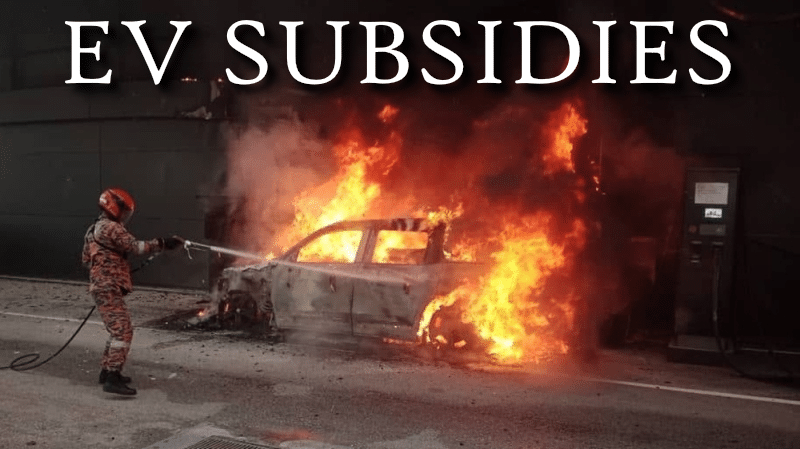
RoRo! EV Fire At Port!

Major EV Fire Breaks Out Aboard Ro/Ro at Zeebrugge

On Wednesday, a fire broke out aboard a ro/ro cargo ship at the port of Zeebrugge, Belgium, prompting an immediate – and successful – emergency response.

Ro/ro fires are a serious issue, and the growing popularity of electric cars has made the potential consequences more severe. Fires can spread rapidly within enclosed ro/ro decks, and EV fires are even harder to put out. New industry guidance calls for operators to respond with evacuation, ventilation shutdown and initiation of CO2 flooding very early in the firefighting process – before the fire can spread or injure anyone.

Got Lucky. h/t Simus

Share

The electric car honeymoon is over

Sooner or later, it is going to dawn on the owners of electric cars that they have been enjoying one of the longest introductory free offers in history. The moment of realisation may even come tomorrow. That is when, for the first time, electric cars (EVs) are going to become liable to pay road tax. It won’t necessarily be too onerous. Drive an EV out of a showroom tomorrow and you will pay just £10 in car tax for the first year, rising to £195 for your second year of ownership and beyond. Owners of vehicles registered between 1 April 2017 and today will pay £195 a year. Those registered between 2001 and 2017 will be liable for £20 a year road tax.

EV’s are heavy vehicles that still get a free pass in Canada for the added road wear they cause.

Share

Trump Was Right to Kill the EV Mandate

Scrapping the EPA’s draconian tailpipe-emissions rule will boost competition, benefit consumers, and strengthen national security.

In his March 4 address to a joint session of Congress, President Donald Trump celebrated terminating Joe Biden’s “insane electric vehicle mandate.” A year ago, the Biden Environmental Protection Agency had finalized a rule, nominally about tailpipe emissions, that would have required 30 percent to 56 percent of all new light-duty consumer cars sold in the United States to be electric vehicles (EVs). Trump announced his intention to undo Biden’s EV overreach in his first week in office, as part of his executive order entitled “Unleashing American Energy.”

Share

Tariffs, Elon Musk and charging headaches: Quebec is suddenly seeing trouble in its EV paradise

MONTREAL — U.S. President Donald Trump’s latest tariff on the auto sector is a new blow to electric vehicle owners in Quebec but, in the province with the most electric vehicles in the country, EVs were already losing their lustre.

Robert Brunelle, a resident of Saint-Lambert, Quebec, is almost relieved after getting into a car accident last year. He bought a Tesla Model S in 2021 because it’s “a great car.” It’s fast. It’s quiet. It’s cutting-edge technology.

Share

$270M investment in Northvolt’s parent company now worthless, says Quebec government

The $270 million invested by Quebec in Northvolt’s parent company in Sweden is now worthless, confirmed the provincial government.

“We estimate that the value of this amount is lost,” said Christine Fréchette, Minister of the Economy, Innovation and Energy, on Wednesday.

The amount was part of a $2.9 billion investment by Quebec and Ottawa.

Share

McTEAGUE: Don’t let the Liberals fool you on electric cars

The Liberals’ carbon tax ploy is utterly shameless. For years they’ve been telling us that the Carbon Tax was a hallmark of Canadian patriotism, that it was the best way to save the planet, that it was really a “price on pollution,” which would ultimately benefit the little guy, in the form of a rebate in which Canadians would get back all the money they paid in, and more!

Meanwhile big, faceless Captain Planet villain corporations — who are out there wrecking the planet for the sheer fun of it! — will shoulder the whole burden.

Share

CHARLEBOIS: Farmers pay the price for Ottawa’s electric vehicle obsession

Canada started a trade war with China, yet few in Ottawa seem willing to acknowledge the consequences.

Unlike the United States, which often imposes tariffs as a bargaining chip only to later negotiate, China takes a far more calculated and punitive approach. When Beijing retaliates, it targets industries with economic and symbolic significance, ensuring maximum pressure on its adversary.

Share

Audi to cut 7,500 jobs amid ‘challenging’ switch to EVs

Audi plans to cut 7,500 jobs as the German car maker scrambles to find money to fund the “challenging transition to electric mobility”.

The manufacturer, which is owned by Volkswagen, on Monday announced plans to axe around 8pc of its workforce by 2029. The job cuts are part of a series of measures aimed at saving €1bn (£840m) a year.

Audi said: “The economic conditions are becoming increasingly tougher, competitive pressure and political uncertainties are presenting the company with immense challenges.”

Share

There’s No Such Thing as ‘Green’ Industry

News this week emerged about the collapse of Swedish battery startup Northvolt. “Like many companies in the battery sector,” the failed company’s website explained, “Northvolt has experienced a series of compounding challenges in recent months that eroded its financial position.” European Governments, including those of Britain and the EU, have long claimed that as pioneers of green policy and the ‘transition to a low carbon economy’, their policies will cause domestic industries and the green economy to boom. But instead of the green dream turning into reality, across the continent there is only a bleak economic outlook and deindustrialisation. Given that so much of this was predicted, yet those predictions met with policymakers’ intransigence, isn’t it time to ask if this nightmare is a feature of green policy, not merely a bug?

Share

How Europe’s electric battery dream ran out of power

Setting ourselves stringent net zero targets will help us get ahead of other countries in the race to develop green technologies of the future. We know this must be true because Ed Miliband, and many others, keep telling us so. It is just that things don’t seem to be working out quite this way in the real world.

The collapse this week of the Swedish electric vehicle (EV) battery-maker Northvolt has once again shown how the countries most committed to net zero seem to be the ones which keep missing out on the spoils – while their industries drain away abroad, quite often to China.

Share