
WASHINGTON, Jan 24 (Reuters) – U.S. President Donald Trump on Saturday said he would impose a 100% tariff on all Canadian imports if the North American country makes a trade deal with China.
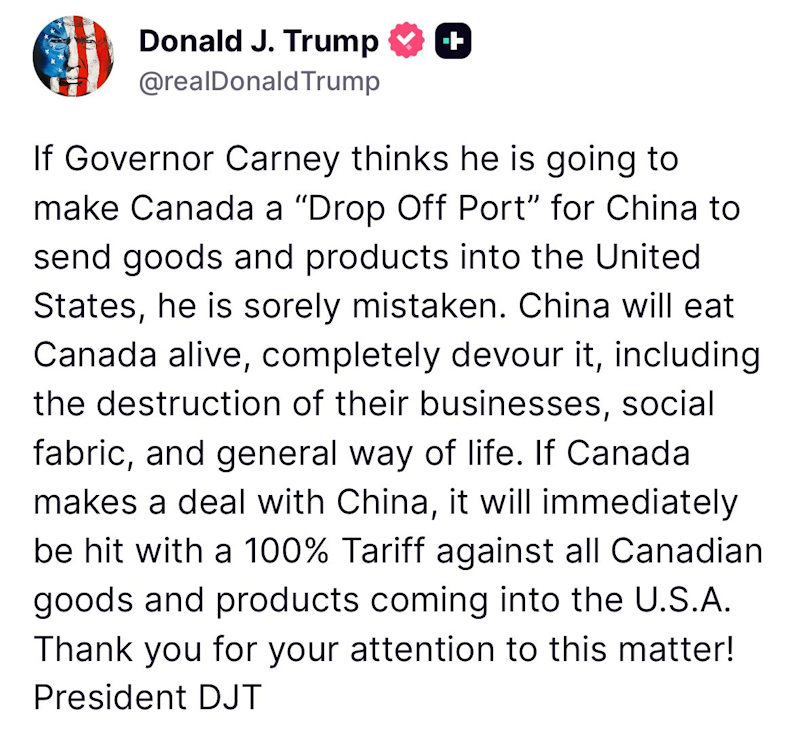
WASHINGTON, Jan 24 (Reuters) – U.S. President Donald Trump on Saturday said he would impose a 100% tariff on all Canadian imports if the North American country makes a trade deal with China.
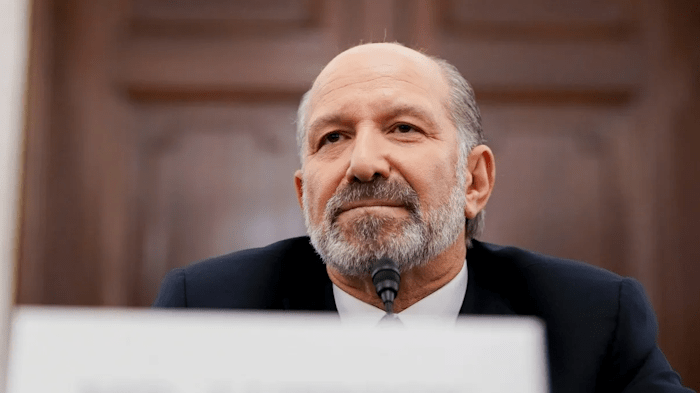
Commerce Secretary Howard Lutnick revealed on Fox News’ Jesse Watters Primetime Thursday who the sole booer of his speech at the World Economic Forum in Davos was, and why he considered it the “greatest honor.”
Lutnick described the panel he was on at the Summit as “basically a very left set of talks where someone said we need a new form of capitalism, which I think is another way to say communism. And then they let me speak at the end. Then I gave a three-minute talk. And I just talked about my op-ed.”
Link to Lutnick’s FP article – Howard Lutnick: Why the Trump administration is going to Davos
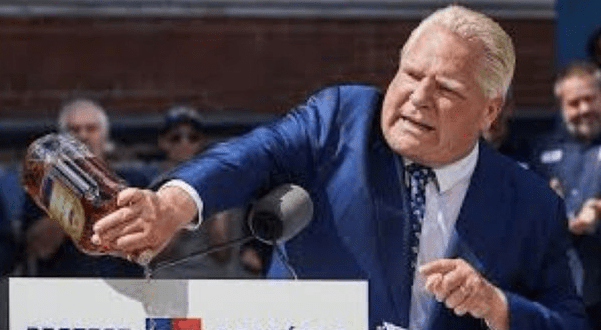
For the second time in as many days, Ontario Premier Doug Ford suggested he was willing to back down from his threat to remove Crown Royal from the LCBO, but only if his government can extract concessions from the international alcohol maker that produces the Canadian whisky.
U.S. Commerce Secretary Howard Lutnick says Canada is “playing with a set of rules that they haven’t really thought through” by moving to reset relations with China ahead of trade deal renegotiations with the United States.
Lutnick made the comments in an interview with Bloomberg in Davos, Switzerland on Thursday.
U.S. Commerce Secretary Lutnick UNLOADS on the arrogance of Carney's speech at WEF.
Lutnick says Canada has the 2nd-best trade deal w/ the US in the world.
Lutnick warns that cozying up to China will have repercussions when renegotiating CUSMA.
— Kat Kanada (@KatKanada_TM) January 22, 2026
h/t Mauser
Ontario Premier Doug Ford is calling on Canadians to boycott Chinese-made electric vehicles when they are allowed back into the country under a deal recently struck by Prime Minister Mark Carney.
Ford has been critical of the deal — and the fact Carney did not speak to him about it in advance — saying it will harm Ontario’s auto sector.
Carney and Chinese President Xi Jinping agreed while the prime minister was in China that Canada will all but drop its 100 per cent tariffs on Chinese EVs and allow an annual import quota of up to 49,000 of the vehicles in exchange for China reducing its canola tariffs.
OTTAWA — After nearly five decades in policing, intelligence, and financial-crime investigations—including professional experience working in Asia—I have learned a simple rule: who you cooperate with matters as much as what you cooperate on.
Last week, the Prime Minister’s Office announced that Canada and the People’s Republic of China will enhance law enforcement cooperation on drug trafficking, transnational and cybercrime, and money laundering. On paper, this sounds reasonable. Fentanyl is devastating communities. Cybercrime drains billions. Organized crime adapts faster than borders.
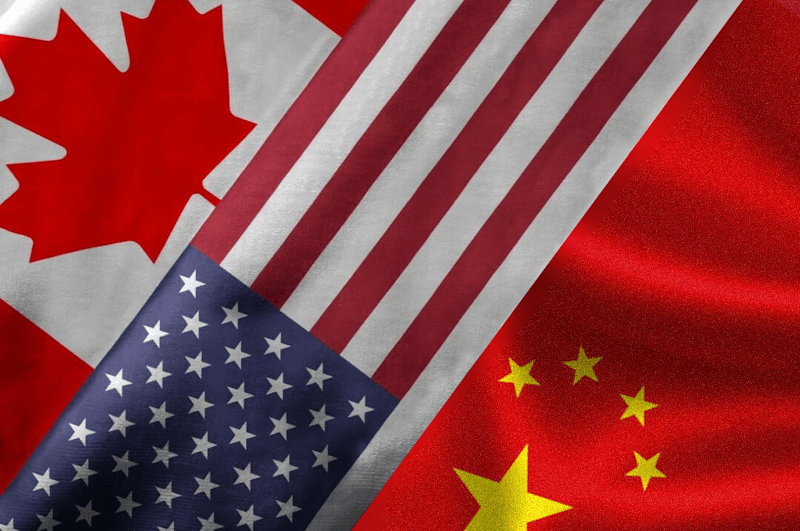
Canada is cozying up to China. It’s not surprising because of President Donald Trump’s bullying, but it is shortsighted.
Describing a “new world order,” Canadian Prime Minister Mark Carney had the gall during a trip to Beijing last week to claim that China is a “more predictable” partner than the United States.
Trump has been a bad neighbor, so maybe Carney is trolling Trump for musing about making Canada the 51st state. After all, he acknowledged last year while campaigning for the premiership that China is the biggest threat to his country’s security. At the same time, the Greenland saber-rattling, which threatens to upend NATO, is deeply unnerving Canada.
Great, now all our Amazon shipments will go missing.
OTTAWA — A high-level Canadian Security Intelligence Service assessment in June 2019 concluded that Beijing, jolted by Canada’s detention of Huawei executive Meng Wanzhou, launched a “calibrated and multi-faceted pressure campaign” that blended trade coercion — including curtailing canola imports — with the detention of Canadians and clandestine interference surrounding the 2019 federal election, aiming to exert “personalized political pressure on Canada’s leadership,” with the Ministry of State Security driving the response and CSIS collection further establishing that President Xi Jinping received reports “directly from the MSS.”
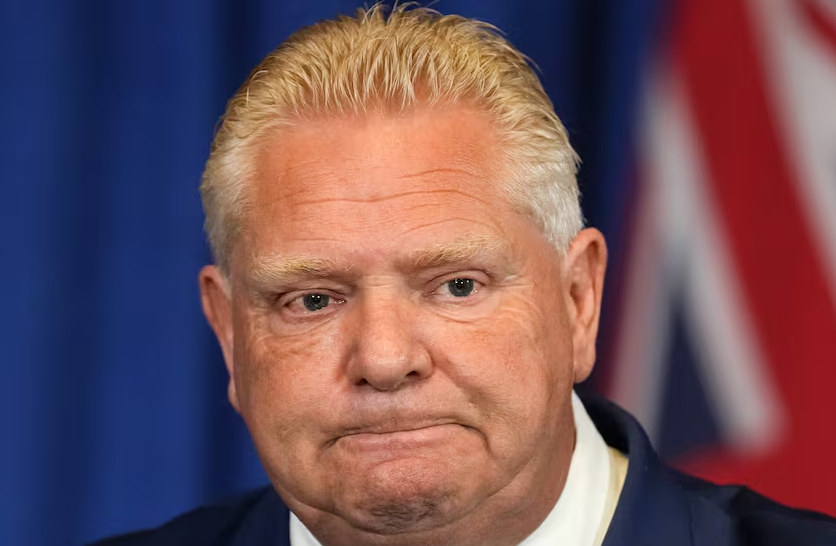
As Prime Minister Mark Carney moves to allay concerns about lifting tariffs on Chinese EVs, Premier Doug Ford says Ottawa needs to “step up” to protect Ontario’s auto industry.
Speaking to Rural Ontario Municipal Association conference delegates at the Sheraton Centre on Monday, Ford reiterated his alarm at Carney’s new agreement with China.
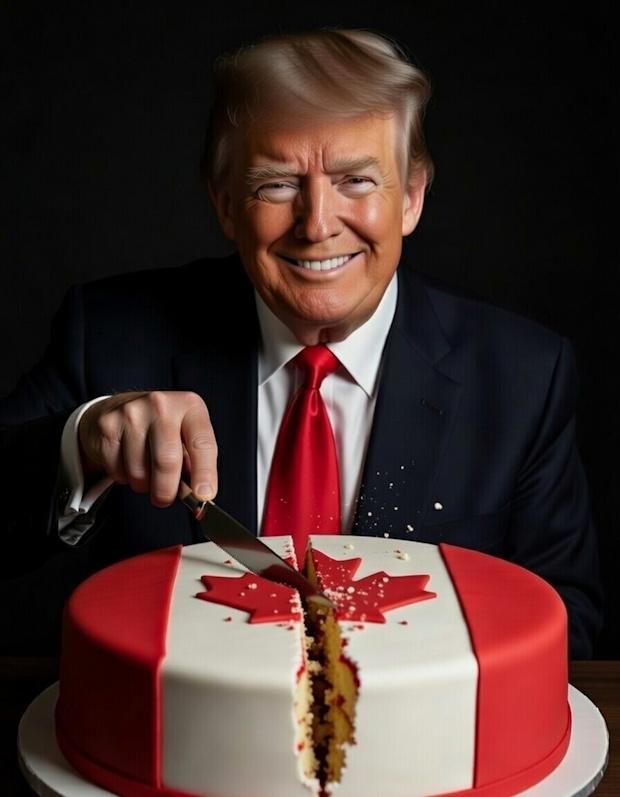
What does U.S. President Donald Trump actually want from Canada?
While Trump says the U.S. doesn’t need Canadian products, he has also repeatedly expressed a desire to turn Canada into a “cherished” state. Before leaving office, former prime minister Justin Trudeau suggested the Trump administration was really after Canada’s natural wealth. Trump and U.S. officials are also pressuring Ottawa on a range of issues like dairy supply management, border security, drug trafficking and defence spending.
Trade negotiations between the U.S. and Canada have, meanwhile, ground to a halt. When asked earlier this week about renewing the Canada-U.S.-Mexico Trade Agreement (CUSMA) he championed during his first term, Trump said it was “irrelevant to me.”
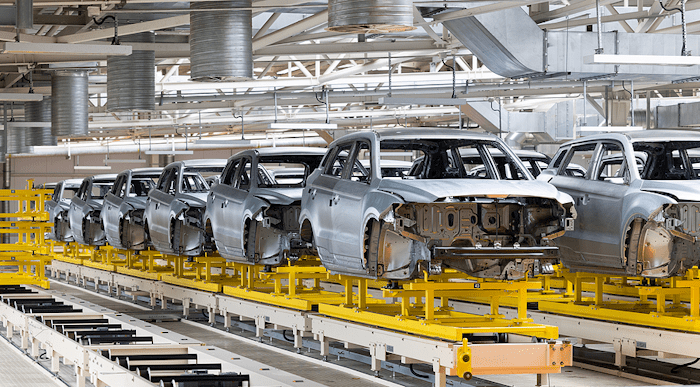
The U.S. House Select Committee on China is warning Canada that it should reconsider opening its auto industry to Beijing and risking thousands of jobs, ahead of the upcoming renewal negotiations for the United States-Mexico-Canada Agreement (USMCA).
By opening its market to Chinese electric vehicles (EVs), Canada risks distorting its auto industry by giving “Beijing a foothold in the North American auto market, threatening thousands of jobs and undermining a century of integrated automotive leadership,” the committee said in a Jan. 16 post on X.
“China’s state-subsidized overcapacity has already distorted Europe’s auto industry, and North America will be next if this precedent stands,” the committee said.
Canada’s decision to open its market to Chinese electric vehicles risks giving Beijing a foothold in the North American auto market, threatening thousands of jobs and undermining a century of integrated automotive leadership.
China’s state-subsidized overcapacity has already…
— Select Committee on China (@ChinaSelect) January 16, 2026
Surrender!
Without even a single shot being fired.
Without a murmur of protest.
That is what Mark Carney has done with his lame capitulation to the Dictatorship of China.
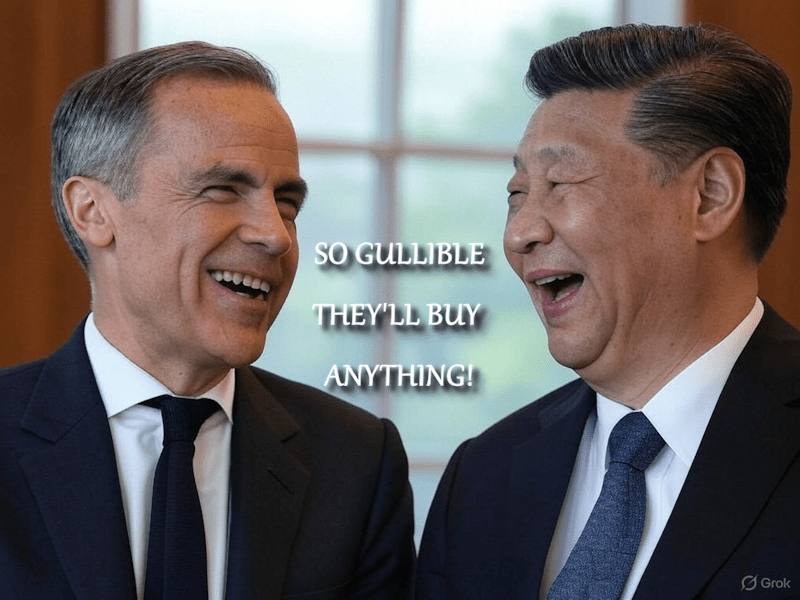
DOHA — Prime Minister Mark Carney’s response to Doug Ford’s criticism of Ottawa’s deal to reduce tariffs on Chinese EVs: he’s out to build the auto industry of the future, not the past.
“Remember, this is a market that is the auto sector, which is evolving very rapidly,” Carney told reporters at a news conference. “We don’t want to be competitive in the market of 2000, 2010. We want to become competitive in the market in the future. That’s what’s going to get great jobs for Ontarians going forward,” said Carney.
The auto industry of the future? Sure Carney.
The only thing this carpetbagger is building is policy to funnel ill-gotten gains to his pals.
U.S. President Donald Trump’s Venezuelan adventure has generated a great deal of ink about the so-called Donroe doctrine. Commentators are eager to impose some form of coherence on a wide-ranging and often contradictory series of foreign-policy actions. But the subject resists.
The rhetoric of isolationism clashes with the covert action of a Delta Force raid to capture a foreign leader on foreign soil. The label of “president of peace” is not exactly consistent with gangster statecraft that threatens to acquire Greenland by any means necessary. Nor does it sit comfortably alongside the gutting of the State Department and foreign aid, the casual lobbing of tariffs, and what has become the habitual mistreatment of NATO allies.
Related …
BREAKING: In September, Mark Carney officially became the Chair of Trudeau’s Task Force on Economic Growth.
In October, Carney met with the Deputy Director of the People’s Bank of China.
Just two weeks later, news broke that Brookfield secured a quarter billion dollar loan from… pic.twitter.com/caXKPlSFsg
— Pierre Poilievre (@PierrePoilievre) March 25, 2025
Former Canadian diplomat Michael Kovrig — who was detained by China for more than 1,000 days between 2018 and 2021 — says Prime Minister Mark Carney’s tone and messaging during his trip to China were “worrisome.”
In a bid to reset relations with China and counter trade threats from the United States, Carney became the first Canadian prime minister to travel to the Asian country in eight years this week.
Thread by @andrewmichta on Thread Reader App
The announcement by Canadian PM @MarkJCarney of a reset in Canada-China ties accompanied by a trade deal of dramatic proportions will likely go down in history as a major political blunder. But don’t listen to me: Premier Doug Ford of Ontario already denounced the deal. 1/9
Anger, however justified, should never be the principal driver of policy. This is true both about our Canadian brethren, and true about our European allies. We are living through a rocky transformation of the international system, but the geopolitical realities remain
