Carney Has Tried the Carrot and the Stick With Trump—but Neither Is Working

Carney Has Tried the Carrot and the Stick With Trump—but Neither Is Working

TORONTO—Prime Minister Mark Carney swept to power promising an “elbows out” stance against President Trump’s tariff threats and rhetoric, vowing he would never accept a bad trade deal.

Sixteen months later, Carney says he has avoided making a bad deal but critics say it has come at a cost: A series of trade concessions to the U.S. that are beginning to add up.

Carney has scrapped a digital-services tax affecting U.S. tech companies, rolled back retaliatory levies and halted streaming regulations opposed by American companies.


Carney was “swept” to a minority government, the WSJ is not a Trump fan.

Share

Trump’s new tariffs are dubious tactics that put Carney in a tight spot, trade watchers say

Trump’s new tariffs are dubious tactics that put Carney in a tight spot, trade watchers say

The Trump administration’s announcement of a new round of tariffs on Canadian goods may be less of a reprisal over trade barriers and more about gaining leverage in CUSMA negotiations, trade watchers suggest.

Whether the measures are legal are not is open to debate, but that may not matter because for now they put Canada in a difficult position of whether to strike back and risk even further heightening the trade war or to try playing along with President Donald Trump’s game.

Share

Canada’s ‘powerful’ dairy sector is in Trump’s trade crosshairs

Canada’s ‘powerful’ dairy sector is in Trump’s trade crosshairs

Canada’s dairy industry policy is among the most politically sacrosanct in the country. It has also long been a thorn in the side of Donald Trump.

Now, Canada’s dairy supply management system is back in the spotlight after the US president singled it out as one of three main irritants used to justify a 50% tariff on $20bn worth of Canadian goods imported to the US, which is set to come into effect in August.

Trump argues the system, which sees production quotas, set pricing, and import quotas on dairy, eggs, and poultry, is “unreasonable” to American farmers who want to sell their product north of the border.

Share

Carson Jerema: Trump wants trade — just not on terms anyone can decipher

Carson Jerema: Trump wants trade — just not on terms anyone can decipher

U.S. President Donald Trump’s position in his trade dispute with Canada is that this country must absorb any and all unprovoked acts of aggression and possibly even ask the Americans if they can deliver more hardship, maybe even thank the president for imposing tariffs on us. It is difficult to draw any other conclusion from the new round of tariffs Trump has pledged this week to enact on Canada.

Share

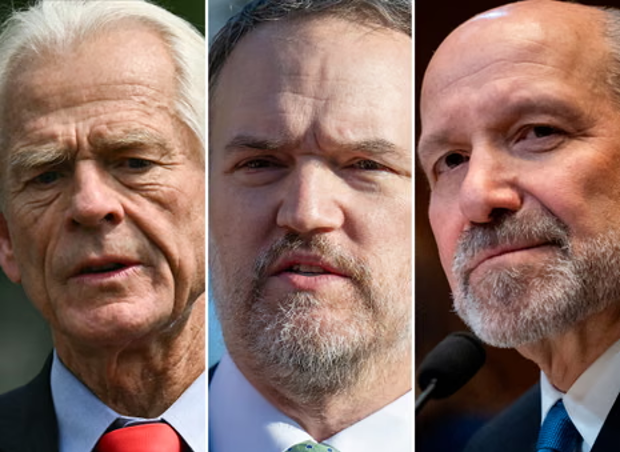
Peter Navarro: Canada wants free trade — only on its terms

Peter Navarro: Canada wants free trade — only on its terms

Canada has long cultivated the image of America’s friendly, free-trading neighbor. The reality is less polite.

Behind the maple-leaf branding is a protectionist system that singles out American farmers, distillers, automakers, and workers. Canada demands access to the American market while reserving the right to close its own when competition becomes inconvenient.

Share

Why did Canada give in to the Gordie Howe bridge shakedown?

Why did Canada give in to the Gordie Howe bridge shakedown?

This is not how completion of the Gordie Howe International Bridge should have ended, with Canada giving in to another U.S. shakedown.

A few days before the bridge’s originally scheduled opening on June 15, U.S. President Donald Trump renewed his threat, first stated in February, to block the opening of the Canadian-built and financed Windsor-Detroit bridge.


Of course Carney lied … Text of Gordie Howe Bridge deal with U.S. contradicts Carney’s initial description

More … Read the full text of the Gordie Howe Bridge deal: ‘Proposed agreement in principle’

He lies because he can.

Share

There is no appeasing Donald Trump, or deterring him

There is no appeasing Donald Trump, or deterring him

Section 338 of the Tariff Act of 1930 – yes, that tariff act, aka the Smoot-Hawley Tariff Act, the law that famously turned a stock market crash into a worldwide depression – authorizes the President of the United States to impose tariffs on imports from foreign countries that impose “any unreasonable charge, exaction, regulation, or limitation which is not equally enforced upon the like articles of every foreign country,” or that otherwise discriminate “against the commerce of the United States.” The tariff can be anything up to 50 per cent.

Share

Trump’s new tariffs signal CUSMA may no longer protect Canadian trade, experts warn

Trump’s new tariffs signal CUSMA may no longer protect Canadian trade, experts warn

On paper, Donald Trump’s latest tariffs only apply to about five per cent of Canada’s goods exports.

But they set a precedent of ignoring the Canada-U.S.-Mexico Agreement on trade (CUSMA) that economists, trade experts and business leaders warn could inflict much wider damage. They also use a legal mechanism that gives the U.S. president a lot more flexibility.

Share

Trump’s 50% tariffs on Canada are an approximate 2.5% effective rate increase, less severe than headlines suggest: Economist

Trump’s 50% tariffs on Canada are an approximate 2.5% effective rate increase, less severe than headlines suggest: Economist

U.S. President Donald Trump’s move to impose 50 percent tariffs on a range of Canadian exports has sparked alarm across the country. But according to a leading trade economist, the actual economic impact may be far less dramatic than the eye-popping headline number suggests.

On Monday, Trump signed three proclamations under Section 338 of America’s Tariff Act of 1930—a provision unused for decades—imposing the new duties in response to what the administration calls Canada’s discriminatory treatment of American motor vehicles, alcohol, and dairy products.

Share

Carney won’t rule out retaliation to latest tariff threat

Carney won’t rule out retaliation to latest tariff threat

OTTAWA – Prime Minister Mark Carney did not rule out retaliation in response to U.S. President Donald Trump’s latest tariff threat on a number of Canadian goods, part of the latest escalation of the U.S.-Canada trade conflict.

“We have a situation where the American tariffs, the 338 tariffs, will come into effect in 29 days, and we will look at all options in terms of how we would respond if they do come into effect,” Carney told reporters in Ottawa on Tuesday.

Share

Donald Trump says Canadians ‘need us to survive’ after Mark Carney says trade talks will ‘intensify’

Donald Trump says Canadians ‘need us to survive’ after Mark Carney says trade talks will ‘intensify’

OTTAWA — Prime Minister Mark Carney says he has agreed to “intensify” trade negotiations with the U.S. after President Donald Trump threatened punishing new tariffs on Canada.

Carney said he spoke with Trump on Tuesday morning following Monday’s announcement that the United States plans to impose 50 per cent tariffs on a wide swath of Canadian goods in 30 days.

h/t Patti Jo

Share

Ford refuses to lift U.S. booze ban, says Canada ‘could dismantle the U.S. if we wanted to’

Ford refuses to lift U.S. booze ban, says Canada ‘could dismantle the U.S. if we wanted to’

TORONTO — Ontario Premier Doug Ford has vowed not to lift the province’s ban on U.S. alcohol and urged Canada to take an aggressive approach to looming American tariffs, declaring that “we could dismantle the U.S. if we wanted to.”

h/t Mauser, Clink and Auntie Polly

Share

Playing defence didn’t protect Canada from Trump’s latest tariffs. It’s time to move into the offensive zone

Playing defence didn’t protect Canada from Trump’s latest tariffs. It’s time to move into the offensive zone

Donald Trump’s latest tariff tantrum, delivered the day after the World Cup finals, was a sucker punch to Prime Minister Mark Carney, who was seated with the President during the match.

The new measures, which were announced Monday, impose 50-per-cent duties on roughly US$20-billion worth of Canadian goods, from milk and cream to alcohol, hockey equipment and electrical machinery, and are set to take effect on Aug. 19. The administration cast them as retaliation for what it calls Canada’s unfair treatment of American dairy, alcohol and automakers. Tellingly, the list spares energy, potash and critical minerals – all things the U.S. urgently needs from us right now, along with goods already captured by the separate steel and auto tariffs.

Share

CHARLEBOIS: Donald Trump’s new tariffs put Canada’s food economy on menu

CHARLEBOIS: Donald Trump’s new tariffs put Canada’s food economy on menu

The United States has announced a sweeping 50% tariff on Canadian goods, citing discriminatory treatment of American alcohol, automobiles and dairy products. The duties are expected to take effect Aug. 19 and, unusually, will reach some products that would ordinarily receive preferential treatment under the Canada-U.S.-Mexico Agreement. Energy, potash, fish and critical minerals are among the reported exemptions.

Share