Crucial decision in MAID debate looms

Crucial decision in MAID debate looms

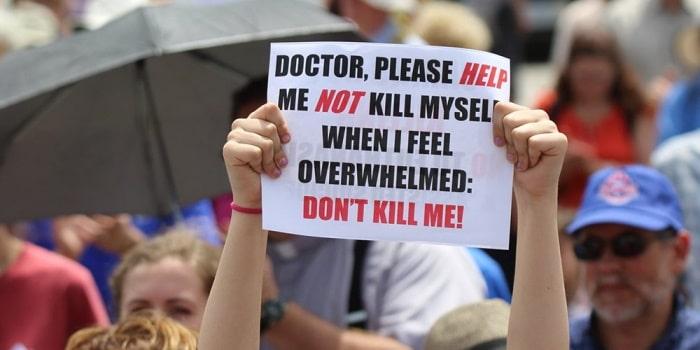
Mark Carney’s government will, come fall, face the pivotal task of deciding how to respond to a parliamentary committee recommendation to bar medical assistance in dying for patients with mental illness.

Justice Minister Sean Fraser has promised to review the newly released report from the Special Joint Committee on Medical Assistance in Dying. He also intends to read dissenting opinions. Four senators want the government to refer the matter to the Supreme Court of Canada.


The guy who messed up both immigration and housing is now going to play God.

Share

Of course Canada is not ready for MAID for mental illness. We probably won’t ever be

Of course Canada is not ready for MAID for mental illness. We probably won’t ever be

We have some confusing notions of autonomy in this country when it comes to issues around medical assistance in dying (MAID). Some are of the view that people should be allowed to do what they want with their bodies no matter what, and that the state should have little to no role in decisions of life and death. But there is an important difference between letting people do what they want to themselves, and allowing some people to euthanize others who may be in a vulnerable state. It is not paternalistic to try to protect those people, and for the state to err on the side of life where there are questions of capacity, coercion and consent for an act for which there is no going back.

Share

Canadian government should ‘indefinitely exclude’ people with mental illness from MAiD, committee recommends

Canadian government should ‘indefinitely exclude’ people with mental illness from MAiD, committee recommends

A special parliamentary committee is recommending that the federal government “indefinitely exclude” people whose sole underlying condition is a mental illness from applying for medical assistance in dying (MAID).

In a report tabled in the House of Commons Wednesday, the Special Joint Committee on Medical Assistance in Dying (AMAD) recommended that the government “amend the Criminal Code” to add this exclusion.

The 88-page report — which comes on the 10-year anniversary of MAID being legalized in Canada — reviews whether the country is ready from a clinical, health systems and regulatory perspective based on expert testimony.

Share

Howard Jampolsky: Canadians must pump the brakes on MAID

Howard Jampolsky: Canadians must pump the brakes on MAID

When medical assistance in dying (MAID) became law in 2016, advocates of the policy celebrated. People now had the right to ask their doctor to end their lives to avoid suffering and spare their loved ones the agony of watching them die a slow and possibly undignified death. This was argued as the most basic of human rights: the right to control one’s own destiny.

The debate was between those who believe only God can decide when we die, and those who believe people should have the right to control their own destiny. Ultimately, the law of land permitted physicians to end the life of a patient, as long rigid criteria were met.

Share

Chronically ill people are turning to MAID for a dignified death. Why can’t we give them a dignified life?

Chronically ill people are turning to MAID for a dignified death. Why can’t we give them a dignified life?

When is it enough?

This question has often run through my head. Maybe it’s the question everyone living with chronic illness asks themselves at certain times. Which is to say, “What is a good life? What is a life worth living?”

For 40 years I’ve lived with Type 1 diabetes. There have been good years and bad years. Complications, some challenging, most manageable, built up over time. Then, four years ago I developed long COVID. Diabetes was plenty to manage. Long COVID’s neurological effects took living with disability to a whole other level. It was, at times, too much.

Share

A decade after MAID became legal, life has become cheap in Canada

A decade after MAID became legal, life has become cheap in Canada

What does it look like when a country starts to die?

We can see it plainly when the death is catastrophic: when a nation succumbs to a hostile takeover, or to the forces of tyranny, corruption or lawlessness.
But what about when the soul of a nation starts to atrophy, slowly, in a manner that’s nearly undetectable at first? Maybe it starts with just a little ache – the niggling kind you can ignore when you’re out and about during the day. But when it’s nighttime and you’re alone, you wonder if that little ache might signal something far more pernicious.

Share

Canada hellbent on … eliminating Canadians

Canada hellbent on … eliminating Canadians

According to LifeSiteNews, Ontario doctor James MacLean was given just six months’ probation by the College of Physicians and Surgeons of Ontario (CPSO) for scoping out and assessing a man outside a Tim Hortons coffeehouse and then personally driving him to his medically assisted death by fatal injection. He will be allowed to continue to practice under state supervision for those six months and after that is free to do what he does.

Instances of euthanasia — solicited, coerced, and delivered without permission — are becoming ever more common in the Great White North.

Share

Support for original MAiD law strong but Canadians divided on mental illness expansion

Support for original MAiD law strong but Canadians divided on mental illness expansion

Canadians remain broadly supportive of the country’s original assisted dying law, but new polling suggests support weakens sharply when eligibility is expanded to include people who are not near death or those seeking MAiD for mental illness alone.

A new Angus Reid Institute survey released Monday found 77% of Canadians still support the original 2016 Medical Assistance in Dying framework, which applied to people whose deaths were reasonably foreseeable and who were suffering from a severe and irremediable condition.

(Incognito)

Share

Republican candidate urges end to US-Canada trade over Tim Hortons MAiD case

Republican candidate urges end to US-Canada trade over Tim Hortons MAiD case

In response to a shocking MAiD case going viral — one Republican candidate running for US senate says the US should stop all trade with Canada until it trashes its euthanasia practice.

Mark Lynch, a Republican candidate for South Carolina, reacted to a story publicized on X, which reported on a London Ontario man, Thomas Dillon, who was assessed and approved outside a Tim Hortons for MAiD.

(Incognito)

Share

Canada’s Medical Assistance In Dying Program Is An Express Train To Hell

Canada’s Medical Assistance In Dying Program Is An Express Train To Hell

We were warned.

There’s been a great deal of media attention this week on the professional discipline meted out to a Canadian physician who dispensed Medical Assistance in Dying (MAID) with what appears to have been an extraordinarily casual approach to the job. As the Toronto newspaper The Globe and Mail first reported, the College of Physicians and Surgeons of Ontario found that Dr. James MacLean medically assessed a Crohn’s Disease patient for euthanasia at a Tim Horton’s coffee shop, then later gave him a ride to the euthanasia facility. As the Globe and Mail also reported, “Dr. MacLean administered the lethal medications in a room at a holding facility in an industrial unit where cadavers are prepared for transport to funeral homes.”

Share

Ontario doctor cautioned over MAID complaints can continue practice under supervision, regulator rules

Ontario doctor cautioned over MAID complaints can continue practice under supervision, regulator rules

An Ontario doctor has been placed under supervision by the provincial physicians regulator after an investigation into his MAID practice found that he crossed professional boundaries and failed to adhere to protocols – including in one case where inadequate medication caused a patient to resume breathing after the doctor pronounced him dead and left.

The College of Physicians and Surgeons of Ontario reviewed two complaints against Dr. James MacLean relating to two 2024 medical assistance in dying cases and conducted a broader probe into his general medical practice that included a review of his charts.

Share

Some advocates fear Canada and the U.S. will use assisted dying to curb elder and health care costs

Some advocates fear Canada and the U.S. will use assisted dying to curb elder and health care costs

WASHINGTON, D.C. — Emergency rooms are known for long waits — whether in Canada or south of the border — but they’re still among the shortest delays in health care.

Seeing a specialist, however, can take months, sometimes leaving nervous Canadians languishing as they await treatment, surgery, or both. In the U.S., the wait times are shorter, but access may be limited by one’s ability to procure and pay for insurance.


In Canada its already open season on the “bothersome”.

Share

What is a ‘safe death’? Mentally ill woman asks for assisted dying in Canada

What is a ‘safe death’? Mentally ill woman asks for assisted dying in Canada

Claire Brosseau has travelled the world doing stand-up comedy and acting in television shows, films and plays. She has also been struggling with debilitating mental illness from a young age, and has been treated by psychiatrists in four major North American cities over three decades.

Brosseau has tried nearly every treatment available to people like herself with bipolar disorder and PTSD, she said, from behavioral therapy and medication to electric shocks to the brain.

Share

Canadian doctor suggested disabled babies could be EUTHANIZED under country’s controversial assisted suicide laws

Canadian doctor suggested disabled babies could be EUTHANIZED under country’s controversial assisted suicide laws

A Canadian doctor has suggested that babies with severe deformities could be euthanized under the country’s controversial assisted suicide laws.

Quebec College of Physicians member Louis Roy has been condemned by a lobbying group after a comment he made during a 2022 parliamentary committee resurfaced.

Roy previously said that under current Canadian law, assisted suicide could be considered for infants up to one year old with severe ailments.

Share