British Born and Bred

A mirror of crisis, there is an ongoing debate in the news media and various podcasts about what it actually means to be “British” (i.e. beyond the possession of a passport). A particularly sensitive topic in that connection is the right of a nation to demarcate itself from the rest of the world. (In the United States, the political conflict is symbolized by a border wall.)

In a trivial sense, we are all equally human, belonging to the same humanity. However, it goes against the ordinary meaning of the word to claim that we all equally belong to the same “nation”. Arising from Judeo-Christian faith, Greco-Roman philosophy-oratory, and Enlightenment ideals, neither British nor broader Western values ​​are universal.

Share

This St George’s Day felt different English nationalism is rising

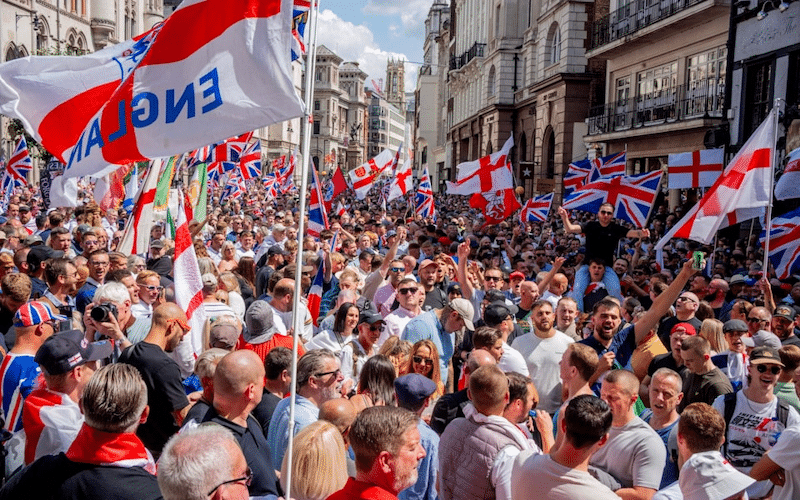
St George’s Day is a moveable feast: this year marked by the political world on its traditional date, rather than on the day next week chosen by an increasingly irrelevant Church of England. But it also shifts in terms of its meaning. A year ago, I remarked that the ghost of English ethnic nationalism, so often fearfully invoked by its detractors, was remarkable mostly for its dormancy. Yet other interpretations are available: just a few months later, Northern England was shaken by its most violent ethnic riots in decades, casting a cloud of doom over the new Labour government from which it has never yet emerged. Today, the country is in an unhappy state, the air heavy with the pressure of a storm about to break. Mild-mannered Telegraph columnists write anxious premonitions of approaching civil war, while the nation’s second city slips beneath the basic expectations of First World governance. Civil war may be unlikely, but that the very idea can be seriously entertained by credible people demonstrates a growing fissure entering British life, one which will take serious political reform to avert disaster: requiring a capacity, and appetite to undertake that the Government does not appear to possess. Translating the nation’s febrile atmosphere to an American audience, the writer Dominic Green observes in the Wall Street Journal that “The mood in England today is eerie. The government can’t govern. The police menace law-abiding people for speaking their minds. The borders are open. The country feels as if it is one Islamist bombing away from eruption.”


England is so fecked.


Share

The Virtue That Enables All Others: A Conversation with Ayaan Hirsi Ali

For the past several decades, Ayaan Hirsi Ali has been everywhere. She has been a New Atheist, a Dutch parliamentarian, and a public intellectual living under Islamist death threats; now, to the shock of many, she has converted to Christianity and launched her own media platform to advocate for the restoration of the West called Couarge.Media.

In retrospect, there were indications that Hirsi Ali was considering Christianity. In 2021, I interviewed both Hirsi Ali and her husband historian Niall Ferguson within a few weeks of each other. Both had just released books; I was reviewing Ferguson’s Doom: The Politics of Catastrophe for The American Conservative and Hirsi Ali’s Prey: Immigration, Islam, and the Erosion of Women’s Rights for this publication. Later, going over my transcripts, I noted with interest that both Ferguson and Hirsi Ali had brought up—and defended—Christianity during the interviews unprompted.

Share

Putting Down Our Parent Civilisation: Do We Live in the West, or Euthan-Asia?

Many seek to force the old West into dying, so the civilisational slate can be wiped clean.

The latest act of senseless Western civilisational suicide comes from Nottingham University in the allegedly Christian country of England. Here, as previously reported on this website, a module upon its undergraduate English Literature course, “Chaucer and his Contemporaries,” has gained a vital new trigger-warning for the 2024/25 academic year, alerting students that the books on its reading-list may contain “incidences of violence, mental illness and [by far the worst!] expressions of Christian faith.”

Share

With Teachers Like These, no Wonder British Youngsters Are so Unpatriotic

According to a recent survey, pride in British history is at an all-time low, especially among 18 to 24 year-olds.

This worrying trend doesn’t surprise me. Indeed, a revealing and sadly not uncommon conversation I had with a Year 10 class last term goes some way to explaining it. They asked me what I thought about the repatriation of the Elgin Marbles. “Should they be sent back to Greece?” one asked. Initially surprised by an unexpected foray into current affairs, I demurred from committing to a position, concerned that the wrong answer could land me in hot water with my woke colleagues, and aware of my professional obligation to remain neutral.

Share

One in five Britons are ‘ethnic nationalists’ — survey

The 2023 survey data published this week by the National Centre for Social Research is revealing on the subject of how Britons think about themselves. The survey shows that while the UK is an overwhelmingly inclusive society in terms of how people frame British identity and belonging, there remains a significant minority which continues to support more ethnocentric and exclusionary understandings of these qualities.

Share

Why Fight? A Civilization Not Worth Dying for Is Not Worth Living for Either

Secular values are simply not enough to motivate a people to live sacrificially to perpetuate their social order.

Sigmar Gabriel, the left-wing former German foreign minister and still an influential voice in European politics, is talking very tough these days. In a recent interview with Stern, Gabriel said Germany should be willing to escalate the war with Russia over Ukraine.

“I never thought I’d have to say this: However, we’ll need to checkmate Russia again as we did during the Cold War with the Soviet Union,” Gabriel said. “Putin must grasp our resolve.”

“The clear signal should be sent to Putin: Stop this war—or we’ll target you. If that entails deploying German air defense systems, assisted by the Bundeswehr, to establish no-fly zones in Ukraine to shield Ukrainian cities from Russian attacks on the civilian population, I wouldn’t guarantee Mr. Putin that we’d never act this way.”

Share

‘I don’t want him to be gay’: UFC star Bryce Mitchell says he will homeschool his son to prevent him from being a communist

UFC featherweight Bryce Mitchell presented his newborn son to the world and declared he will be homeschooling his child and avoiding any vaccinations, as well.

Mitchell took to his Instagram account to showcase new baby Tucker, telling his fans that the infant is “very healthy” and is doing “very good.” After some basic pleasantries, the 145-pound fighter explained that he was not willing to vaccinate his child.

h/t XC

Share

Will the English ever revolt?

The threat of ethnonationalism is a progressive fantasy

In The Return of the Native, Hardy observes of the mummers’ St George play that the proof it is a genuine folk tradition lies in the sullen joylessness with which it is carried out, “which sets one wondering why a thing that is done so perfunctorily should be kept up at all”. And yet, Hardy observes, “the agents seem moved by an inner compulsion to say and do their allotted parts whether they will or no”. Much of the same could be said of today’s annual St George ritual, in which Twitter liberals set out to slay the dragon of xenophobic nationalism, and their conservative opponents the equivalent monster of oikophobic deracination. No other European nation behaves like this. Even within our home archipelago, the Irish do not do this on St Patrick’s Day, nor the Welsh and Scots on St David’s or St Andrew’s Days: it is no doubt a marker of my fundamental un-Englishness that I find this trait strange and maladaptive. In this hysteric faux-cosmopolitanism, so distinct from the national consciousness of our neighbouring Dutch or Danes or Norwegians, the English prove themselves the very weirdest of the weird. But then: “What should they know of England, who only England know?”

Share

We Are Closer Than You Think to Civilizational Suicide: Lessons From Burnham

“Liberalism,” he wrote, “permits Western civilization to be reconciled to dissolution.”

Sixty years ago, James Burnham’s book Suicide of the West was published to much acclaim from conservatives and much criticism by liberals. It was Burnham’s last book (other than a collection of his National Review columns titled The War We Are In) and, perhaps, his most pessimistic and prophetic work. Western civilization led by the United States, he wrote, was dying, not because of external challenges but, rather, because of internal decay. The West, in other words, was in the process of committing civilizational suicide. And what caused liberals to ridicule and deride the book was Burnham’s conclusion that liberalism was the “ideology of Western suicide.” 

Share

Jonathan Pageau: A Prophet Rises From Quebec and YouTube

On a trip to Germany last month, I met a young man who wanted me to understand something important about his country. He said he, like me, is a believing Christian—and this, he did not need to tell me, makes him rare in his generation. He also said he is a conservative, but a conservative under siege in a way that an American like me might not understand.

“You have to realize that in Germany, anything to the right of the liberal conservative party”—he meant the Christian Democrats—“is seen as fascist,” the young man said. Given Germany’s history, this designation demonizes any and all challenges to the current system.

Share

Le Pen and AfD Meet To Clarify Positions on Remigration

While relations between the French Rassemblement National (RN) and the German Alternative für Deutschland (AfD) had become strained after a cabal in the German press against the AfD about remigration, the leaders of the two political groupings have stepped up contacts to overcome misunderstandings and try to strengthen ties.

An investigation published by the German ‘investigative journalism network’ Correctiv claimed in January that the AfD had spoken out at a meeting in favour of the ‘remigration’ of German nationals who had not assimilated. On the strength of these press rumours, which were denied by the AfD, the Rassemblement National, the AfD’s ally in the European Parliament’s right-wing Identity & Democracy (ID) group, announced that it wanted to distance itself from its German counterpart, and vigorously condemned any form of ‘remigration.’

Share

My Dinner with André: A Melancholy Repast at the End of a World

“It feels great to be in this city,” said my French interlocutor, over dinner this week in a neighborhood Hungarian restaurant. “It feels like I’m back in Europe.”

I laughed, telling him that that is the second time since I moved to Budapest that I’ve heard those words from the mouth of a visitor from France. He smiled and said, “It’s true. I feel it also in Poland.”

He’s talking about migration and crime, of course. Since moving permanently to Europe last autumn, I have put myself on a crash course to learn what life is really like in Europe, as opposed to what the American media says it’s like. One would understand from paying attention to the US media that Europe has migration problems. But one would almost never grasp the depth and breadth of the problem if one did not have the chance to talk to Europeans who are living with it, but whose views do not fit the media’s preferred liberal narrative.

Share