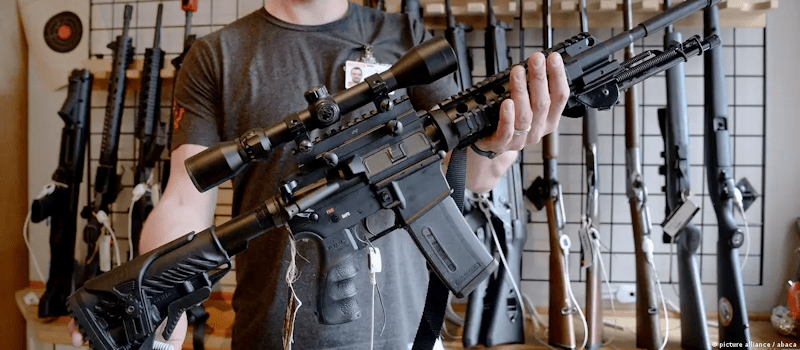
CALGARY — While the Liberal government formally announced the start of its nationwide firearms gun grab program for individuals in Montreal on Saturday, it remains to be seen how enforcement will be initiated in the Prairie provinces.

CALGARY — While the Liberal government formally announced the start of its nationwide firearms gun grab program for individuals in Montreal on Saturday, it remains to be seen how enforcement will be initiated in the Prairie provinces.

When an individual falls victim to the sunk cost fallacy, the consequences that follow are generally even worse. Maybe it’s an extra few thousand wasted on a rust bucket of a car just to feel like the money invested in it wasn’t for nothing. Maybe it means staying in a bad relationship that ought to have ended years ago. Maybe it’s why – just to pick a totally random example – a columnist will persist with a snoozer of a column because she’s typed out 500 words already. These are emotional, illogical decisions, but humans are emotional, illogical creatures who often have a hard time reversing course when we feel like we’ve already invested a lot of money, time or attention.

Twenty-five guns. That’s all the federal government collected in a recent pilot project in Nova Scotia for its new “buyback” (a.k.a. expropriation) program for prohibited firearms. “A total of 25 prohibited firearms, turned in by 16 participants, were destroyed,” spokesperson Noémie Allard said Friday. “The total compensation paid to pilot participants is $26,535.”

This past fall, the federal government ran a pilot program on Cape Breton for its long-delayed firearms confiscation scheme.
The six-week-long test as a colossal failure. The federal public safety department expected Cape Bretoners would turn in 200 guns during the month-and-a-half long trial. They turned in 25.

Just 25 guns. That’s how many firearms were taken in as part of the Mark Carney government’s gun “buyback” pilot program in Nova Scotia’s Cape Breton region.
The government had been hoping for 200 guns collected in an area that industry experts estimate has at least 2,000 guns that the government has banned.

Ottawa’s gun grab program is under renewed fire after a federal pilot project in Cape Breton netted just 25 firearms, far short of government targets, prompting critics to call the entire scheme a costly failure.
The Canadian Taxpayers Federation says the six-week pilot project, launched in September 2025, demonstrates what law enforcement and policy experts have warned for years: confiscating firearms from licensed owners will not make communities safer.

The Liberal government says it’s learned some lessons after a pilot project to buy outlawed assault-style firearms from owners yielded a low uptake.
Since 2020, Ottawa has banned some 2,500 makes and models of assault-style firearms, arguing they are designed for warfare — not hunters and sport shooters.
The decision saw backlash from the Opposition Conservatives and firearms-rights groups. The government has pointed to its plan to buy back those guns as a way to fairly compensate owners.

Instead of disarming law-abiding gun owners across Canada, why not offer them the opportunity to enlist in a supplementary reserve by taking an oath of allegiance and registering with a militia regiment at the local armoury?
OTTAWA—The senior leadership of the Canadian Armed Forces and the Department of National Defence are presently scrambling to formulate a plan that would lead to the creation of a Supplementary Reserve.
The projected number of this force of citizen soldiers is to be a whopping 300,000 volunteers. The basic training would be a one-week course, presumably involving some measure of small arms weapon training and basic vehicle driving skills.
According to the initial plan, the Supplementary Reserve would have more lax standards of physical fitness than the regular force and the active reserves. The kicker is that there is no plan to provide these supplementary reservists with uniforms.

It may be too early for an in-depth analysis of the horrific attack on a Hanukkah gathering at Australia’s famous Bondi Beach, beyond the obvious fact that it was yet another act of Islamist terror, the latest in a long line of attacks meant to murder Jews. But it’s not too early to draw a single, transparently obvious conclusion. The Bondi Beach attack totally undermines the common progressive focus on the guns rather than the shooters.
The guns at Bondi Beach didn’t simply jump out of a car and begin shooting on their own. They were brought to the location by a father and son team of Islamist terrorists who used them to murder 15 people, including a ten-year-old girl who was deliberately targeted as she tried to run away.

It was a Sunday afternoon in April 1996 when a lone gunman armed with semi-automatic rifles killed 35 people in the Australian tourist town of Port Arthur.
The massacre almost 30 years ago, which ushered in some of the strictest gun laws in the world, feels like a bygone age for many Australians.
But the Bondi Beach attack on Sunday, which left 15 dead, rekindled memories of the Tasmanian tragedy – none more so than for leading gun control advocate Roland Browne.
Making your citizens prey for Muslims is a swell idea.
h/t Mauser

Democrats want our guns, and they want to repeal the Second Amendment. They’ve been very clear about their agenda for quite some time now. Unfortunately for them, jurisprudence and good, old-fashioned American stubbornness are not on their side. Americans own hundreds of millions of firearms, ranging from handguns to various rifles.

Australia is poised to overhaul its gun laws in the wake of the terror attack on Jewish festivalgoers at Bondi Beach in Sydney.
Australian Prime Minister Anthony Albanese on Monday tabled changes to national laws at a meeting of the National Cabinet, a roundtable of the nation’s federal, state and territory leaders.
They includes bringing into effect a national firearms register, which is anticipated would allow information sharing on gun owners across state borders.

Picture a winter morning in northern Alberta or rural Saskatchewan.
A licenced firearms owner — maybe an indigenous hunter, maybe a rancher — reaches for the same rifle or shotgun they’ve used for decades.
It might be an SKS picked up when they were still cheap and plentiful. It might be a semi-automatic shotgun that takes detachable magazines because that’s what the local shop had in stock at the time.

Kenneth Santana-Rodriguez brought along his 9mm handgun on a pedicure date with a woman at “A Touch of Beauty” nail salon in Holyoke, Mass.
They were sitting side by side when the father of the woman’s child burst into the salon, demanding to know the nature of their relationship. Santana-Rodriguez told police the man raised his shirt to reveal a firearm and said, You know what’s about to happen.
Santana-Rodriguez pulled out his 9mm and shot twice. “It was him or me,” he told police. Yet he missed his intended target, Irvin Sanchez. One bullet instead struck the chest of an employee who had been working on the woman’s toenails, killing Trung “Michael” Tran, 33 years old. Prosecutors filed a charge of first-degree murder against Santana-Rodriguez.

OTTAWA — A new report from an expert panel struck to help guide the Liberals’ efforts to ban firearms shows the government appears to have ignored parts of its advice when it comes to certain makes of the SKS semi-automatic rifle.
That make of firearm has proven to be among the most controversial for the Liberals when it comes to the government’s list of more than 2,500 makes and models of guns it has banned since 2020.
I’m sick of this DEI hire.