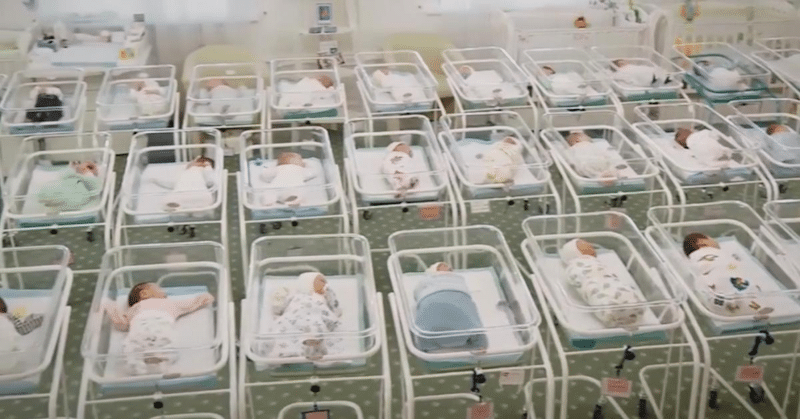
We are not having enough babies and that’s a problem for all us

It’s not rocket science.

Ensure families have access to affordable, high-quality child care and guess what? You get drastically better outcomes. Not just for kids, who get a fair start in life, but also for parents, who can return to the workforce far earlier and with greater confidence.

For those, like myself, who advocated for the national $10-a-day child care strategy for years, achieving these results was never driven by short-term political calculus. We understood that the true impact of this policy would unfold over decades, not just in months or years; that politics, at its best, is one generation making and keeping a promise to the next.

Being unable to rent or buy a home is a disincentive to raising a family.

Share

The strange death of the family

That watermelon looks racist.

The world is sleepwalking towards a depopulation crisis.

Over a decade ago, I led a team of Singapore-based researchers to investigate why families were declining. Back then, we were experiencing a historic shift away from population growth and familial ties, towards individualism. Since then, the post-familial age has entered full swing.

This situation would have been unthinkable in the 1960s, when ‘overpopulation’ was seen as inevitable. In his 1968 book, The Population Bomb, Paul Ehrlich predicted that the number of people on Earth would rocket to unsustainable levels, resulting in global famine.

Share

France’s falling birth rate has prompted frantic calls for a ‘demographic rearmament’

Based on average fertility rates, France is Europe’s baby utopia.

In 2022, there were 1.8 live births for every woman in France. This was the highest rate across the Continent except for Georgia, according to official figures.

Parents in France get big tax cuts if they have more children, and access to a wide range of heavily subsidised childcare.

Share

World’s population to fall for first time since the Black Death

The world population is expected to fall for the first time since the Black Death because of plummeting birth rates, a Lancet study has found.

The decline in the number of children women are having has started to slow the growth of the global population, which stands at just over eight billion, and could mean it starts to fall within decades.

It would be the first time that the number of people on the planet has decreased since the Black Death bubonic plague pandemic killed as many as 50 million people in the mid-1300s, including up to a third of the population in Europe.

Share

Demographic Collapse and Hungarian Family Policy, Part I

In 1992, P. D. James published Children of Men. The novel is set in 2021 in the United Kingdom. James’ world is one in which no children have been born since 1995. Male fertility has since been zero and no woman has been able to have a baby. James’s dystopia is one of economic, societal, and political collapse, driven by the lack of children.

Our own world is not teetering on the brink of this scenario. However, birth rates are plummeting across the globe, especially in OECD countries. Conservative estimates put the global population peak at around 2060, followed by a decline into the twenty-second century. Many nations are already in the midst of a demographic collapse, with modernized Asian economies leading the way. Japan’s fertility rate in 2020 was 1.34, whilst South Korea’s was an appalling 0.78 as of 2022. This rate is appalling because the minimum replacement fertility rate is 2.1. For a population to sustain itself, women need to, on average, bear 2.1 or more children. This low-fertility scenario might sound attractive if your environmental policy boat is floated by the idea of fewer human beings. However, James’ dystopia ought to make us think twice about the virtues of population collapse.

Share

Cost of living under Trudeau regime a key reason Canadians are having fewer kids: poll

Financial concern a key reason Canadians are having fewer kids: poll

The rising cost of living appears to be dragging down Canada’s birth rate, which recently hit its lowest level in recorded history.



Ipsos polling done exclusively for Global News found most Canadians are having fewer children than they would like because it’s too expensive to raise them.

The poll looked at responses from 1,001 Canadians between Feb. 16 and Feb. 20 on Canada’s falling fertility rate. Nearly half of respondents said they consider two the “ideal number of kids.”

Share

How low birth rates could threaten our civilization

For Italians — and for everyone else — there is a warning from history

The village we moved to in central Italy is lovely — old stone houses and olive trees on a hillside — but it is eerily deserted most of the time. A neighbor in his forties says that when he grew up here, it was full of children playing in the cobbled streets. There were about 350 people then, he tells me; now the population is precisely forty-two, and that includes the latest residents, me and my wife. The village is dying on its feet, becoming a perfectly preserved museum piece. My neighbor shakes his head and says how sad it is. There are many villages like this in Italy. First one house is boarded up, then another; the trattoria closes, after that the bakery and other shops, and then people leave all at once because the place isn’t what it was. Some mayors are famously offering newcomers houses for just €1. This makes almost no difference because of something that is happening across the whole country: Italians are not having as many babies as they used to.

Share

Germany tests 4-day workweek amid labor shortage

It sounds counterintuitive: While Germany, like many countries, struggles to find enough workers, dozens of companies are starting an experiment that will see employees work a day less. In February, 45 companies and organizations in Europe’s largest economy will introduce a 4-day workweek for half a year. Employees will continue to receive their full salary. The initiative is led by the consulting firm Intraprenör in collaboration with the non-profit organization 4 Day Week Global (4DWG).

Share

Jamie Sarkonak: France wants to solve the baby bust, and Canada should too

A population that can’t sustain itself will eventually cease to exist. And France, facing the lowest number of births it’s ever seen since the Second World War (at a rate of 1.86 per woman), is starting to wake up to that fact.

Last week, French President Emmanuel Macron announced his government will engage in a “demographic rearmament” to raise the country’s faltering birth rate. The actual plan behind this is a lot less exciting: he plans to revise parental leave and devote more resources to combatting infertility. Right now, France gives 16 weeks of maternity leave, with the optional extension of up to three years, but this is poorly-paid at 400 euros (C$586) per month.

Share

Can Canada Be Saved From Extinction?

The greatest crisis now facing the West is not so-called climate change or the real dangers of mass immigration, although these are being used by global influencers to destabilize populations and even overthrow sovereignties. The greatest crisis is not the rise of surveillance regimes that gravely threaten freedom and democracy, nor is it the rise of a legion of sexual ideologies that assault the primordial male-female binary and the procreative relationship that is its exclusive prerogative.

Share

More than half of US’s 25,000 cities are predicted to become ghost towns by 2100…

Half of the nearly 25,000 cities in the US could become ghost towns by 2100, a study suggests.

Researchers at the University of Illinois Chicago found that in a modest scenario, around half of cities could lose up to a quarter of their resident populations by the end of the century.

If fertility rates continue to decline and the exodus from cities gets worse, as many as two-third of cities could see their populations shrink significantly.

Share

All I want for Christmas is a rise in birth rates

Game of Life – featuring dangerous looking white people in what may be an intact family.

“For unto us a child is born, unto us a son is given: and the government shall be upon his shoulder: and his name shall be called Wonderful, Counsellor, The mighty God, The everlasting Father, The Prince of Peace.”

These words are from the Book of Isaiah, written hundreds of years before the first Christmas. For Christians, however, they are prophetic of the most important birth of all time.

For non-believers, though, what really gives Christmas its power over the human imagination is that it is about life, as well as light. The flame flickering in the darkness is an uncertain symbol of hope, but the newborn child is a living promise. Christmas, with its focus on the Infant Jesus — and, by extension, children everywhere — exerts a special hold on the human heart.

Share

Out with a Whimper: Europe’s Quiet Crisis of Fertility

Anyone in need of a break from the frivolity of so much Western politics should spend time in Poland. The conditions there, I was pleased to find on my first ever visit last month, are highly favourable to thoughtful debate about important matters. The country does not go through the tedious ritual of pretending, for instance, that importing endless numbers of foreigners with no ancestral attachment to Poland is an enriching exercise. This may have something to do with the fact that the Polish elite, whatever their other faults, never subjected their country to such a treacherous demographic experiment in the first place, so there is no need to dream up an ex post facto rationalisation. Nor is Polish conservatism plagued by the predominance, so regrettable in Britain, of free market fundamentalists who obsess over GDP while failing to grasp that all economic activity takes place within a pre-existing culture whose health is paramount.

Share

As Canada’s fertility rate declines, the debate over how to respond will get ugly

Although this country’s population grew robustly last year, our total fertility rate continues to decline, data released by Statistics Canada Wednesday reveal.

The debate over how to address the issue is going to get ugly. In some parts of the world, it already has.

Canada grew by more than a million people in 2022, because we took in just under 470,000 immigrants and almost 700,000 non-permanent residents, mostly students and temporary workers. That’s significant, because at just 1.33 children per woman last year, this country’s total fertility rate (TFR) is far below the replacement rate of 2.1 needed to maintain population stability absent immigration.

Share