NATO Summit: Canada Must Now Deliver

NATO Summit: Canada Must Now Deliver

Canada leaves this week’s NATO Summit in Ankara with good reason for cautious optimism. After years of debating defence budgets and delayed procurements, the Alliance has reached an important turning point. The discussion is no longer about promises. It is about military capability. That is precisely where Canada’s focus must remain.

For years, NATO measured commitment by the percentage of GDP devoted to defence. That benchmark still matters, but it is no longer sufficient. The true measure of national security is whether those dollars produce soldiers, ships, submarines, aircraft, armoured vehicles and ammunition that can fight. Capability deters aggression. Announcements do not.

Share

Canada’s going to need to use its aging secondhand British subs for another decade

Canada’s going to need to use its aging secondhand British subs for another decade

Canada will have to squeeze at least another decade of life out of its used British submarines as it waits for Germany to deliver up to 12 new vessels. But not everyone’s convinced that can be done.

The four diesel-electric subs the Royal Canadian Navy acquired from Britain in the late 1990s have been plagued with disasters, including floods, a deadly fire and a grounding that took the only operational sub we have right now out of action for a decade.

Share

Guns and butter: The true cost of Canada’s military spending is yet to be tallied

Guns and butter: The true cost of Canada’s military spending is yet to be tallied

Canada will never be a military powerhouse. But it is making up for lost time during the post-Cold War years, when spending on fighting machines sank to risible levels. As various MPs have stated, Canada had planes that wouldn’t go up and submarines that wouldn’t go down, and still does for the most part. Today, only one of Canada’s four rust-bucket submarines is in service and its CF-18 fighter jets are twice the age of some of its pilots.

Share

Canada’s next defence fight won’t be over spending. It’ll be over trust

Canada’s next defence fight won’t be over spending. It’ll be over trust

If there’s one catchphrase to sum up the dilemma facing Canada and other allies post-NATO summit, it might very well be: Show me the money.

It may be cliché. It may be somewhat worn out — after all, it’s a pop reference to the 1996 movie Jerry Maguire. But it probably best captures a stirring public sentiment.

Britain found out the hard way recently that being able to account for an avalanche of money going to defence and security is a live, visceral political and policy issue that is capable of causing damage and casualties.

Share

Number of new submarines still undecided as Canada begins talks with German builder

Number of new submarines still undecided as Canada begins talks with German builder

OTTAWA — Canada might not buy a full slate of 12 submarines through its new partnership with Germany and Norway because of factors like advancing technology in autonomous underwater machines, says the government’s secretary of state for defence procurement.

In an interview with the Star on Wednesday, Stephen Fuhr said the government has not settled on how many 212CD submarines it will ultimately buy as negotiations begin on the purchase of “up to” 12 of the modern diesel-electric craft from German-based shipbuilder TKMS.

Share

Why is Canada spending tens of billions on new submarines?

Why is Canada spending tens of billions on new submarines?

Canada is looking to spend tens of billions of dollars on a contract with German shipbuilder ThyssenKrupp Marine Systems (TKMS) to replace Canada’s aging fleet of submarines with up to a dozen new vessels.

Prime Minister Mark Carney called it the biggest defence procurement project in Canada’s history.

Here’s why the purchase could stack up to a major price tag of $100 billion or more over the lifetime of the deal.


A lot of money sloshing around, some of it will land near to Carney’s feet.

Share

Ottawa sidelines foreign firms in $4.9B army vehicle competition

Ottawa sidelines foreign firms in $4.9B army vehicle competition

The Carney government quietly cancelled the second phase of a long-standing competition to provide the army with light utility vehicles and intends to “invite a limited number of Canadian suppliers” to bid directly, CBC News has learned.

Public Services and Procurement Canada (PSPC) issued a notice late Friday that says the federal government intends to “transition to an updated procurement approach.”


Whichever firm is most closely linked to Brookfield wins.

Share

There’s a message for Trump in Mark Carney’s new submarine decision

There’s a message for Trump in Mark Carney’s new submarine decision

It will take close to a decade before the submarines Canada wants to buy will have any in-the-sea impact on the country’s security.

But Prime Minister Mark Carney will nonetheless get a boost from Monday’s announcement immediately upon arrival Tuesday for the NATO Leaders’ Summit.

That’s because it’s right on track with the theme of this year’s gathering in Ankara.

Share

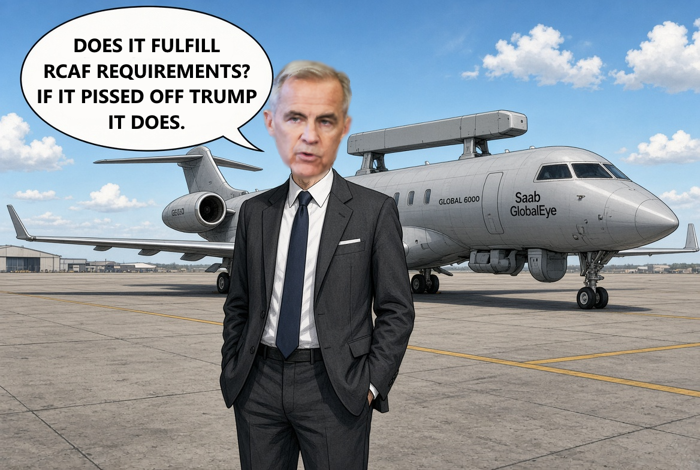
NATO bets on Saab, giving Canada’s GlobalEye gamble a major boost

NATO bets on Saab, giving Canada’s GlobalEye gamble a major boost

NATO has made it official, announcing Tuesday that it intends to acquire up to 10 Saab-manufactured GlobalEye early warning surveillance aircraft in a plan that has important implications for Canada.

Secretary General Mark Rutte said at the outset of this year’s leader’s summit in Ankara, Turkey, that the Western military alliance will open formal negotiations with the Swedish company in order to secure the planes.

The alliance had previously signalled it was looking at the high-tech jet as a replacement for NATO’s existing fleet of aging Boeing E-3 AWACs.

Share

Five things you should know about Canada’s new fleet of submarines

Five things you should know about Canada’s new fleet of submarines

OTTAWA – Prime Minister Mark Carney’s Liberal government is set to name Germany’s ThyssenKrupp Marine Systems as the preferred bidder to build the navy’s next fleet of submarines, according to multiple media reports.

That means Canada will now enter into months of closed-door negotiations with the winner.

TKMS had been competing with South Korean defence firm Hanwha Ocean for the lucrative contract.

Share

A NATO submarine partner: Why Canada chose Germany

A NATO submarine partner: Why Canada chose Germany

After a closely fought battle between Germany’s TKMS and South Korea’s Hanwha Ocean to build the next generation of submarines for Canada, the federal government has selected a preferred bidder.

Ottawa has chosen TKMS, The Globe and Mail reported on Monday. Prime Minister Mark Carney is set to make the official announcement later in the day in Halifax.

Share

Carney to choose Germany and Norway to build Canada’s submarines

Carney to choose Germany and Norway to build Canada’s submarines

German shipbuilder ThyssenKrupp Marine Systems (TKMS) is expected to be Canada’s preferred choice to build the navy’s new fleet of submarines, sources confirm to CBC News.

Prime Minister Mark Carney will be in Halifax later today where he’ll put an end to long-running speculation about the future of the multi-billion dollar program which will determine the navy’s future.


I’m liking the Korean Turtle Ships as consolation prize for the surface fleet’s replenishment given the U-Boats have won the day for Germany.

Share

LILLEY: Will Carney announce mixed submarine fleet on his way to NATO?

LILLEY: Will Carney announce mixed submarine fleet on his way to NATO?

There’s a good chance that Prime Minister Mark Carney could make a brief stop in Halifax on his way to the NATO Summit in Turkey this week.

Speculation has been building that the Royal Canadian Navy is preparing to announce the winner of its competition for a new submarine fleet, and Monday would be an ideal day to do it.

Share

Liberals refuse to provide proof of Carney’s NATO defence spending claims

Liberals refuse to provide proof of Carney’s NATO defence spending claims

The finance minister’s office is refusing to release data to back up recent claims by Prime Minister Mark Carney that Canada will substantially accelerate its defence spending.

“Our fiscal framework has already provisioned to achieve four per cent of GDP in total defence spending by the end of this decade, ahead of NATO’s timetable,” Carney told the CANSEC Defence conference in Ottawa in May, a claim he later repeated at a press conference in June.


Carney is spending money. Just not in Canada …

NATO’s European members and Canada have signaled a readiness to fully take over the financing of Ukraine’s fight against Russia

Share