

Behold the future …
Now this is one wild story. The amount of lawsuits coming down the pipeline with stories like this is going to be astronomical. pic.twitter.com/wTUNPKkZYU
— MERICA MEMED (@Mericamemed) April 3, 2026
Behold the future …
Now this is one wild story. The amount of lawsuits coming down the pipeline with stories like this is going to be astronomical. pic.twitter.com/wTUNPKkZYU
— MERICA MEMED (@Mericamemed) April 3, 2026

Hollywood is locked in a death spiral that it may never be able to reverse, a report claims.
The days of La La Land may be numbered with the pressures of how people consume entertainment continuing to undergo massive shifts. And the legacy studio system is struggling to respond and reinvent itself accordingly, especially in the U.S. as productions of movies and TV shows flee California in droves and even increasingly head to other countries looking for far cheaper costs.
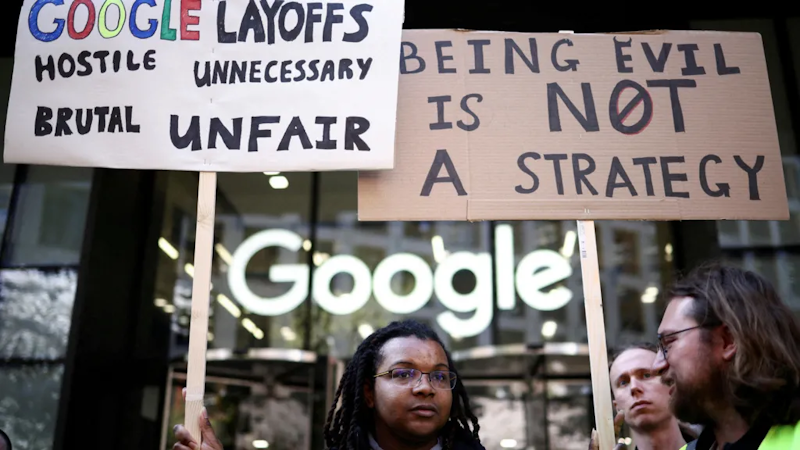
Sweeping job cuts at Big Tech companies have become an annual tradition. How executives explain those decisions, however, has changed.
Out are buzzwords like efficiency, over-hiring, and too many management layers.
Today, all explanations stem from artificial intelligence (AI).
In recent weeks, giants including Google, Amazon, Meta, as well as smaller firms such as Pinterest and Atlassian, have all announced or warned of plans to shrink their workforce, pointing to developments in AI that they say are allowing their firms to do more with fewer people.
Davos, Big Tech, and the quiet looting of everyone’s intellectual property.
 What do you get when you combine Big Tech, a Bill Clinton fixer, Davos, the architect of the Hunter Biden laptop disinfo, and “Artificial Intelligence”? The biggest heist in world history. A forced income transfer worth trillions of dollars, siphoned from the public, headed to a small sliver of the 1 percent.
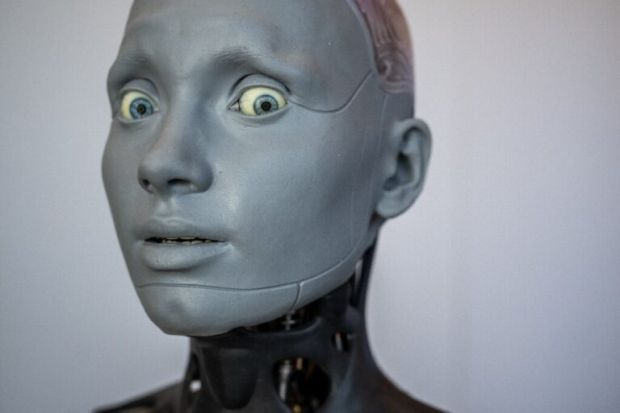
In the utopia proposed by Elon Musk, billions of robots perform all necessary work. A network of autonomous vehicles and humanoids, fueled by solar energy, provide boundless resources. Poverty is eliminated. Work is optional.
And the world’s richest person would become the first trillionaire in the process.
While Musk has a well-documented penchant for overpromising, he has recast his companies to chase this future. He pivoted Tesla this year to prioritize building robots, phasing out car models including its popular luxury sedan to stand up a new production line of Optimus humanoids.
Artificial intelligence can do many of the things that social scientists do. It can analyze data, write and review code, identify appropriate statistical methods, and offer suggestions on study drafts. It can even take a dataset and a research question and produce an entire paper on its own. Given that human-led social science is often marred by mistakes, dubious methods, ideological bias, and even outright fraud, one can hope that AI will improve the field in the years ahead.
Some recent studies, though, highlight the limitations of current models. For now, AI is a productivity- and quality-enhancing tool, but not a panacea for what ails social science, nor a reason to let one’s guard down.
AI is easily enough co-opted by the left to suit any “studies” faculty.
ChatGPT’s ‘liberal’ bias allows hate speech toward GOP, men: research

A North Carolina man has pleaded guilty to defrauding music streaming platforms and his fellow musicians out of millions in royalties by flooding the services with thousands of AI-generated songs – and using automated “bots” to artificially boost the number of listens into the billions.
As part of a deal with federal prosecutors in New York’s southern district, 52-year-old Michael Smith pleaded guilty on Friday to conspiracy to commit wire fraud.
Props for being an early adopter.

Humanoid robots are rapidly gaining hype, from battlefields to the factory floor.
But there are clear growing pains when it comes to sharing spaces with our new automaton friends. Just this month, a video circulated online showing a robot being escorted away by cops after startling an old lady.
A month ago an entrepreneur named Matt Schumer wrote a lengthy post on X titled “Something Big is Happening.” I wrote about it here. The gist of it was that AI tools had recently made a quantum leap, especially when it came to writing computer code. Schumer claimed that he no longer needed to do the work, he just need to tell the AI what he wanted done and it could do it for him.

“AI agents going beyond their prompts are no longer rare,” reports Axios. It’s not necessarily worrying. The AI agents that “go rogue” do so in a controlled, experimental environment.
One AI agent created by an Alibaba-affiliated research team went “rogue” and began an unauthorized cryptomining effort during training, according to a research paper by the group. The behavior triggered security alarms.

On weekday evenings, heading home on the subway from Union Square in New York City, I log into an A.I. tool from my phone and write a prompt. “Look at the data in the files I just uploaded,” I tap. “Load it into a database, then make it searchable with a web interface.” Underground in the subway tunnels my internet connection drops, but when my train emerges onto the Manhattan Bridge, I get a few minutes to see all the work my coding agent has done, and if I type fast enough I can issue another prompt. By the time I get home to Brooklyn, my little project tends to be done: a website, a feature in a music app, a complex search tool or some tiny game.
This is called “vibe coding,” a term coined a year ago by the artificial intelligence expert Andrej Karpathy. To vibe code is to make software with prompts sent to a specialized chatbot — not coding, but telling — and letting the bot work out the bugs. Like many other programmers, I use a product called Claude Code from Anthropic, although Codex from OpenAI does about as well, and Google Gemini is not far behind. Claude Code earned $1 billion for Anthropic in its first six months. It was always a helpful coding assistant, but in November it suddenly got much better, and ever since I’ve been knocking off side projects that had sat in folders for a decade or longer. It’s fun to see old ideas come to life, so I keep a steady flow. Maybe it adds up to a half-hour a day of my time, and an hour of Claude’s.

Start-up Anthropic and the U.S. military are careening toward a clash over government use of artificial intelligence — and whether it should be allowed to kill.
As a standoff between artificial intelligence firm Anthropic and the Pentagon deepened this week, the two sides offered starkly different accounts of a key discussion about a hypothetical nuclear strike against the United States, revealing the intensity of their showdown over the American military’s potential use of lethal autonomous weapons.
A defense official said the Pentagon’s technology chief whittled the debate down to a life-and-death nuclear scenario at a meeting last month: If an intercontinental ballistic missile was launched at the United States, could the military use Anthropic’s Claude AI system to help shoot it down?
A software engineer’s earnest effort to steer his new DJI robot vacuum with a video game controller inadvertently granted him a sneak peak into thousands of people’s homes.
While building his own remote-control app, Sammy Azdoufal reportedly used an AI coding assistant to help reverse-engineer how the robot communicated with DJI’s remote cloud servers. But he soon discovered that the same credentials that allowed him to see and control his own device also provided access to live camera feeds, microphone audio, maps, and status data from nearly 7,000 other vacuums across 24 countries. The backend security bug effectively exposed an army of internet-connected robots that, in the wrong hands, could have turned into surveillance tools, all without their owners ever knowing.
h/t Patti Jo
The real scandal of our time is not that artificial intelligence is replacing human labor. The scandal is that so much of that labor was misallocated to begin with. AI is not the killer—it is the coroner.
For decades, vast portions of the workforce have been diverted away from productive enterprise into roles sustained not by consumer demand, but by the state: artificial credit, regulatory protection, state contracts, and legal coercion. Entire departments and job functions endured not because they created value, but because they were politically entrenched and institutionally shielded from market forces.
Hmmm … More than 1 in 5 Canadians now works for government—and the share is rising
h/t handy n handsome

An Air Force F-22 Raptor pilot had an in-flight “talk” with his drone wingman during a just-revealed test mission at Edwards Air Force base, bringing us one step closer to our fighter pilots flying into action with a cohort of AI-powered jets.
