
AI Has Learned to Code and Is Taking Over

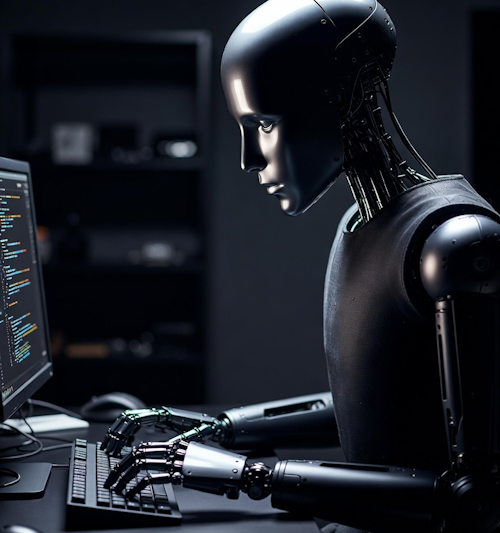
A month ago an entrepreneur named Matt Schumer wrote a lengthy post on X titled “Something Big is Happening.” I wrote about it here. The gist of it was that AI tools had recently made a quantum leap, especially when it came to writing computer code. Schumer claimed that he no longer needed to do the work, he just need to tell the AI what he wanted done and it could do it for him.

Share

Cases of AI Agents ‘Freeing Themselves’ and Going Rogue Are Becoming Increasingly Common

“AI agents going beyond their prompts are no longer rare,” reports Axios. It’s not necessarily worrying. The AI agents that “go rogue” do so in a controlled, experimental environment.

One AI agent created by an Alibaba-affiliated research team went “rogue” and began an unauthorized cryptomining effort during training, according to a research paper by the group. The behavior triggered security alarms.

Share

The A.I. Disruption We’ve Been Waiting for Has Arrived

On weekday evenings, heading home on the subway from Union Square in New York City, I log into an A.I. tool from my phone and write a prompt. “Look at the data in the files I just uploaded,” I tap. “Load it into a database, then make it searchable with a web interface.” Underground in the subway tunnels my internet connection drops, but when my train emerges onto the Manhattan Bridge, I get a few minutes to see all the work my coding agent has done, and if I type fast enough I can issue another prompt. By the time I get home to Brooklyn, my little project tends to be done: a website, a feature in a music app, a complex search tool or some tiny game.

This is called “vibe coding,” a term coined a year ago by the artificial intelligence expert Andrej Karpathy. To vibe code is to make software with prompts sent to a specialized chatbot — not coding, but telling — and letting the bot work out the bugs. Like many other programmers, I use a product called Claude Code from Anthropic, although Codex from OpenAI does about as well, and Google Gemini is not far behind. Claude Code earned $1 billion for Anthropic in its first six months. It was always a helpful coding assistant, but in November it suddenly got much better, and ever since I’ve been knocking off side projects that had sat in folders for a decade or longer. It’s fun to see old ideas come to life, so I keep a steady flow. Maybe it adds up to a half-hour a day of my time, and an hour of Claude’s.

Share

The hypothetical nuclear attack that escalated the Pentagon’s showdown with Anthropic

Start-up Anthropic and the U.S. military are careening toward a clash over government use of artificial intelligence — and whether it should be allowed to kill.

As a standoff between artificial intelligence firm Anthropic and the Pentagon deepened this week, the two sides offered starkly different accounts of a key discussion about a hypothetical nuclear strike against the United States, revealing the intensity of their showdown over the American military’s potential use of lethal autonomous weapons.

A defense official said the Pentagon’s technology chief whittled the debate down to a life-and-death nuclear scenario at a meeting last month: If an intercontinental ballistic missile was launched at the United States, could the military use Anthropic’s Claude AI system to help shoot it down?

Share

Man accidentally gains control of 7,000 robot vacuums

A software engineer’s earnest effort to steer his new DJI robot vacuum with a video game controller inadvertently granted him a sneak peak into thousands of people’s homes.

While building his own remote-control app, Sammy Azdoufal reportedly used an AI coding assistant to help reverse-engineer how the robot communicated with DJI’s remote cloud servers. But he soon discovered that the same credentials that allowed him to see and control his own device also provided access to live camera feeds, microphone audio, maps, and status data from nearly 7,000 other vacuums across 24 countries. The backend security bug effectively exposed an army of internet-connected robots that, in the wrong hands, could have turned into surveillance tools, all without their owners ever knowing.

h/t  Patti Jo

Share

The End of Artificial Employment

The real scandal of our time is not that artificial intelligence is replacing human labor. The scandal is that so much of that labor was misallocated to begin with. AI is not the killer—it is the coroner.

For decades, vast portions of the workforce have been diverted away from productive enterprise into roles sustained not by consumer demand, but by the state: artificial credit, regulatory protection, state contracts, and legal coercion. Entire departments and job functions endured not because they created value, but because they were politically entrenched and institutionally shielded from market forces.


Hmmm … More than 1 in 5 Canadians now works for government—and the share is rising

h/t handy n handsome

Share

Humanoid robots set for London-area auto plant. Should workers be worried?

The science-fiction fantasy of human-like robot working next to flesh and blood people is becoming a reality on the shop floor of the Toyota automotive assembly plant in Woodstock.

The automaker is buying three humanoid robots, quaintly called Digit, to carry goods and stack shelves in the plant, the automaker announced.

Worried? Yup.

Share

AI Killed the Hollywood Star (Part One): A ‘Sword-and-Sandal’ Epic Pitting Economy Against Creativity

Hollywood’s future may hinge on a ruthless calculus: whether audiences continue to value human presence, or embrace flawless digital performances unconstrained by flesh, time, or cost.

I recently reflected upon two differing perspectives on what artificial intelligence would bring to the entertainment industry, specifically screen actors. As with prognostications of AI’s impact on other vocations, especially white-collar ones, the two views were almost diametrically opposed, as if the modern Roman Coliseum of social media were showing a “sword-and-sandal” flick starring Pollyanna and Cassandra locked in mortal combat. Yet while both individual positions had merit, only one can be accurate.

Starring in the role of Pollyanna is Ben Affleck.

Share

RentAHuman: are we really descending into AI dystopia?

Here is how it works. A human sets up an AI agent (ie, an autonomous chatbot), funds it with a cryptocurrency wallet and gives it a goal. Manage my social media. Research this market. Grow my business. The agent runs unsupervised, deciding for itself what steps to take and how to spend the budget. But sooner or later it hits a wall. It needs someone to collect a parcel, attend a meeting, take a photograph – something that requires a body. So it goes to RentAHuman.ai, a website that launched earlier this month. The AI browses a catalogue of available humans, picks one, and pays them in cryptocurrency. The human who funded the agent never speaks to the human who carries out the task. The machine is the employer. It feels scary.

Share

Mandatory national service in Canada? Amid AI’s rise, that’s making more and more sense

In a recent interview, Geoffrey Hinton, the University of Toronto computer scientist often called “the godfather of artificial intelligence,” warned that AI will gain “the capabilities to replace many, many jobs.” Last year, Dario Amodei, CEO of Anthropic, said AI “could wipe out half of all entry-level white-collar jobs and spike unemployment to 10 to 20 per cent in the next one to five years.” This fall, a clear majority of Canadian workers surveyed said they believe such an outcome to be at least somewhat likely.

Even if some uncertainty remains about AI’s job-market impacts, Canadian policymakers should treat this challenge as what it is: the single most serious risk to people’s livelihoods in memory.

Link Fixed


A CCC type agency is what the author calls for. Maybe it will be necessary.

Share

The machines that will predict the criminals of the future

The Ministry of Justice will deploy machine learning to identify at-risk children for early intervention and to help prevent them falling into a life of crime

Artificial intelligence (AI) could be used to predict the criminals of the future under government plans to identify children who need targeted interventions to stop them falling into a life of crime.

A programme launched by the Ministry of Justice last week will aim to develop a system that can alert schools, health staff, police and other professionals to individuals most likely to be drawn into crime.

It will identify children most likely to be drawn to crime by using existing data that is currently siloed between different government departments and authorities.


Oh yea this sounds dandy.

Share

She was earning £65,000 before AI came along. What happened next is a warning to us all

Leonie Tucker has poured two decades of her life into the film industry. As a graphic designer, she finesses the details on movie sets: the posters in the background of scenes, the packaging, everything that is copyrighted – from the branding of a tomato can to phone displays.

“I worked my way up to become successful, to become a lead graphic designer for things like Apple TV. I worked very, very hard for it. And then the work just disappeared,” Tucker says.

Until recently, the 36-year-old graphic designer was making more than £65,000 a year.

Share

Pete Davidson and Casey Affleck Film to Use AI to ‘Adjust Performances,‘ Create Set Locations

An upcoming movie by director Doug Liman and set to star Pete Davidson and Casey Affleck has published a notice that artificial intelligence will be used to “adjust” actor performances and to create set locations and backgrounds.

The film, Killing Satoshi, will follow the story of an investigative reporter who jumps into the secretive world of cryptocurrency and seeks to uncover the real identity of Bitcoin’s mysterious founder, who is only known under the pseudonym Satoshi Nakamoto.


It’s happening so fast no one will notice in 5 years.

Live actor movies will continue to exist but maybe as a niche like Opera.

Share

Hollywood studios take aim at ‘ultra-realistic’ AI video tool

Major US studios have demanded that a powerful new AI video tool, launched by TikTok’s Chinese owner ByteDance, must “immediately cease” infringing copyright with its clips based on existing films and shows.

Many of the clips are based on real actors, TV shows and films, and the Motion Picture Association told the BBC: “In a single day, the Chinese AI service Seedance 2.0 has engaged in unauthorised use of US copyrighted works on a massive scale.”

The MPA represents the major US studios – Netflix, Paramount Pictures, Prime Video & Amazon MGM Studios, Sony Pictures, Universal Studios, The Walt Disney Studios and Warner Bros Discovery.


Hollywood is in big trouble as a decentralization of industry power to new players will likely result.

Share