Ukraine invasion: Fighting breaks out in Ukraine’s second city Kharkiv

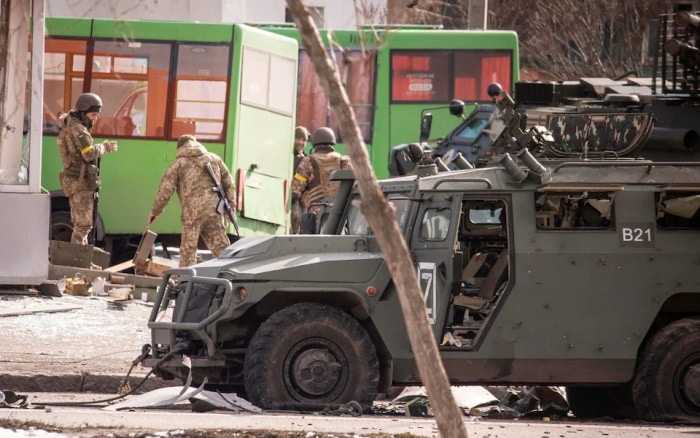
Ukrainian forces say they have repelled an attack on the country’s second city Kharkiv after fierce clashes with Russian forces.

Regional governor Oleh Sinegubov said the city was now rid of Russian troops – after street-to-street fighting overnight.

Residents described intense shelling, with one woman saying it was “something like Star Wars above your head”.

A nine-storey residential tower was hit, emergency services said.

The building was severely damaged and an elderly woman was killed, according to emergency services. Rescuers said about 60 people were spared injury as they had taken refuge in the basement.

Fighting on streets of Kharkiv, Ukraine’s second-largest city, as west bars Russian banks from Swift

The war in Ukraine intensified on Sunday, as Russian troops entered the country’s second-largest city, Kharkiv, and Vladimir Putin unleashed a wave of attacks on airfields and fuel facilities.

Kharkiv residents were urged to stay indoors by governor Oleg Sinegubov, who said “there has been a breakthrough in light equipment including in the central part of the city”. A nine-storey building was reportedly hit, with one woman killed.

Share

China ponders how Russia’s actions in Ukraine could reshape world order

The news came as a surprise to many in Beijing. Barely 24 hours ago, Chinese pundits predicted that a war in Ukraine was not inevitable. In New York, as Russia geared up for a full-on assault on its neighbour, China’s UN envoy, Zhang Jun, urged in a security council meeting that “the door to a peaceful solution to the Ukraine issue is not fully shut, nor should it be shut”.

But when people in Kyiv woke up to sound of bombs in what the Nato chief called a “deliberate, cold-blooded” invasion, the door had clearly been closed. China’s state media, however, insisted it was a “special military action” by Russia. Quoting Vladimir Putin, China’s central television tweeted: “Russia was left with no other choice.”


This guy is good to follow on Twitter.

Share

Conrad Black: The vassalization of Ukraine and the fall of western civilization

Having been overseas last week, it is my task to cover in this column both the postmortem on the truckers movement and events in Ukraine. As I wrote here two weeks ago, the truckers were right to be outraged at the escalated requirement for the 10 per cent or so who are unvaccinated to quarantine for two weeks when returning from the United States. That provision is oppressive and malicious. The truckers also acted for millions of other Canadians in rising up against the compulsive and imperishable authoritarianism of the substantially failed Canadian COVID regime and the smug acceptance of it by much of the media.

Share

West to cut some Russian banks off from Swift


The EU, US and their allies have agreed to cut off a number of Russian banks from the main international payment system, Swift.

“This is intended to cut off these institutions from international financial flows, which will massively restrict their global operations,” a German government spokesman said.

Russia is heavily reliant on the Swift system for its oil and gas exports.

But the move could also harm Western businesses doing business with Russia.

Share

Ukraine: Is Russia’s invasion going as expected?

History shows that it’s much easier to start a war than to end one.

That’s certainly true of the US-led invasion of Afghanistan in 2001 and Iraq in 2003. And it might turn out to be the same for President Vladimir Putin in Ukraine.

There’s an old axiom that military plans never survive the first contact with the enemy. It certainly appears to be true for Russia’s forces in Ukraine.

Ed Arnold, an expert on European security at the Royal United Services Institute (Rusi), describes Russia’s initial assault as “underwhelming” and “slower than expected”.

Share

59% say Biden’s weakness made Russia decide to declare war

62% of Americans think Putin WOULDN’T have invaded Ukraine if Trump were president, poll claims – and 59% say Biden’s weakness made Russia decide to declare war

Close to two thirds of Americans believe that Russian President Vladimir Putin would not have invaded Ukraine if Trump were still president, according to a new survey released Friday.

A recent Harvard Center for American Political Studies-Harris Poll survey revealed that 62 percent of those Americans polled felt that Putin would not be launching an offense against Ukraine if Trump, rather than incumbent President Joe Biden, was still in office. Broken down, 39 percent of Democrats and 85 percent of Republicans believe that Trump would have made Putin think twice about launching the war.

Share

Battle for Kyiv as Ukrainians attempt to hold off Russian forces

Fierce fighting broke out in Kyiv as Russian forces tried to push their way towards the city centre from multiple directions in the early hours of Saturday, and as the Ukrainian president, Volodomyr Zelenskiy, bluntly rejected a US offer to evacuate him from the country’s capital.

“The fight is here,” Zelinskiy said. By 8am, however, residents were reporting a lull in the attack as it appeared Kyiv’s defenders had held out against another night of Russian advances from multiple directions, including both north and south of the main western route from Zhitomyr to Kyiv, and in the area of the motorway towards the country’s south.

Ukraine invasion: Russians close in on Kyiv but meet strong resistance

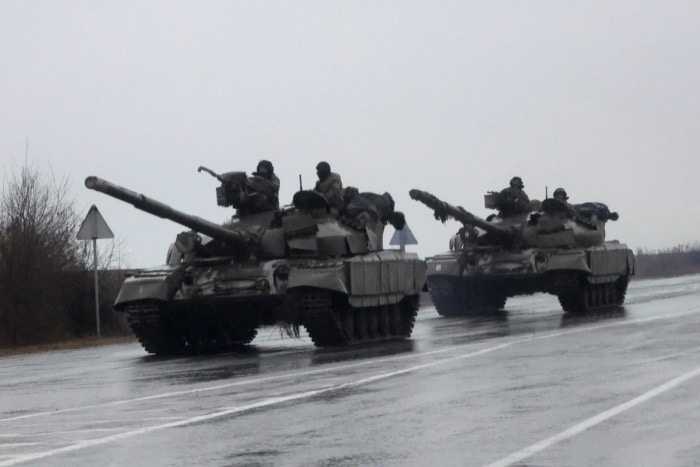
Russian assaults on the Ukrainian capital Kyiv have been met with fierce resistance, as the Ukrainian military says it fought off several attacks.

The military said in a Facebook post early on Saturday that an army unit managed to repel Russian forces near its base on a major city street.

President Volodymyr Zelensky said: “The occupiers wanted to block the centre of our state… We broke their plan.”

Meanwhile, fighting continues near several other Ukrainian cities.

Share

Russian vigilante hacker: ‘I want to help beat Ukraine from my computer’

“This site can’t be reached.”

That was the message greeting visitors to dozens of Ukrainian websites on Wednesday afternoon.

From 16:00 local time webpages for banks and government ministries started going down.

Naturally, fingers quickly pointed towards Moscow – Russia’s cyber army once again accused of hacking to spread fear and confusion online as troops massed on Ukraine’s borders.

Share

Not Peter the Great, he’s Vlad the Mad

Ever since he first seized the Russian presidency 20 years ago, a question has lingered around Vladimir Putin. Is he crazy, or not?

The jury always seemed to be out. On the one hand, there were the signs of relatively harmless crazy. The tiger-wrestling, semi-naked horseback riding and more. There were also more than enough signs of harmful crazy. Such as sending his henchmen to poison enemies in foreign capitals using nerve agents which, if leaked, would have killed tens of thousands of people in those cities.

Share

How Ukraine Could Become a Nuclear Crisis

Chaos creates countless opportunities for mistakes.

The Russian invasion of Ukraine is not a nuclear crisis. Yet. Concern about the role of nuclear weapons is perfectly understandable, however, now that a paranoid dictator has led Russia into a major war in the middle of Europe, attacking a country that shares a border with four of America’s NATO allies. A nuclear crisis is unlikely, but not impossible.

Share

Gallup on Russia: Most Americans realize the 80s called — and Biden didn’t answer

Looks like we’ve achieved nearly a full consensus on Mitt Romney’s vindication — even before Russia invaded Ukraine. A Gallup poll conduced between February 1-17 shows anger rising rapidly toward Russia, across all political denominations. It had already gotten bad shortly after Barack Obama’s 2012 bon mot to Romney that “the 80s called and they want their foreign policy back,” but Vladimir Putin’s aggression has turned it into a consensus even before the first shot was fired.

Share

Adam Pankratz: Ukraine invasion shows why Canada needs to become an energy superpower

The reverberations of Russian President Vladimir Putin’s invasion of Ukraine will be felt for months, and likely years, to come. To understand our responsibility to the people of Ukraine and the actions needed on a global scale, we need a holistic understanding of how we have come to this point and why Putin felt confident and empowered enough to take the gamble he did. One theme stands out as particularly relevant to Canada: oil and gas.

Share

The Ukraine crisis started with Suez

Oil shocks crash economies and enable enemies

Oil prices are surging. Brent crude has broken through the $100 per barrel mark — the highest level since 2014. And this could just be the start of a new oil price shock.

Russia is the world’s second biggest exporter — supplying nearly five million of the 100 million barrels of crude oil the world consumes every day. More than half of those exports flow westwards into Europe, through pipelines that cross Ukraine and Belarus. It’s difficult know which is the grimmest scenario: that the oil stops flowing due to sanctions or sabotage; or that the trade continues — filling the Kremlin’s coffers while Russian bombs rain down on Kyiv.

Share

REPORT: Italy Scored ‘Gucci Loafers’ Carve-Out In Russian Sanctions

Italy allegedly managed to secure a carve-out of one of its biggest industries in the sanctions the European Union levied on Russia, The Telegraph reported Friday.

“Italian prime minister Mario Draghi successfully secured a carve-out for Italian luxury goods from the EU’s package of economic sanctions against Nato,” Telegraph reporter Joe Barnes tweeted. He alleged that “multiple sources” reportedly confirmed luxury goods were excluded from the package after lobbying from Draghi.

Share