
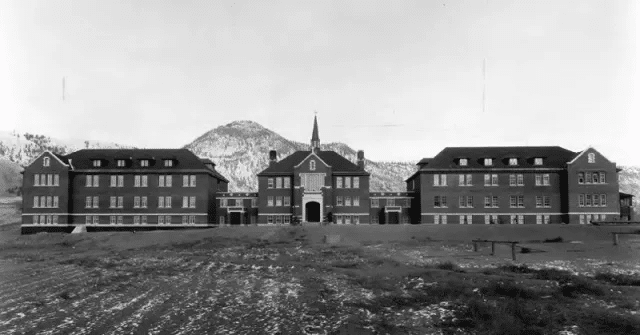
History shows that many hoaxes, fake news stories, and conspiracy theories have proven nearly unassailable, even when proven false. So far, it seems a British Columbia burial canard will be added to this list.
History shows that many hoaxes, fake news stories, and conspiracy theories have proven nearly unassailable, even when proven false. So far, it seems a British Columbia burial canard will be added to this list.

CHARLOTTETOWN — A village councillor in Prince Edward Island is asking a court to quash sanctions imposed on him after he displayed a sign on his property questioning the existence of unmarked graves at former residential schools.
The word “epidemic,” once limited to describing the spread of disease, has evolved both colloquially and formally as a label for all sorts of deleterious activities that have become widespread. Gender-based violence is an epidemic, according to the federal government and various municipalities. So, too, is opioid and other drug addiction, as described by the government’s standing committee on health. Loneliness is an epidemic, says the National Institute on Aging. Even the issue of car theft in Canada has been called an “epidemic” by various media outlets.
It’s a rhetorical flourish: a way to convey impact and severity with a single word, invoking a sense of urgency to act.
On May 27, 2021, Chief Rosanne Casimir of the Tk’emlúps te Secwépemc First Nation announced that ground penetrating radar (GPR) technology had located the remains of 215 children on the grounds of the former Kamloops Indian Residential School located in British Columbia, Canada.
The news was readily accepted and publicly grieved by every society figurehead and institution.
h/t Mauser

Conservative Leader Pierre Poilievre is calling on the federal government to provide the resources necessary for a “full investigation” into alleged graves at the sites of former residential schools.
Mr. Poilievre said a proper investigation is warranted after the site of a potential burial ground found nearly three years ago in British Columbia has yet to be excavated to confirm.
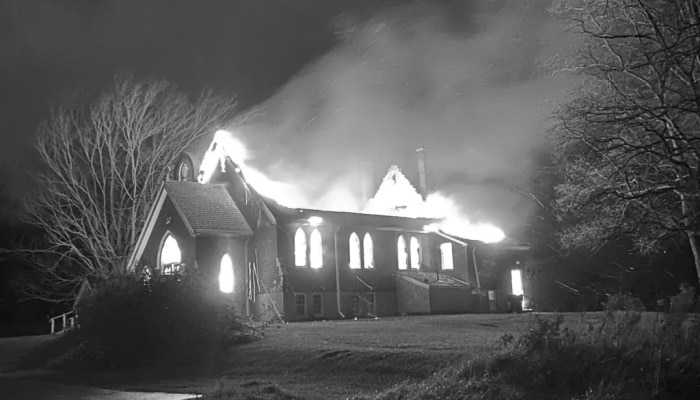
Five days before Christmas, the Seventh-day Adventist Church in the small Albertan village of Beiseker burned to the ground. With a population of less than 1,000, Beiseker seemed an unlikely place for an arsonist to strike—but it was the fourth prairie church to burn in December 2023 alone. On the night of December 7, St. Mary Abbots Anglican church and St. Aidan’s Church went up in flames in Barrhead, with the arsonist apparently waiting for fire crews to arrive at St. Aidan’s before torching the second church; St. Gabriel Catholic Mission burned down on December 15 in the hamlet of Janvier (population, 140). The RCMP claims that, thus far, there is no evidence of a “concerted effort” against churches.
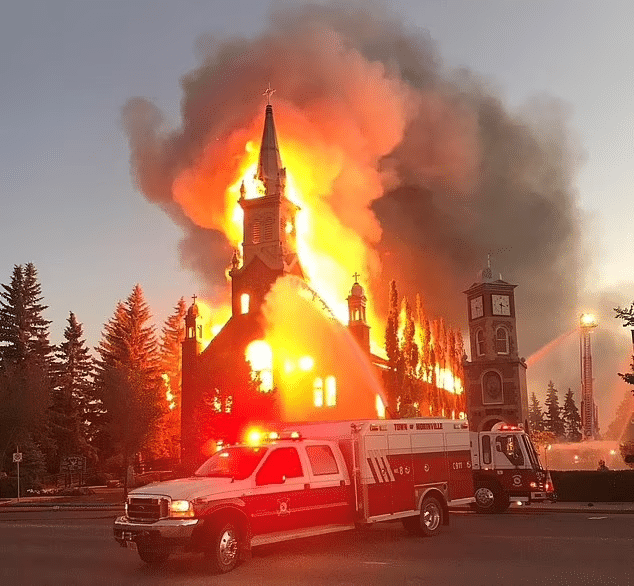
Almost 100 Christian churches in Canada have been systematically targeted in apparent revenge attacks following a hoax about mass graves containing Native American children.
In 2021, a horrific story swept the internet as an indigenous group in Saskatchewan claimed to find 751 unmarked graves under the Marieval Indian Residential School, weeks after 215 children were supposedly discovered under another school in British Columbia.
The schools were run by Christian churches – largely Catholic – and sought to eliminate their students’ Indigenous culture so they could ‘assimilate’ into Canadian society.
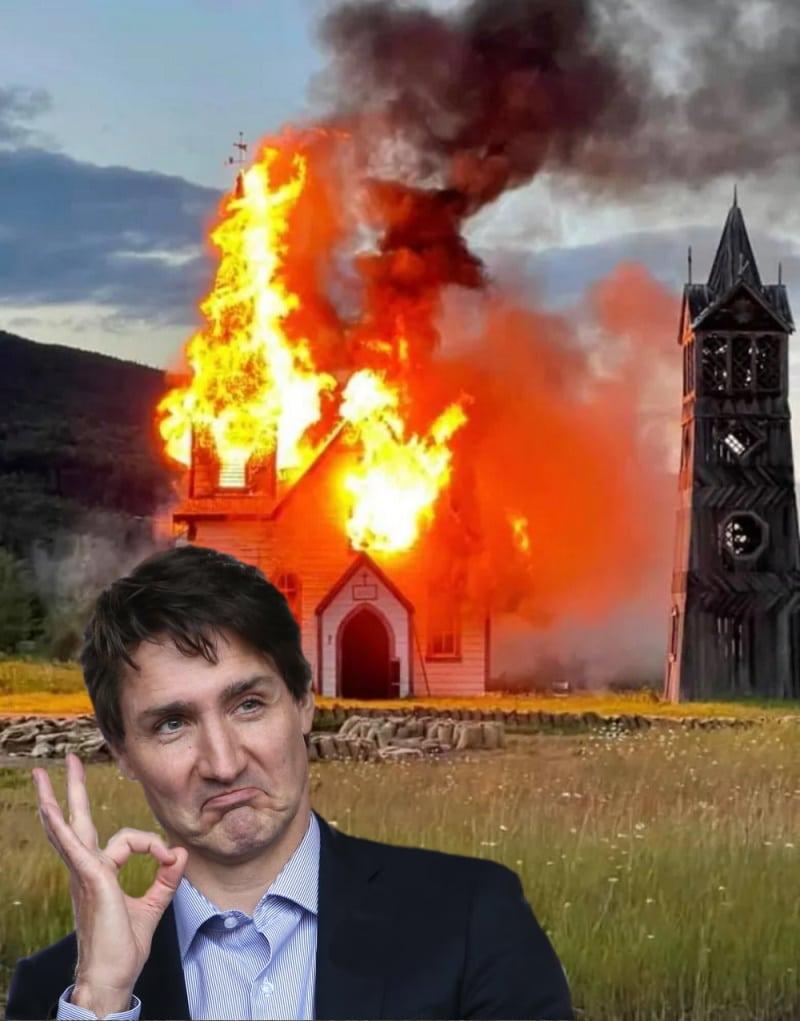
At least 33 Canadian churches have burned to the ground since May 2021. Only 2 were accidents
WARNING: This story contains distressing details. (CBC Lies have that effect)
In a barren field of sagebrush alongside a road through the Osoyoos Indian Band, Chief Clarence Louie stands atop a concrete pad and surveys the rubble in front of him.
This used to be the front entrance to St. Gregory’s, the simple wooden church that hosted countless community celebrations, dinners and religious services, on the reserve just north of the Canada-U.S. border in central B.C.
Seems the CBC is a little light on their figures.
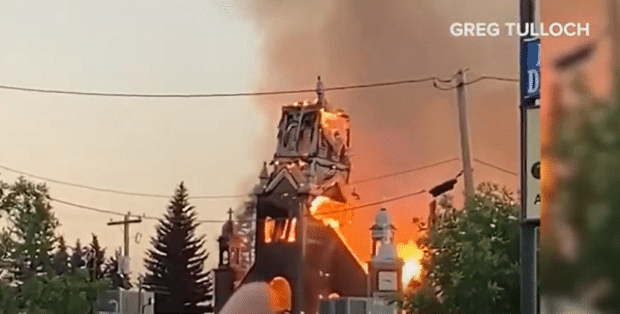
Nearly 100 Canadian churches have been burned or vandalized since 2021.
As of January 2, 2024, 96 churches across Canada have been attacked since media claims of unmarked graves at residential schools in 2021, according to a map created by independent media outlet True North.
… The Canadian government has often intervened at the same court in support of human-rights cases against the governments of Myanmar, Syria, Iran and Russia over the past two years. As a supporter of Israel, it is likely to oppose the South African application, but will struggle to explain the apparent inconsistency, legal analysts say.
In a submission to the court in the Myanmar case last month, for example, Canada and five other Western governments argued that the evidence of genocide can include “a violent military operation triggering the forced displacement of members of a targeted group” and can also include “subjecting a group of people to a subsistence diet, systematic expulsion from homes and the induction of essential medical services below minimum requirement.”
There have been 15 suspicious church fires so far in 2023 and police have arrested suspects in five of them
While Montreal’s Notre Dame held Christmas mass after a fire, four Alberta churches stood skeletal, damaged, quiet on Christmas, set ablaze by arsonists in the last few weeks.
The four Alberta churches, in various parts of the province, are all under investigation by police. Most recently, just five days before Christmas, the Seventh-day Adventist Church in Beiseker, a village of less than 1,000 people northeast of Calgary, was burned to the ground.
There has been a fourth church fire in Alberta this month suspected of being caused by arson, this time destroying the Beiseker Seventh Day Adventist Church, according to the RCMP.
On Dec. 20, the Airdrie Integrated Rural RCMP received a report of a fire at the church near the village of Beiseker, which is located about 50 kilometres northeast of Calgary. Fire crews from the Rockyford Fire Department responded to the incident after receiving a call at 6 a.m., but by the time they arrived, the church was fully engulfed in flames, RCMP said in a release.
The new book Grave Error: How the Media Misled Us (and the Truth about Residential Schools) constitutes a response to the moral panic unleashed in Canada on May 27, 2021, when the Chief of the Tk’emlúps te Secwepemc (aka, the Kamloops Indian Band) announced that ground-penetrating radar (GPR) had located the remains of 215 “missing children” in an apple orchard on the grounds of the local residential school.
Barrhead RCMP and Barrhead Fire Services are investigating two arson fires that have severely damaged two of the town’s churches on Thursday night.
At approximately 7:52 p.m. police responded to a structural fire at The Glenreagh Church, located on Range Road 40 in Barrhead. At 9 p.m. police responded to a second structure fire at The United Church, located on Range Road 54 in Barrhead, according to a Friday morning news release.

“It wasn’t that bad, they got an education out of it.”
Michael Eshkawkogan says he’s seen that exact comment and others like it when scrolling on social media. No one has ever said it to his face, but he knows it’s out there.
“Some don’t believe churches or people are capable of this,” said Eshkawkogan, whose grandmother was forced to attend the Spanish Indian Residential School for girls in northeastern Ontario before it closed in 1965.
