The Case Against ‘Medical Assistance in Dying’

Canada’s assisted-death law seems connected to the atomization of our society—as much a symptom of inhumanity as a cause.

Canadian law now permits something called “medical assistance in dying.” This practice, to be clear, is not palliative care. It does not refer to helping Canadians as they journey toward natural death by offering treatment to manage their pain and suffering. Medical assistance in dying—assisted death for short—is the deliberate act of ending a person’s life, typically through the administration of a lethal substance.

Share

Judges are allowing Canadians to get away with murder in the name of ‘mercy killing’

On April 13, 2005, 19-year-old Katrina Effert secretly gave birth to a baby boy in the basement of her parents’ home in Wetaskiwin, Alberta. She then strangled the newborn child to death with her thong underwear and threw the corpse over the fence into her neighbor’s backyard.

On September 9, 2011, the CBC reported that Effert’s conviction for murder had been “downgraded” to infanticide, and she was sentenced merely to time served for improper disposal of a human corpse.

Share

Thanks to Trudeau, Canada’s death-care system is top of the line

In February, Abbotsford Conservative Party MP Ed Fast introduced Bill C-314, the Mental Health Protection Act , which would quash the federal government’s (delayed) mental-health extension, without repealing the original “foreseeable death” principle. Nice try, but Sen. Stan Kutcher, prime mover of the mental-disorder expansion, says the issue is “decided.” In a culture where, to nattering nabobs, the words “slippery slope” conjure up not an avalanche, but a delightful toboggan ride.

Share

The issue of expanding assisted dying eligibility ‘has already been decided’: senator

OTTAWA – The senator who pushed for Canada’s assisted dying regime to include people whose only condition is a mental disorder says the debate about that policy is now over.

“The issue of expansion has already been decided upon,” said Stan Kutcher, who sits with the Independent Senators Group.

As far as Kutcher is concerned, the what was determined two years ago, when his arguments in the Senate convinced the Liberal government to move forward with an expansion of eligibility.


EXPOSED: Euthanasia in Canada is now disguised as palliative care

Canada’s disturbing slide into offering euthanasia as standard medical practice marks another disconcerting milestone in the degradation of civil society. Even in cases where a person is not deemed terminally ill, Canadian patients and their guardians are now proffered the option of accepting and accelerating their deaths—all in the name of mercy.

Share

How euthanasia has revived the death penalty

The Belgian state has once again authorised the killing of a prisoner, 105 years after its last peacetime execution.

Geneviève Lhermitte was an infamous murderer. She killed her son and four daughters, aged between three and 14, in Nivelles, Belgium on 28 February 2007. On 28 February 2023, she was euthanised, after she successfully invoked her ‘right to die’.

Share

Don’t kill me, Canada

Last month, one of many Super Bowl ads called on Americans to say “Thank You” to Canada for all it has contributed to our world.

Unfortunately, one of those contributions is a disturbing devotion to euthanasia.

Euthanasia is defined as the intentional killing of a patient suffering from an “incurable and painful disease” or in an irreversible coma. The practice is still illegal in most countries; Canada is an exception.

Share

Trudeau’s government calls for euthanasia program to ‘treat’ children with naysaying parents

Treat human life as anything less than sacred, and humanity is rapidly dehumanized.

Canada’s MAiD, like all medical homicide programs, is the metaphorical foot in the door, an obstinate wedge, breaking the seal of a once-closed divider. Or we call it what it is (genocide), and MAiD is like an axe-wielding Jack Nicholson in The Shining.

Share

In Canada, MAID has become a matter of ideology

Now that the federal government has introduced a bill to delay implementing psychiatric MAID – assisted dying for people whose sole underlying condition is a mental illness – this is a good time to step back and reflect on how Canada got here. Last week’s release of a joint parliamentary committee’s report on MAID only adds to the need for such reflection.

Share

Canada moves one step closer to euthanizing CHILDREN: Critics slam ‘reckless’ and ‘horrible’ panel urging government to pass law allowing minors under 18 with terminal illnesses to die by assisted suicide

Campaigners have slammed as ‘reckless’ and ‘horrible’ a plan by a Canadian parliamentary committee to expand the country’s assisted-suicide program to terminally sick children.

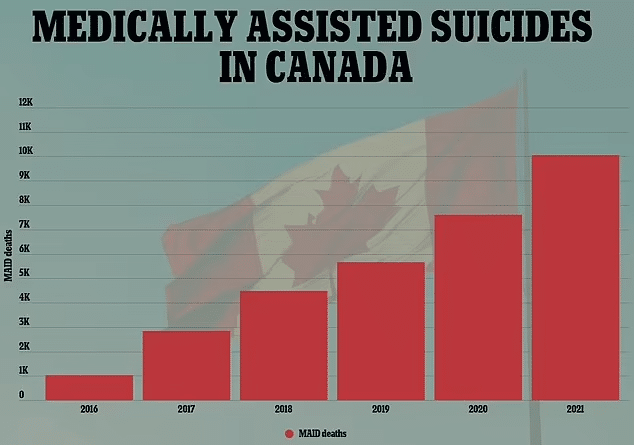
They told DailyMail.com that sick and disabled kids could soon be joining the roughly 10,000 adults who end their lives each year by state-sanctioned euthanasia in the world’s most permissive such program.

Share

Canada: Parliamentary Report Calls for Euthanasia To Be Expanded to Minors

Parents should be consulted “where appropriate,” states the document, but the will of the child would “ultimately take priority.”

On Wednesday, a parliamentary committee report, presented for discussion in the House of Commons, recommended that Canada should expand doctor-assisted suicide to include “mature minors”—teenagers as young as 12, who are ‘capable of making decisions concerning their health’—and patients with mental illnesses, currently not covered by the law. The report also called for providing the opportunity of “advance requests” for people with serious illnesses, such as dementia, that could, later on, hinder their ability to consent to euthanasia.

Share

Minors should be eligible for assisted dying, parliamentary committee says

Canada’s assisted dying laws should be expanded to include minors, a parliamentary committee has recommended in a report tabled in the House of Commons.

After hearing from nearly 150 witnesses and reviewing more than 350 briefs on Canada’s medically assisted dying (MAiD) program, the special joint committee of MPs and senators concluded that minors deemed to have the appropriate decision-making capacity should be eligible for assisted death.

Share

The truth slips out about Justin Trudeau’s euthanasia regime

It’s based on a false distinction that the Canadian government can’t even keep straight

Two cheers for a brief hiatus in the Canadian stampede towards suicide for all. Earlier this month, David Lametti, Justin Trudeau’s justice minister, announced that legalization of euthanasia for the mentally ill will be delayed by one year. This, he said, will give the health system and regulatory bodies more time to prepare. Mentally ill adults will now become eligible for euthanasia in March 2024.

Share

A Yale Professor Suggested Mass Suicide for Old People in Japan. What Did He Mean?

His pronouncements could hardly sound more drastic.

In interviews and public appearances, Yusuke Narita, an assistant professor of economics at Yale, has taken on the question of how to deal with the burdens of Japan’s rapidly aging society.

“I feel like the only solution is pretty clear,” he said during one online news program in late 2021. “In the end, isn’t it mass suicide and mass ‘seppuku’ of the elderly?” Seppuku is an act of ritual disembowelment that was a code among dishonored samurai in the 19th century.

Share

Nienhuis: Assisted dying for the mentally ill should be cancelled altogether — not merely delayed

When the Senate, an unelected body, introduced a clause into its Medical Assistance in Dying legislation (MAiD) that added mental illness as a qualifying factor, it showed a deep disconnect from the people of Canada and a lack of care for those who suffer from mental illness. Since then, psychiatrists, psychologists and thousands of Canadians have called for a stop to this madness. It seems the federal government is finally listening.

Share