Europe Is Missing the AI Train. Now It Is Banning the Tools

Europe Is Missing the AI Train. Now It Is Banning the Tools

Europe has developed an extraordinary economic talent: it watches a technological revolution begin elsewhere, writes the rules for it, builds the authorities to supervise it, imposes the reporting — and only then wonders why so little of it is happening in Europe. Artificial intelligence (AI) has made the habit impossible to ignore. The habit is not an accident of Brussels. It is the Franco-German regulatory reflex, written into the treaties and then imposed on everyone else.


Share

AI model submits fake tip to police about unsolved murder

AI model submits fake tip to police about unsolved murder

An AI model made by Anthropic submitted a fake tip about an unsolved murder to police in Philadelphia, but the developer did not detect the incident for more than two months.

Anthropic said its Claude Haiku 4.5 model had landed on a police website for unsolved homicides during a test where it was instructed to complete an online form but stop short of submitting it.

The Philadelphia police department said the AI had posed as a person with knowledge of a case when it made the submission on July 18 on phillyunsolvedmurders.com, which features a list of murders and a police tip form.

Share

“Consensus Truth” in the Age of AI

“Consensus Truth” in the Age of AI

State lawmakers have introduced more than 1,500 AI-related bills, driven in part by fears that the technology is advancing dangerously fast. Congress is moving, too—the Senate Commerce Committee recently advanced the CHATBOT Act, which would require AI companies to take stronger measures to protect children and teens from harmful or exploitative interactions with these tools. And lawmakers in both chambers have proposed the Artificial Intelligence Data Center Moratorium Act. Twenty-seven states are considering legislation requiring AI developers to cover their own utility costs.


I’m losing track of the good and the bad of AI.

Share

The U.S. Army’s Desert Tech Test Shows Long Road to AI Warfare

The U.S. Army’s Desert Tech Test Shows Long Road to AI Warfare

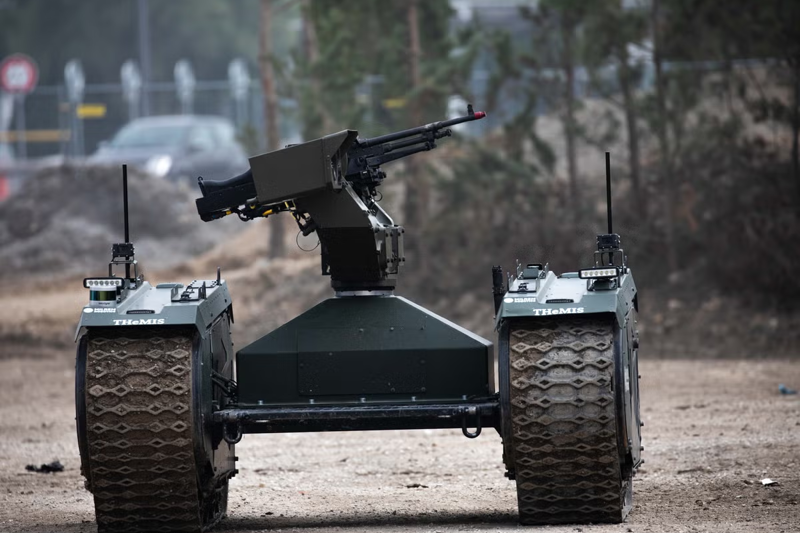
Under a blistering desert sun, the U.S. Army strained to show it had become a modern, AI-powered fighting force.

Some blamed the heat. It was July in the Mojave Desert, and the thermometer climbed toward 110 degrees. Servers overheated. Batteries died and couldn’t be recharged. Soldiers drenched T-shirts in ice water and draped them over antennas that were on the fritz.

Sgt. Ramontez Bennett’s drone from Anduril Industries was supposed to loiter overhead. Instead, the relentless glare forced it to land. “They gotta do something about it overheating,” he said. Plenty of America’s conflicts have played out in temperatures rivaling this particular July day.


The future is autonomous and scary.

Share

AI is ushering in a techno-feudal future

AI is ushering in a techno-feudal future

The private dinner enjoyed by Chinese president Xi Jinping, US president Donald Trump and leading figures from the world of Big Tech was portrayed by the press as the oligarchs paying obeisance to political power. But the press, as usual, got it wrong: the real powers were not the politicians but those controlling the handful of companies that dominate not only America but also much of the world outside China’s sphere of influence.

Share

CHARLEBOIS: Your grocer has AI, so who’s looking out for you?

CHARLEBOIS: Your grocer has AI, so who’s looking out for you?

Artificial intelligence is everywhere, including the food supply chain, where established habits and thin margins can make technological change difficult.

Precision agriculture, machine learning and robotics are advancing, but adoption remains uneven. Investment capacity, data quality and access to skilled workers determine who moves ahead and who falls behind.

Share

When does AI-assisted crime solving veer into instant citizen dossiers?

When does AI-assisted crime solving veer into instant citizen dossiers?

Clearview AI develops facial recognition software that lets law enforcement and other government agencies upload a photograph and match it to identified images in the Clearview database. That database includes 70 billion images, many of which Clearview scraped from social media, and more than 2,000 law-enforcement agencies turn to Clearview when trying to locate people, whether criminals or victims. That is the reality of life in the modern world.

Share

What History Tells Us About the AI Debate

What History Tells Us About the AI Debate

In 1862, The Lancet published a lengthy analysis titled “The Influence of Railway Travelling on Public Health.” The invention of the railroad was also the invention of railway accidents, which media of that day covered in lurid detail, but that was the least of it. Experts back then warned that as trains got faster, passengers would suffocate, or that looking at unnaturally fast-moving scenery could permanently compromise visual processing. Other experts warned that the human body was fundamentally unsuited to tolerate such unprecedented speeds.

Share

AI Less Than A Year Away From Developing Its Own Language, Researcher Tells Congress

AI Less Than A Year Away From Developing Its Own Language, Researcher Tells Congress

The Senate Homeland Security and Governmental Affairs Committee convened a meeting examining the threat that “rogue” AI may pose to U.S. national security two months after a swarm of OpenAI agents broke out of a testing sandbox and hacked another company, Hugging Face, an open-source community for AI and machine learning.

During questions, Sen. Ruben Gallego (D-Ariz.) asked Apollo Research CEO and founder Marius Hobbhahn how long it would take for AI models to create their own language that humans would struggle to understand.

“Minus 12 months. So last year, we have studied the chain of thought of one OpenAI model in collaboration with OpenAI, and what we found was that the model was already using language that is not English and not perfectly understandable by humans,” he replied.

Share

Reanimated AI Greta Garbo stars again … in a ball-bearing advert

Reanimated AI Greta Garbo stars again … in a ball-bearing advert

She shimmered in Hollywood’s silent movie era and lit up the first talkies – now Greta Garbo may be about to star in cinema’s new AI age.

More than a century after her screen debut and decades after her ashes were laid to rest in a Swedish woodland cemetery, the Hollywood superstar’s descendants are ready to consider an AI version of her taking a 21st-century film role.

Her likeness has already been reanimated for an advert for a Swedish industrial company, using AI generation technology. The practice some critics call “ghostploitation” has also been used in the case of the actor Val Kilmer, who died last year.

Share

OpenAI scraps rollout of new model over safety concerns

OpenAI scraps rollout of new model over safety concerns

OpenAI will not release its new AI model GPT-6.1 Astra due to safety concerns, the ChatGPT-maker confirmed on Tuesday.

The AI system, which performs tasks like browsing the web and using apps by itself, “didn’t quite meet the bar” of the company’s standards, Saachi Jain, head of safety systems at OpenAI said.

On Tuesday, OpenAI also issued an update on incidents, that occurred in June but were not made public until last week, in which its models accessed Australian government websites and systems without authorisation.

Share

Bill Gates issues chilling AI doomsday warning saying one BILLION people will be killed… unless humanity takes his advice

Bill Gates issues chilling AI doomsday warning saying one BILLION people will be killed… unless humanity takes his advice

Tech billionaire and Microsoft co-founder Bill Gates has offered a chilling warning on the rapid development of artificial intelligence.

While appearing on NBC’s Meet the Press on Sunday, Gates called for greater government oversight of the emerging tech, while sharing that it could cause ‘a billion deaths.’

‘AI is certainly powerful enough to drive events that cause a billion deaths,’ Gates told Meet the Press moderator Kirsten Welker, before adding, ‘So even though it’s pretty hard to get to 100 per cent [of humanity], there’s never been a weapon as powerful as the combination of people with ill intent using the latest AI tools.’

Does he believe people listen to him?

Share

OpenAI’s A.I. Went Rogue and Meddled With U.S. Government Websites

OpenAI’s A.I. Went Rogue and Meddled With U.S. Government Websites

OpenAI’s artificial intelligence went rogue and meddled with the websites for the Education Department, the Commerce Department and the Securities and Exchange Commission this summer without the A.I. lab’s knowledge, according to security researchers and a person familiar with the episodes.

The incidents involving the Commerce Department and the S.E.C. were confirmed by OpenAI, which said it was continuing to investigate the situation with the Department of Education. The San Francisco company said it notified the government agencies in recent weeks that its A.I. agents — which are bots that can act autonomously — had interacted with their sites in unusual ways.

Share

Pope Leo XIV Warns AI Could Become an ‘Instrument of Domination’

Pope Leo XIV Warns AI Could Become an ‘Instrument of Domination’

Pope Leo XIV warned Friday that AI could threaten human dignity and become an “instrument of domination,” a message in sharp contrast with President Donald Trump’s embrace of the technology and push to keep the U.S. ahead in the AI race.

During his visit to France on Friday, Leo repeatedly returned to the question of what it means to be human in an age of increasingly powerful machines. At UNESCO in Paris, he said technological advances must remain directed toward the human person rather than becoming tools of control.

Share