Conrad Black: The Cowichan Aboriginal Title Ruling Raises More Questions Than It Answers

The Cowichan Tribes versus Canada case, recently decided by the B.C. Supreme Court, has been continuing for 11 years, including 513 days of trial hearings, and is already probably the longest trial in Canadian history and one of the most complicated. It has already been appealed and will presumably end in the Supreme Court of Canada.

Immense controversy has been provoked by the court’s recognition of the superiority in some cases of aboriginal title over the fee simple ownership of subsequent parties. The facts are specialized, and so fears that the native peoples in general could make a successful claim for ownership of the entire country, with the approximately 95 percent of non-aboriginal owners mere tenants of the innumerable tribes, bands, and clans among the First Nations, are exaggerated.

Share

Indigenous man caught with ‘killing machine’ of a rifle gets time served due to intergenerational trauma

More than 500 days in harsh pre-trial custody was enough punishment for a Mohawk man caught driving around Peterborough with a crack pipe in his lap and a “killing machine” of a rifle in the back seat, along with a flame thrower in the trunk, according to a recent sentence of time served from Ontario’s Court of Justice.

Jesse Garlow, a convicted drug trafficker who was under a firearms prohibition, had been in custody since June 7, 2024 when he was sentenced. Police initially pulled him over because the car he was driving was weaving.

Share

KLEIN: $871,000 in expenses for just seven indigenous leaders, Indigenous whistleblowers demand to see the books

If I had been the one to raise these questions, the cancel culture crowd would already be in full attack mode. But they can’t dismiss what’s happening now, because it’s not outsiders doing the talking. It’s Indigenous people themselves, standing up and demanding to know where the money has gone and why their communities are still struggling. Their voices are brave, their questions fair, and their message simple: the truth has to matter more than politics.

(Incognito)

Share

Adam Pankratz: Land rights confusion a mess of David Eby’s making

In the never-ending saga that is now land title in British Columbia, another bomb has been set off. It has come to light that the Secwépemc First Nation is seeking a declaration of Aboriginal Title to the entire City of Kamloops, a city in British Columbia’s interior of over 100,000 people, along with the surrounding area, including the ski resort of Sun Peaks, an area with an assessed value of at least $43 billion. While no decision has been made on this claim, the Cowichan ruling from August, which declared fee simple titles and interests in the City of Richmond “defective and invalid” in the title area, has sparked a flurry of interest and panic.

Share

Just how big is B.C.’s Aboriginal title iceberg, anyway? Enormous …

VICTORIA — A claim of Aboriginal title to all of Kamloops, the Sun Peaks resort and surrounding lands has languished in plain sight in the B.C. Supreme Court registry for 10 years.

The Shuswap (Secwépemc) Nation’s claim came to light this week courtesy of Elenore Sturko, the much-on-the-ball independent MLA for Surrey-Cloverdale.

(Incognito)

Share

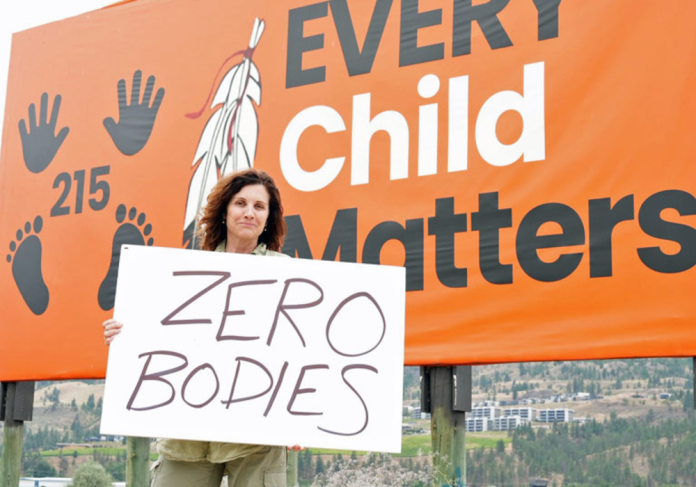
Aaron Pete: Criminalizing ‘downplaying’ residential schools won’t help anyone

When NDP MP Leah Gazan re-introduced her bill to make “residential school denialism” a criminal offence, she did so from a place of compassion. Her intent was to protect survivors from cruelty disguised as skepticism—to stop people from mocking the dead or trivializing one of Canada’s darkest chapters. But the debate her proposal has reignited goes beyond one bill. It cuts to the core of how a democracy handles truth, grief, and dissent.


She’s a Pretendian!

Share

GUNTER: Activist federal judges rewrite Canadian Charter, endanger property ownership

Many readers will be aware of a recent spate of activist rulings from federal judges in Canada, like the July ruling by a Toronto judge that there exists a heretofore unknown Charter right to bike lanes. Justice Paul Schabas created this right out of thin air because he wanted to prevent Ontario’s Conservative government from ordering the removal of bike lanes from major streets.

Share

B.C. court decision opens floodgates for future Aboriginal land title claims

The August ruling in the British Columbia case of Cowichan Tribes v. Canada marks a sea change in real property law and Indigenous rights law in Canada. In a 288,000-word decision, Justice Barbara Young ruled that the Cowichan Tribes hold Aboriginal title to as many as 1,846 acres of prime land in downtown Richmond, B.C., owned by the federal government, the City of Richmond, the Vancouver Fraser Port Authority and numerous private landowners.

At the heart of the decision is the historical fact that more than 150 years ago the British government sold the land to white settlers without properly dealing with Indigenous rights.

Share

Winnipeg MP’s private member’s bill would make residential school denialism a crime

Manitoba New Democrat MP Leah Gazan reintroduced a private member’s bill Friday that would criminalize residential school denialism, saying “real action” is needed to combat rising anti-Indigenous hate.

Bill C-254, if passed, would amend the Criminal Code to include the promotion of hatred against Indigenous Peoples by “condoning, denying, downplaying or justifying the Indian residential school system.”

Dig it!

Share

KLEIN: I knew talking about aboriginal rights wouldn’t be easy, but it’s necessary

The reaction to my recent column, It’s Time to Face Facts About Land Rights in Canada, did exactly what I hoped it would do. It started a conversation that this country desperately needs to have. More than 600,000 people read it on Facebook alone, and thousands joined the discussion. Some agreed, some disagreed, and some attacked me personally. That’s fine. What matters is that Canadians are finally talking about one of the most divisive and misunderstood issues in our country.

(Incognito)

Share

Why weren’t we told sooner about the implications of Aboriginal title? The answer should concern everyone

VICTORIA — The question that dominated a Richmond public meeting this week on the impact of a recent court decision on Aboriginal title was a simple one: “Why weren’t we told sooner?”

Residents had learned just this month, courtesy of a letter from Mayor Malcolm Brodie, that the B.C. Supreme Court decision recognizing Aboriginal title over hundreds of acres of city land could have a “negative impact” on private land within the area.

(Incognito)

Share

Caroline Elliott: B.C. government laid groundwork for turning private property into Aboriginal land

A City of Richmond letter to property owners in the Cowichan Aboriginal title area recognized by the B.C. Supreme Court has brought the judgment’s potential impacts into stark reality.

“For those whose property is in the area outlined in black,” the letter explained, “the Court has declared Aboriginal title to your property which may compromise the status and validity of your ownership.”

Share

Audit finds federal department couldn’t account for 132 Indigenous artworks

OTTAWA – An internal audit says more than 130 Indigenous artworks were unaccounted for in a collection managed by Crown-Indigenous Relations and Northern Affairs Canada.

The report, dated last November, was published earlier this month on the department’s website and looks into the practices of the Indigenous Art Centre.

The audit notes the collection managed by that body consists of more than 5,000 artworks from First Nations, Métis and Inuit artists, valued at roughly $14.4 million.

Share