Hominid Footprints on Crete Could Change Evolutionary Theory For Good

He was not looking for hominid footprints from the prehistoric past. Paleontologist Gerhard Gierlinski, from Warsaw, Poland, was just trying to get away from it all in the summer of 2002 and enjoy the warm seas and soft sands on the Greek island of Crete with his girlfriend.

A researcher at the Polish Geological Institute, he was always ready to take samples of interesting things he spied on vacations, and he traveled with a hammer, a camera and a GPS for just such occasions.

What he discovered along the Mediterranean shores of the town of Trachilos would rock his world and send some researchers who were convinced that humans evolved solely in Africa, into angry denial, resulting in many of them casting aspersions on his jaw-dropping find.

Gierlinski asked colleagues from Poland, Sweden, Greece, the US and the UK, among them Dr. Per Ahlberg, for their opinions on what he saw as human-like footprints that had somehow been made into a flat rock along the shore.

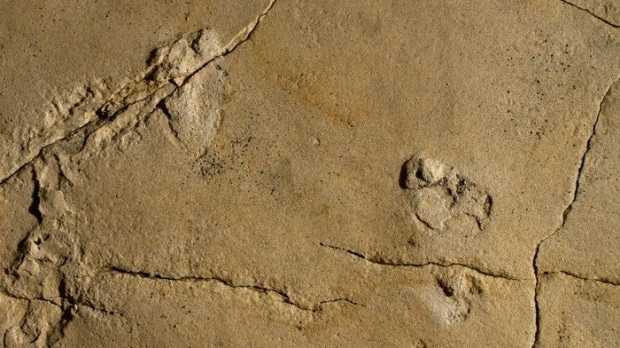
The 5.6 million-year-old footprints made in Trachilos, Crete 5.6 million years ago. Photo: The Conversation.
The team of experts came to the conclusion that indeed, the impressions had been made by ancient human ancestors 5.6 million years ago, making them by far the oldest footprints ever discovered in Europe.

h/t Marvin

Share

Flow of hot rocks rising from the Earth’s core beneath central Greenland is melting the ice from below and contributing to sea-level rise, study finds

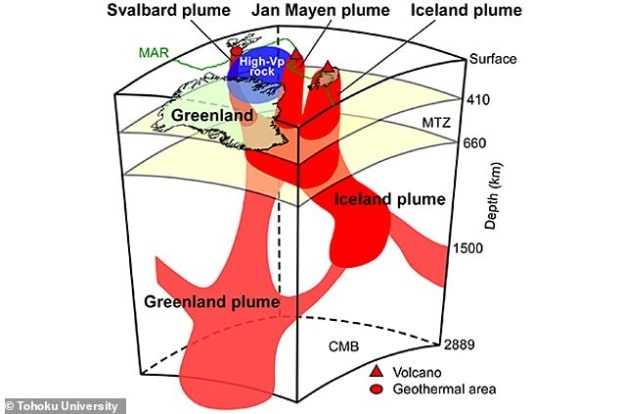
Melting of ice in central Greenland is being accelerated by the heat of molten rocks rising from the core–mantle boundary, adding to sea-level rise, a study has found.

Researchers from Japan mapped out the extent and branches of the so-called ‘Greenland plume’ — the rising flow of molten rock ascending beneath the island.

Share

Hayabusa2 capsule in ‘perfect condition’ as Japan team prepares for analysis

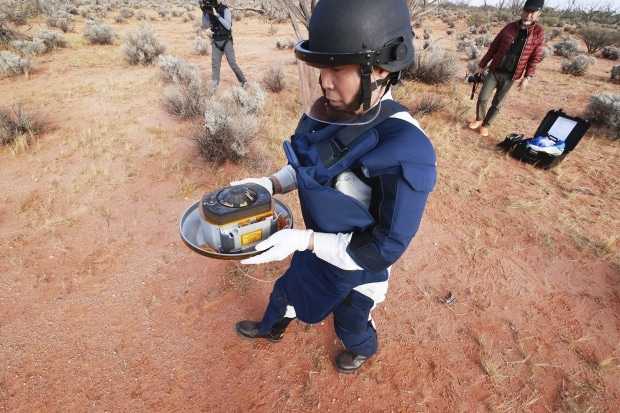
In this photo provided by the Japan Aerospace Exploration Agency (JAXA), a member of JAXA retrieves a capsule dropped by Hayabusa2 in Woomera, southern Australia, Sunday, Dec. 6, 2020. A Japanese capsule carrying the first samples of asteroid subsurface shot across the night atmosphere early Sunday before successfully landing in the remote Australian Outback, completing a mission to provide clues to the origin of the solar system and life on Earth. (JAXA via AP)

If the mission was successful, the capsule will contain two samples from the Ryugu asteroid, including the first subsurface asteroid sample ever collected. Scientists believe that organic matter and water existed on the asteroid when the solar system was created around 4.6 billion years ago.

Share

We’re all alone: Oxford study says chance of intelligent life elsewhere very low

In the paper, scientists from Oxford’s Future of Humanity Institute, theorize that as life evolved on earth, in many cases it depended on a series of unlikely “revolutionary transitions.” Given how late intelligent life evolved on this planet, the chances of similar developments happening on other planets, before they are no longer able to sustain life, were highly unlikely, they said.

Share